To restart an old oil pipeline, you fill it with water and hold extra pressure for eight hours
The water test pushes corroded steel harder than oil ever will, to prove years of repairs actually worked.
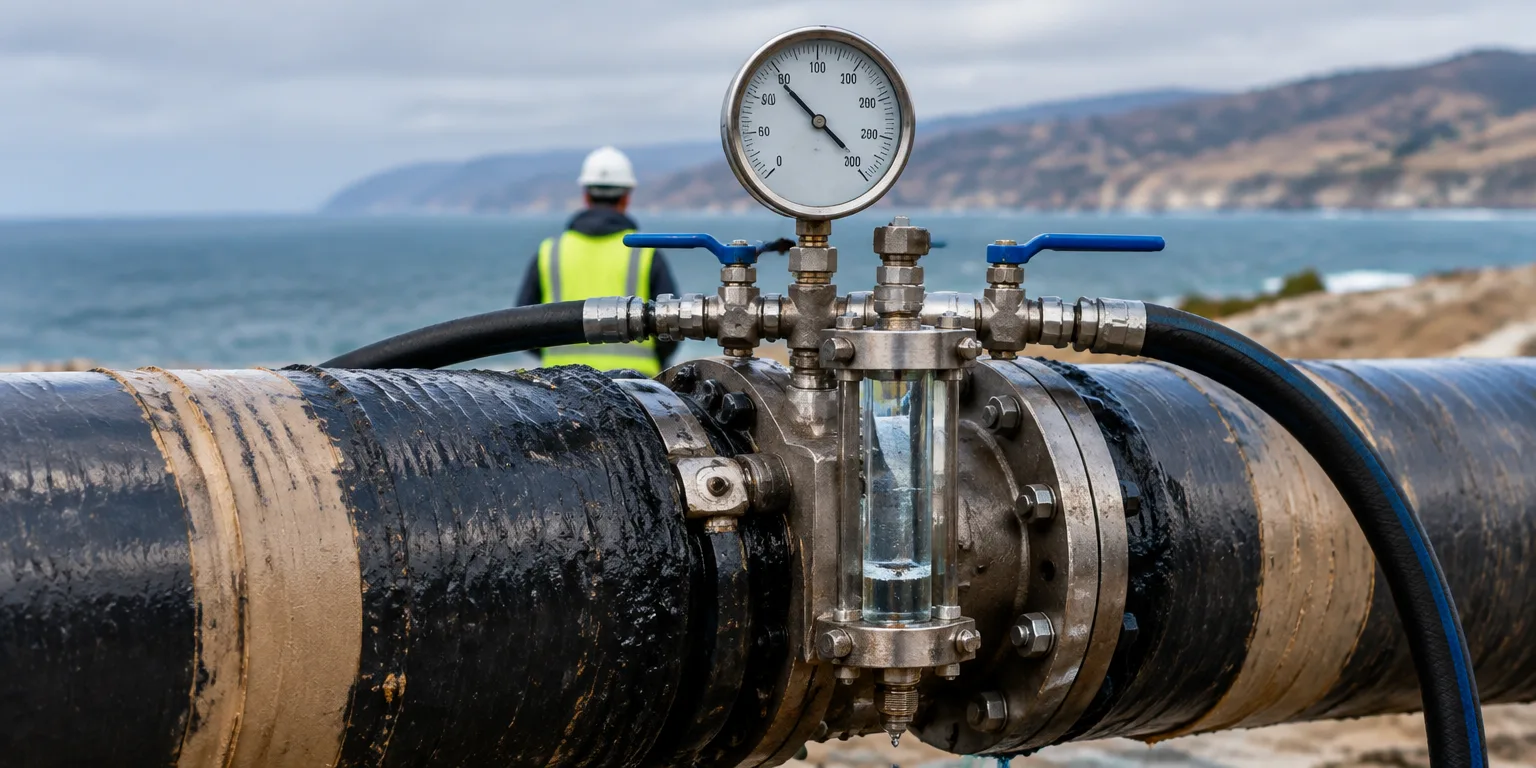
 welfarecapital.substack.com · Sable Offshore Corp (SOC) - Deep Dive #5
Before any oil can flow again off the California coast, Sable Offshore Corp must first fill two 30-year-old pipelines with water and squeeze them harder than they will ever be squeezed in normal use.
The lines, known as 901 and 903, are the only way to move oil from the Santa Ynez Unit, the offshore oil field off Santa Barbara, to shore. Line 901 ruptured in 2015 in what became known as the Refugio spill, leaking 3,400 barrels of oil. Federal investigators later found it burst at little more than half the pressure it was built to withstand.
The reason was corrosion. The pipe is 24-inch steel coated with coal tar, foam insulation, and tape wrap. Water had gotten through that covering and eaten the steel from the outside, in some places wearing away 89% of the wall thickness. A pump shutdown and restart raised pressure to 721 pounds per square inch, far below the line's 1,341-pound limit, and the weakened steel burst.
To fix that, Sable's subsidiary, Pacific Pipeline Corp., has had more than 30 repair crews working under a 2020 federal consent decree, a court-approved agreement requiring the repairs, using modern monitoring tools to bring both lines back to what the company calls "as new" condition.
The hydrotest is the final exam. Workers fill a section, and eventually the whole length, of each line with water. They pump it to 125% of regular operating pressure and hold it there for eight hours, watching gauges for leaks and for any loss of pressure.
That overpressure is the point, to push every repaired weld and thinned spot harder than normal use, so a weak place fails safely with water rather than later with oil. For lines this long, testing the entirety could take weeks. If the pressure holds, Sable still needs about a month to get the Las Flores Canyon plant running and begin selling oil.
Questions people ask
Why use water instead of just testing with oil?
Water is nearly incompressible and does not burn, so a failure during a test releases far less energy than oil or gas would. It is also much cheaper to clean up, and any leak is just water. That makes it the standard fluid for proving strength before hazardous liquids go in.
What happens if pressure drops during those eight hours?
A drop means water is escaping somewhere, through a leak, a bad weld, or a crack opening under stress. Crews then locate the loss, excavate that section, repair or replace it, and test again. Only a flat pressure line for the full hold counts as a pass.
What is maximum operating pressure?
It is the highest pressure a pipeline is legally allowed to run at during normal service, based on its diameter, steel strength, wall thickness, and safety factors. For line 901, the operator reported it as 1,341 pounds per square inch. Testing to 125% means proving it can hold about one quarter more than that.