To Trap Truck and Train Exhaust, a Startup Put an Engine in a Box and Bought a Locomotive
Remora tests semis without leaving the warehouse, and bought a freight locomotive to develop a capture car that trails behind and cleans exhaust.
 Y Combinator · This Startup Is Trying To Delete 29% Of All CO2 Emissions
The truck engine never leaves the building.
Inside its warehouse, Remora, a startup building carbon capture equipment for trucks and trains, keeps a real semi-truck engine inside a shipping container. Founder Paul Gross says the team removed the engine from a truck and installed it in the container so it could run, and be tested, indoors.
The engine is connected to what is called a dynamometer, a machine that loads an engine the way a road would. Gross says it can simulate an engine that is "cruising down the highway with a full load" or "going up a hill or going down a hill," which lets engineers test how the capture device handles exhaust at different temperatures and compositions.
Testing outside the warehouse brings obvious challenges, so the indoor rig lets the team rapidly try different versions of the device. Gross says the company moved from building one fixed design to building an adaptable setup that is easy to change, and that shift has improved energy efficiency, size, capture efficiency, and purity.
The focus on heavy freight is deliberate. Remora says, "There are far fewer trains and trucks than there are passenger cars, but they are used so intensely." Remora also says locomotives use "billions of gallons of diesel every year in the US," making them a large source of carbon dioxide and emissions.
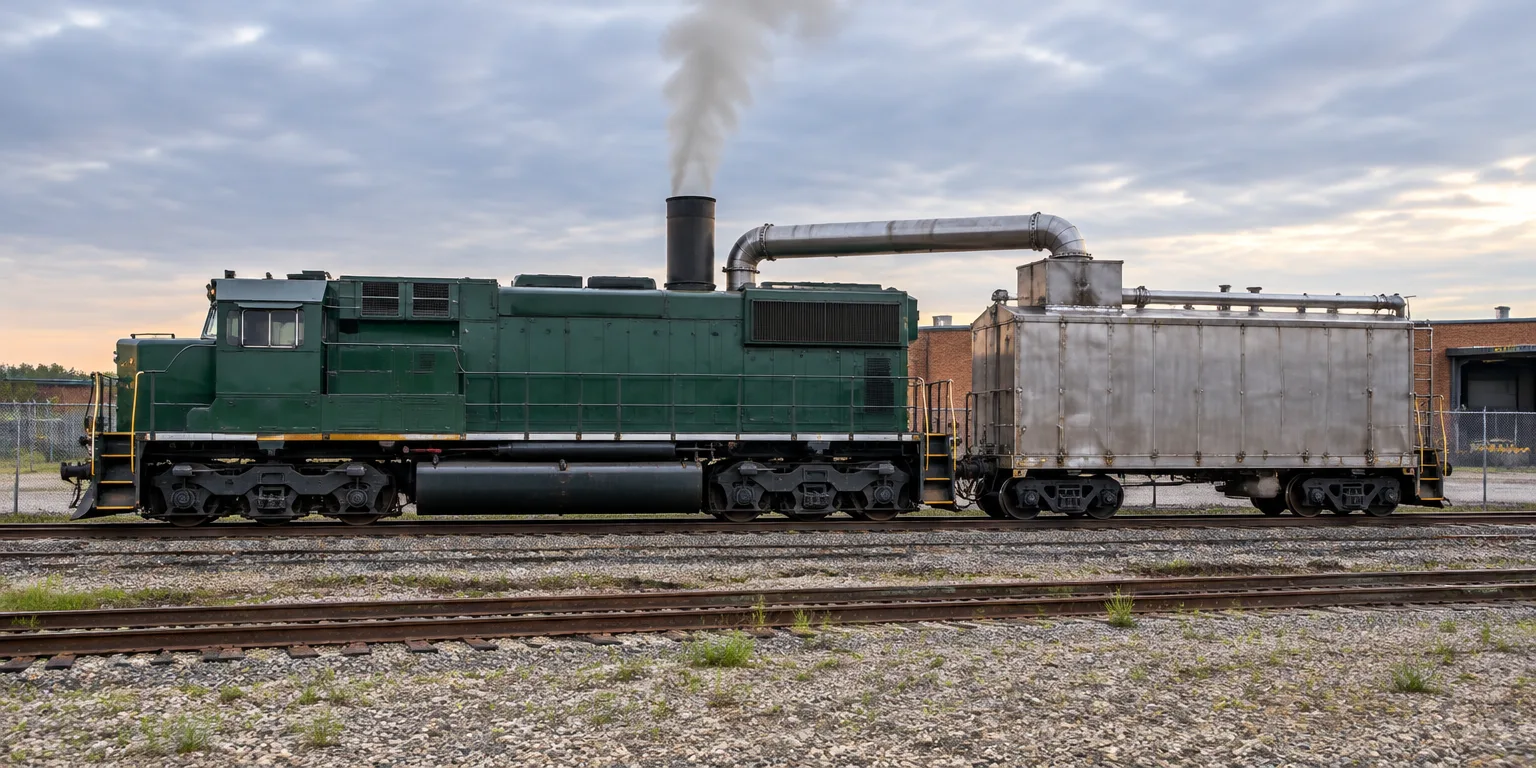
For trains, the test rig is even larger, and it is parked right behind company headquarters. Remora bought a 4,400-horsepower General Electric locomotive to develop an entire separate railcar that attaches to the locomotive exhaust stack and treats the exhaust inside that car.
The scale of the job is visible underneath. A 5,000-gallon fuel tank stretches underneath the entire locomotive, and Gross says the tank built to hold the captured carbon dioxide is being built to that same capacity. The systems are still in testing, but the goal is a modular kit that can fit different trucks and locomotives and work with the same capture car.
Questions people ask
What happens to the carbon dioxide after it is caught?
The captured carbon dioxide is offloaded as a liquid into a big tank. Distributor customers then pick it up in their tanker trucks and deliver it to end users like food and beverage companies, greenhouses, and water treatment plants.
What is a dynamometer?
A dynamometer is a common engineering tool that applies a controllable load to an engine or motor. For cars it often looks like rollers under the wheels, but here it connects directly to the stationary engine to mimic highway cruising, hills, and other road conditions.