Touch Alone Does Not Rewire the Adult Brain. Attention Does.
Volunteers felt identical bumps, but finger maps moved only when they focused on touch.
 Andrew Huberman · How to Focus to Change Your Brain
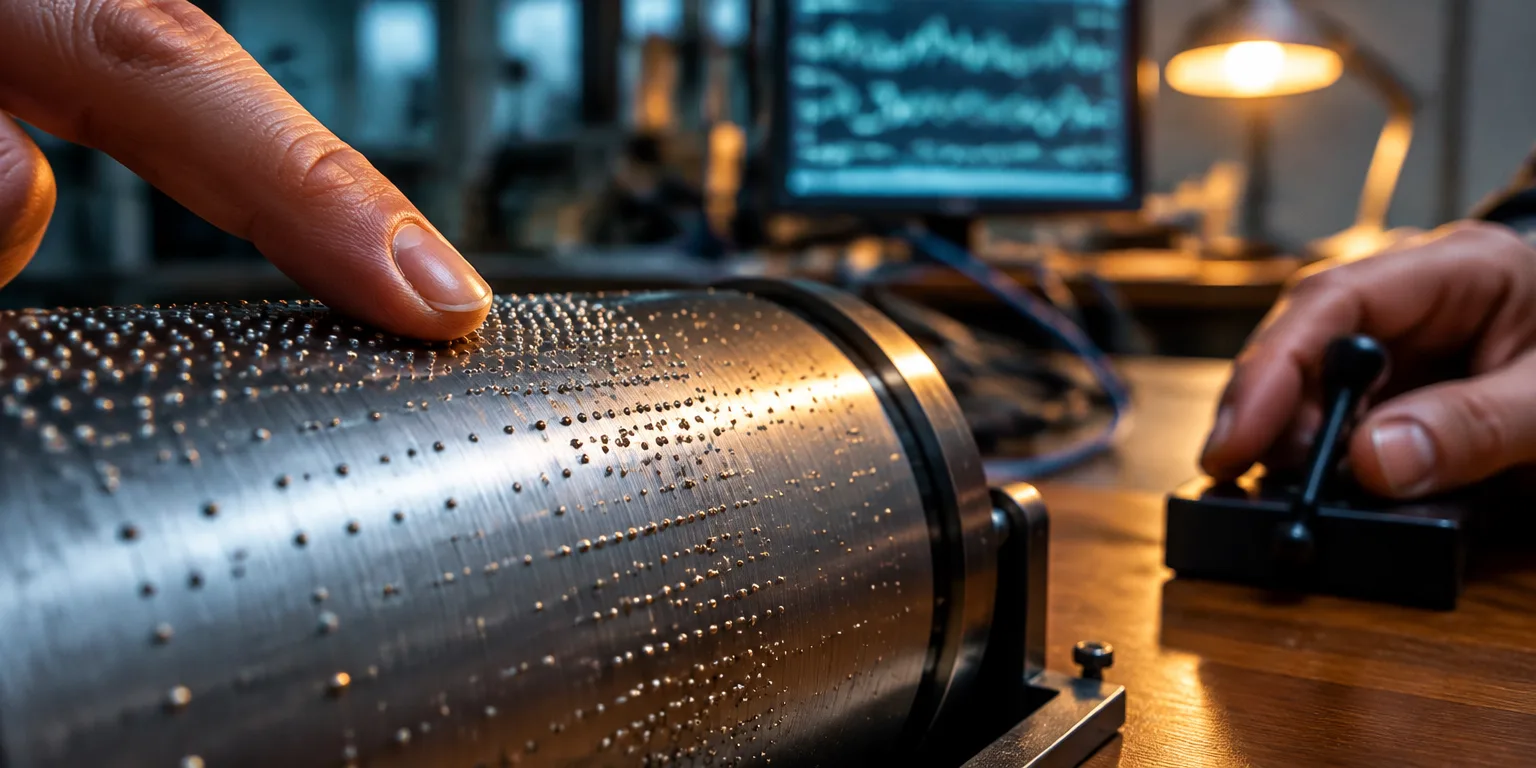
You sit at a table while scientists record the touch maps in your brain. In front of you spins a metal drum studded with tiny bumps, some packed close together and some spaced farther apart. Your job is simple and grueling: press a lever the instant you feel the spacing change, even though the differences are so subtle that you have to focus hard to catch them.
The test was run in the early 1990s by Gregg Recanzone, a graduate student in the laboratory of Mike Merzenich, a neuroscientist at the University of California, San Francisco. The work was tough on the volunteers, and tough on the researchers running it.
They were challenging a rule most brain scientists then accepted. Vision researchers David Hubel and Torsten Wiesel had shown that closing one eye early in life let the open eye take over visual brain space. Many took the lesson to be that the adult brain was no longer plastic, and that a wandering eye or cloudy lens in a child had to be fixed early or never.
Recanzone and Merzenich set out to prove that the adult brain could still change if the conditions were right. As ordinary adult volunteers focused harder on sensing how the spacing changed and signaled each shift, the brain representation of their fingers rapidly remodeled. People got better at noticing whether the gaps were growing or shrinking. None of them were Braille readers. They were fully adult, with no known impairments and no special drugs, yet their touch maps moved.
Then came the control that gave the result its force. Other volunteers touched the same spinning bumps but were asked to ignore the touch and listen instead for when a tone rose or fell. The feeling on the fingers was the same, but the brain change was not. When attention went to sound, the hearing areas showed plasticity and the touch areas did not.
Simply having an experience, even feeling it with your own skin, did not rewire the brain. Only the small slice that people attended to very carefully opened change, and only for that slice.
Questions people ask
What does it mean for finger maps to remodel?
It means the patch of brain that responds to the fingers changed as volunteers practiced. In this test, the finger representation remodeled rapidly as people focused on the bump spacing and signaled changes by pressing a lever. When they felt the same bumps but focused on sound, the touch patch did not remodel.
Can adults still rewire their brains as much as children can?
These experiments showed that fully adult volunteers could rapidly remodel their finger maps when they paid close attention to touch. The cited tests did not include children, so they do not show whether adults rewire as much as children. They show only that adult change happened with attention, and did not happen without it.