Two programmers who could not give away gallery websites built an early web app instead
By letting users build stores with nothing but a browser, they showed a whole store could be made without installing anything.
 paulgraham.com · What I Worked On
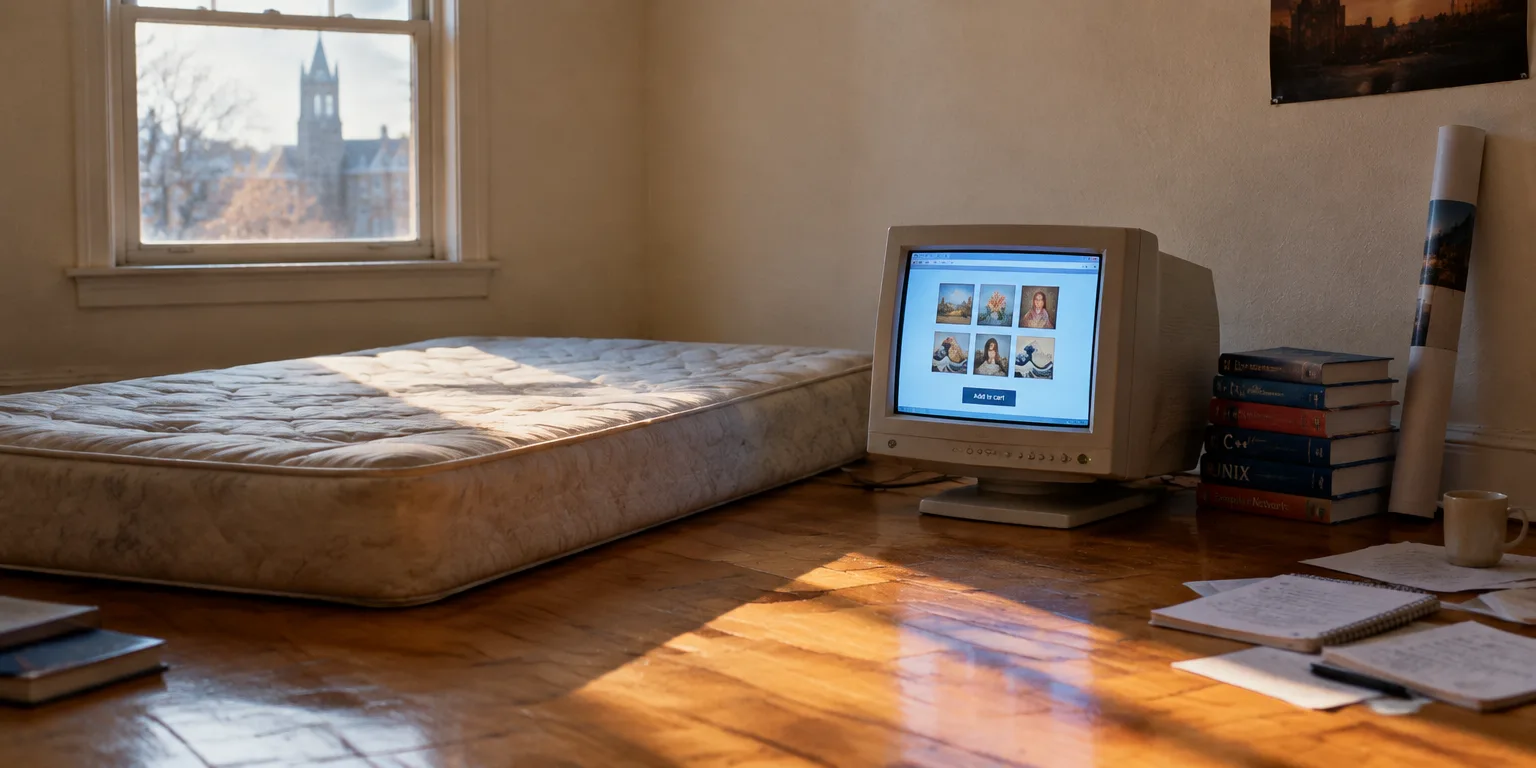
One morning in the summer of 1995, Paul Graham, a programmer, was lying on a mattress on the floor in Cambridge. He was staying with his collaborator, Robert Morris, who was in graduate school at Harvard. Graham was sleeping there because the room belonged to Robert's roommate, who was away. There was no bed frame and no sheets, just the mattress.
Graham and Morris had been trying to put art galleries online. Graham had written software to generate gallery pages, and Morris had written software to resize images and to set up the computer, called a server, that delivers pages to visitors. They could not sell the result. "To call this a difficult sale would be an understatement," Graham later wrote. "It was difficult to give away." A handful agreed to free sites, but none paid.
Then online shops began to show up, and Graham noticed something. Apart from the purchase buttons, they matched the gallery sites they already knew how to build. What people were calling an internet storefront was already within their reach.
This is the story of how that failed gallery business led to an early web app, software that runs on a distant server and is controlled entirely with a browser, with nothing to install. At the time, it was not clear such software was even possible. Web apps are common now.
That summer, after Graham sent the final manuscript of a programming textbook to the publisher, the two men started writing software to build online stores. The plan was normal desktop software, which then meant software for Windows. Neither man knew Windows programming, and they did not want to learn. They lived in the world of Unix, a different system favored by programmers. They decided to at least try a prototype on Unix, with Morris writing a shopping cart and Graham writing a new site generator in Lisp, a programming language he favored.
That was what led to the morning on the mattress. What if they kept the program on their own server computer, Graham thought, and had people steer it by selecting links, so nothing would have to run on the users' computers. They could build the sites and serve them from the same machine, and shoppers and store owners would need only a browser.
Two days later, on August 12, they had a version that worked. The controls were horrible, but a person could assemble an entire shop inside the browser, with no installed program and without typing commands on the server. Graham began imagining a generation of software that would never need separate versions for different computers. At Interleaf, where he had worked, an entire team named Release Engineering, seemingly as large as the group that wrote the software itself, was devoted to that chore. Now the team could just update the program on the server.
They called the new company Viaweb, because it worked via the web. They took $10,000 in seed money from Julian, the husband of painter Idelle Weber, who also did their legal work and gave business advice, in exchange for 10 percent of the company. Graham had a negative net worth at the time, with about a thousand dollars in the bank outweighed by taxes he owed, and though Morris could live on his graduate funding, Graham needed the money to live on. As they kept working, they built an editor in which pages looked exactly like the finished store pages, except the links pointed to bits of program code stored on the server.
Questions people ask
What exactly is a web app?
A web app runs on a company's own computers, called servers, and you use it through a browser. Gmail and Google Docs are common examples. Before Viaweb, most software had to be installed on your own computer, with separate versions for different systems.
What happened to Viaweb?
Viaweb opened in January 1996 with only six stores, grew to about 500 by the end of 1997, and was bought by Yahoo in 1998. Graham has said the team survived by being cheap and easy to use, charging $100 to $300 a month, a price set low partly because they were poor themselves.
Who is Robert?
He is Robert Morris, who was in graduate school at Harvard when he built Viaweb's shopping cart while Graham built the page editor. He had earlier been kicked out of Cornell for writing the internet worm of 1988.