Two Stanford Students in Their Mid-20s Built Hundreds of Prototypes to Get a Robot Into Homes
The founders focused on cheap data to teach robots about real houses, and their backer says a home test is coming this year.
 Invest Like the Best with Patrick O'Shaughnessy · Sarah Guo - Funding the Frontier - [Invest Like the Best, EP.489]
The starting point was cardboard in a Stanford basement. That is how Sarah Guo, a venture capitalist who runs the AI focused firm Conviction, describes the early work of Sunday Robotics.
The builders were Tony Zhou and Chang Ji, then PhD students at Stanford in their mid-20s. Guo believes one of them never finished the degree. Before Stanford, they had worked at Toyota Research, DeepMind, and Tesla, so they were not only academics.
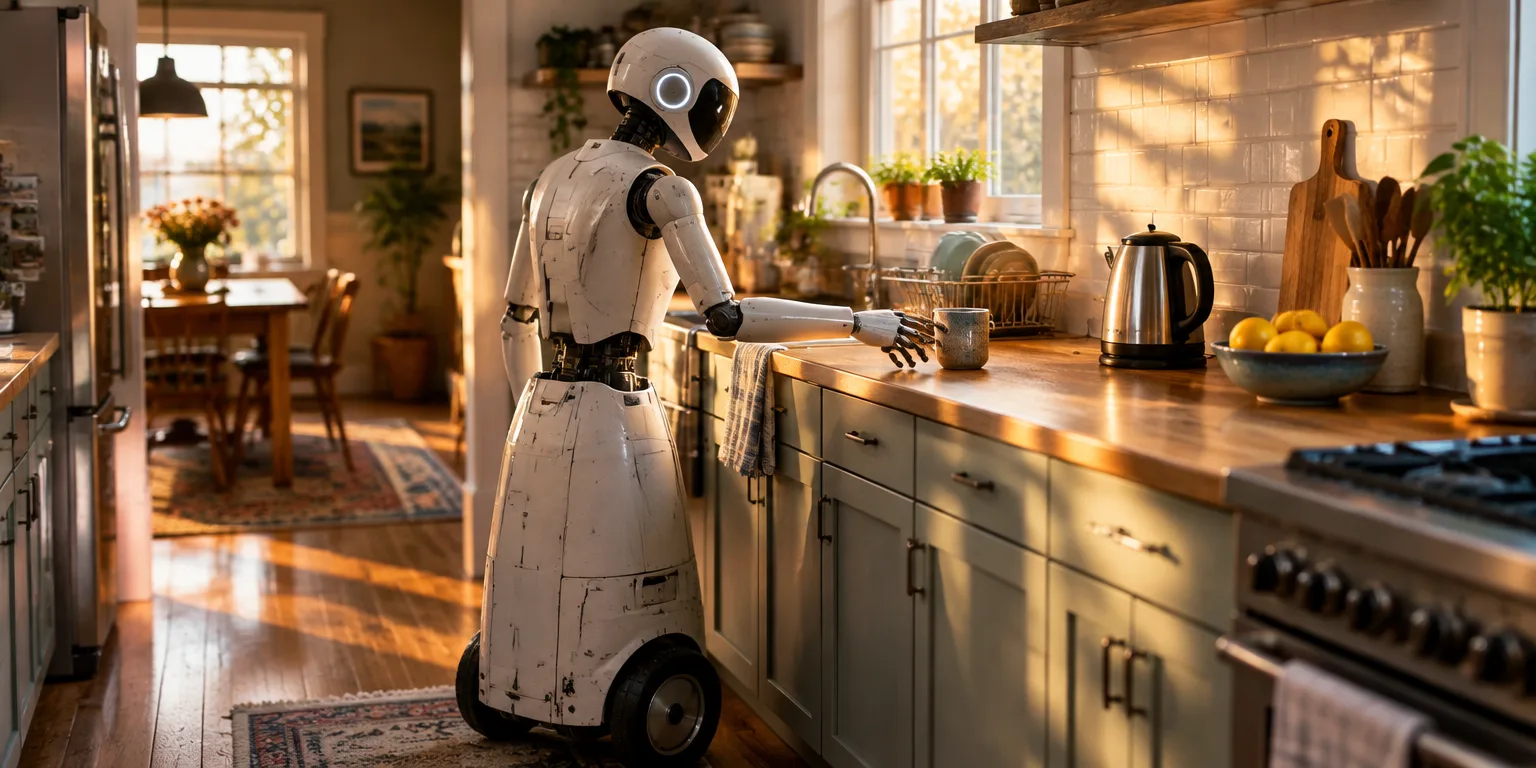
The team now plans a beta of its machines in people's homes by the end of this year. "That is not something that any of us believed," Guo said. The machines are general semi-humanoid robots, meaning robots with arms and hands for grabbing things that can move around a house to do chores.
The company has existed for just under two years. Guo said what amazes her is moving that fast from basement materials to what she called the full stack thing, with hardware manufactured in the United States that has gone through hundreds of iterations and been tested in real world settings.
The work centers on a problem Guo says holds back home robots, which is data. Many people in robotics believe that with enough examples from the real world, the way AI has the text of the internet, they would have fully capable robots. No such collection exists, and gathering it is costly.
Guo credits Zhou and Ji with "most of the interesting ideas in robotics AI over the last four years." She added, "That's a pretty weird thing for two very young people to do." She praised their approach to the data shortage, which focused on collecting data in the cheapest way that still covered different homes and tasks, and then testing how much of that cheap collection could be transferred into learning for the model. She called that focus on working within limits on data and money "outcomes-driven."
Guo said, "I was blown away in the first meeting," and said her firm agreed to invest immediately. She also cautioned, "Nothing is true until it is shipped." No general purpose home helper has shipped yet. Guo predicts this one will work, calling the speed of the work "mind-boggling."
Questions people ask
What is a semi-humanoid robot?
It is a robot with a humanlike upper body, with arms and hands for picking things up, that can move around a space. Homes are built for people, with handles, counters, and steps at human height, so a partly human shape can be useful. It may use wheels rather than legs to get around.
Why is data the big problem for robots?
Modern AI learns from examples, so a robot needs to see many pickups in many kitchens to handle a new kitchen. Researchers call that ability to handle new places generalization. Filming all those real world examples is slow and expensive, unlike copying text from the internet.
Has anyone put robots in homes before?
Yes, but only for narrow jobs. The most successful home robots are vacuum cleaners, which roll on the floor and do not need hands. No company has yet sold an affordable helper that can tidy, fetch, and clean across an ordinary home.