Two Thousand Armed Men Burned a Newspaper and Overthrew Wilmington's Government
The mob acted after Black leaders agreed to yield power in hopes of avoiding bloodshed, but their reply arrived too late.
 Stuff You Should Know · The Wilmington Massacre
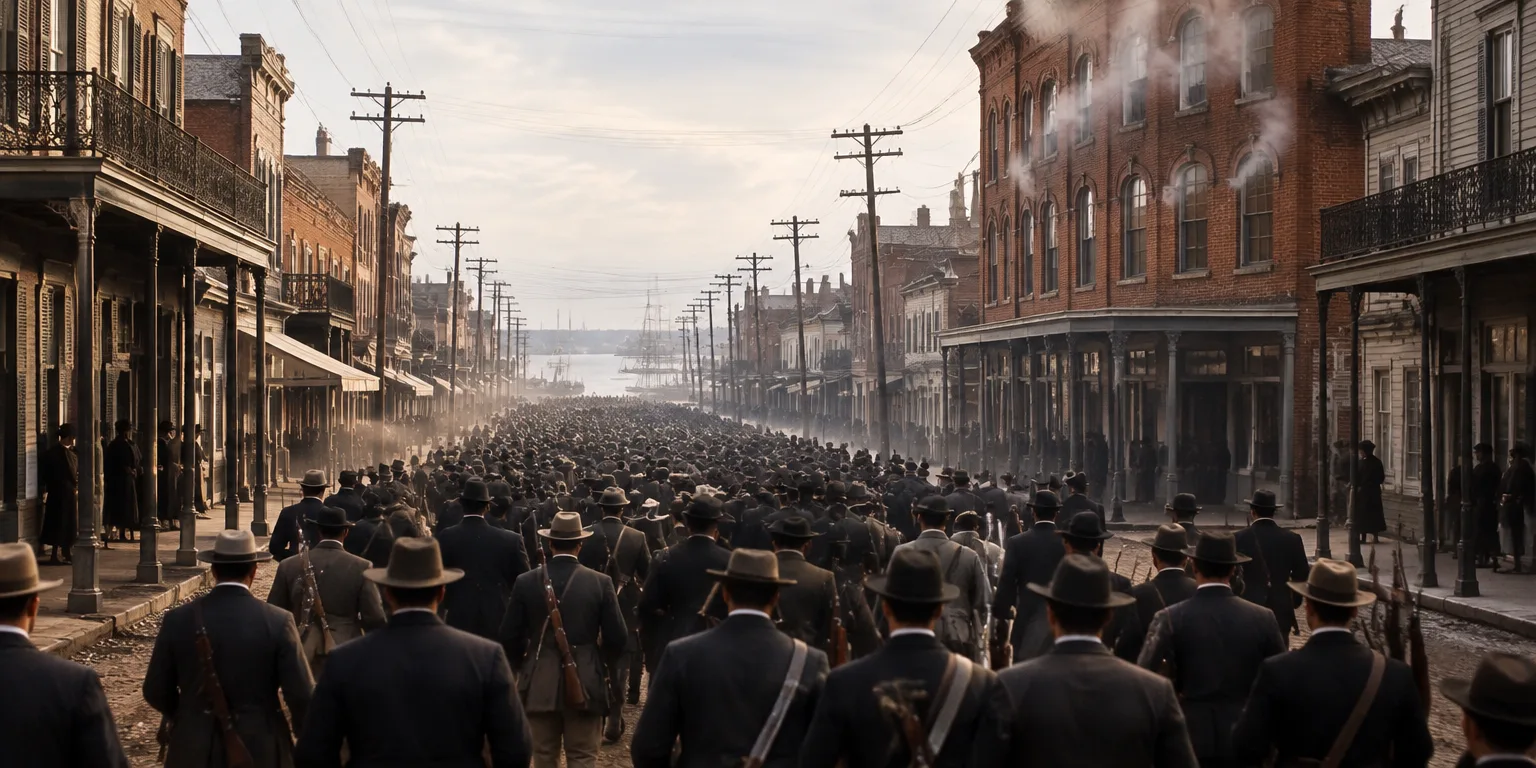
On the morning of Nov. 10, 1898, about 500 armed white men gathered at the armory of the Wilmington Light Infantry in North Carolina and called on its commander, Lt. Col. Walker Taylor, to lead them downtown.
By the time the column reached the offices of the Daily Record, the city's Black newspaper, it had grown to about 2,000 men. In a city of 20,000, that meant roughly one in every 10 residents was marching, armed and angry, through narrow downtown streets.
What followed was the violent overthrow of a legally elected biracial city government by white supremacists determined to end Black political power, the sole instance of its kind to succeed in the United States.
The takeover had been declared a day earlier. White supremacist leaders published what they called the Wilmington Declaration of Independence, pledging to end, in their words, the rule by Negroes. About 450 men, largely from the city's middle and upper classes, signed it.
The declaration demanded that the Daily Record close, that its editor leave town, and that the mayor and police chief be removed. Alfred Moore Waddell, a former congressman and the public face of the white supremacy campaign, then summoned 32 Black civic leaders to the municipal building.
In the offices where those men had been democratically elected to serve, Waddell read the demands and ordered them to surrender political power by 7:30 the next morning. Hoping to prevent bloodshed, the Black leaders agreed and sent a compliant reply by mail because armed guards blocked Waddell's house. It did not arrive by the deadline.
Waddell marched with the mob to the Daily Record on Nov. 10. The editor, Alex Manly, had already fled, so the men burned the building.
From there, the mob moved toward Brooklyn, a Black neighborhood near the waterfront, firing into Black homes and businesses on the way to a cotton processing plant that employed many Black workers. The Light Infantry and naval reservists, ordered to restore peace, instead joined in the attack or stood by.
The attackers fired a Hotchkiss gun, a small rapid-fire cannon, and a Gatling gun, an early machine gun. Black residents were shot, hanged, or dragged from their homes, some killed simply for being in the wrong place. Armed men surrounded the home of Daniel Wright, a Black politician, told him to run, then shot him in the back. Churches were ransacked.
While the killing continued, Waddell ordered the mayor, the police chief, and other elected officials to appear and resign under threat of violence. He then declared himself mayor and filled their seats with fellow conspirators. The death toll remains uncertain, with a coroner's report listing 14, a 2006 state report finding as many as 60, and other accounts estimating up to 300 dead.
Questions people ask
Who was Alfred Moore Waddell?
Waddell was a former Confederate officer and former Democratic congressman who became the public leader of Wilmington's white supremacy campaign. After seizing power, he served as mayor until 1905 and later helped rewrite the history of the coup as a justified uprising.
What happened to the newspaper editor targeted by the mob?
Manly, the Black editor whose editorial criticizing lynching had been used to inflame white voters, fled Wilmington before the mob reached his paper. He survived the massacre and never returned to publish in the city, living first in Washington and later in Philadelphia.
Was anyone punished for the massacre and coup?
No. Despite dozens and possibly hundreds of killings, arson, and the forced removal of elected officials, no one was prosecuted for the massacre or the coup. Many participants kept their stolen offices and later won higher state office.