When a River Splits, the Angle Between Branches Is 72 Degrees
The split equals one-fifth of a circle, a five-sided hint researchers have speculated might echo strange alloys called quasicrystals.
 Quanta Magazine · Why Are Rivers So Mathematical?
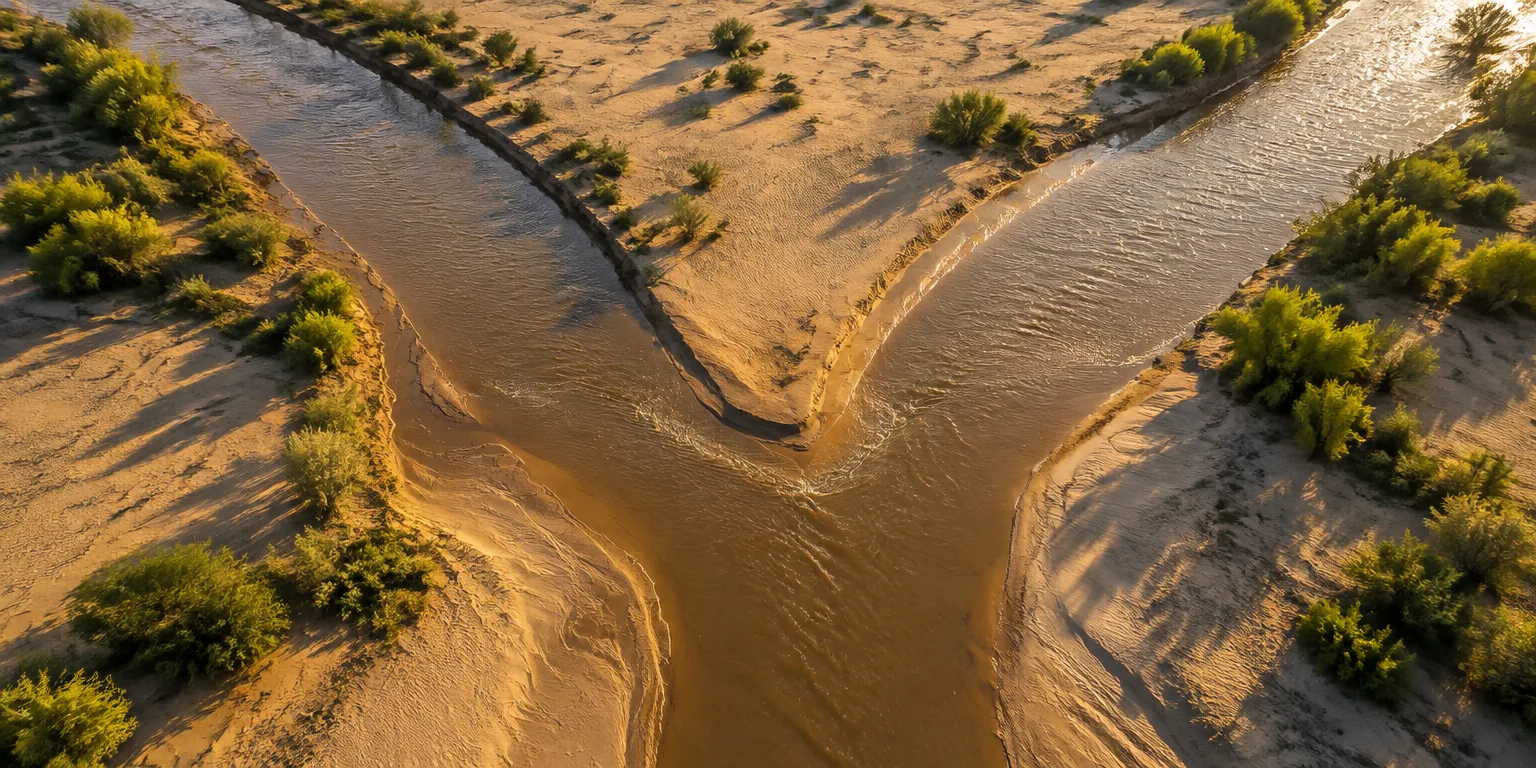
When a stream splits in two, the angle between the branches is predicted to be about 72 degrees, and field measurements matched.
That is the finding from Daniel Rothman, a geophysicist at MIT, and Hansjörg Seybold, a geomorphologist now working in Austria, made with colleagues by modeling stream growth as Laplacian growth, the simple idea that growth begets growth.
The angle holds itself in balance. If the split were wider, water pouring in from the land between the branches would erode the banks and pull the channels together. If it were narrower, water seeping in from the outer banks would force them wider.
That 72-degree span equals a fifth of a full circle, a hint of a five-sided pattern. Regular repeating patterns cannot have that symmetry, any more than regular pentagons can tile a floor.
Quasicrystals, exotic metal alloys with almost repeating five-sided atomic patterns, do show it. Whether river networks are related is only speculation, Seybold said.
Questions people ask
What does 'growth begets growth' mean?
Laplacian growth describes systems where growth attracts more growth. A longer stream collects more runoff, erodes faster, and gets longer still. The same math has been used for lightning bolts, mineral deposits, and bacterial colonies.
What exactly is a quasicrystal?
They are solid alloys, often of aluminum with iron or manganese, whose atoms form ordered but never exactly repeating patterns. Discovered in 1982 by Dan Shechtman, they are hard, slippery, and poor conductors of heat, and they earned the 2011 Nobel Prize in Chemistry.
Is every river split exactly 72 degrees?
No. Seventy-two degrees is the predicted average, and field observations matched that prediction. Individual splits can differ from it, but the angle acts as a stable balance point.