Why your $15 bowl costs $30 by the time it reaches you
Because a meal starts expiring the moment it is cooked, it must be made around the corner, and that changes the entire delivery business.
 David Senra · Travis Kalanick, Founder of Uber & Atoms
A $15 bowl that arrives as a $30 dinner is not a markup trick. Travis Kalanick, Uber's co-founder, points to courier drops at about $12 each and expensive production as why that $15 bowl somehow becomes $30.
Hot food, as Travis Kalanick puts it, "has a 30-minute half-life." Because half an hour is too short for storage and shipping, unlike a book or a pair of shoes, a meal cannot be made in one place, stored in another, and shipped over days.
That one fact rewrites the whole warehouse. Ordinary online shopping separates the factory from the distribution center. Something is manufactured somewhere else, sent to a big Amazon style building, and then sent to you. Food cannot do that. The cooking and the delivery have to happen in the same building, because the clock starts the moment the food is finished.
And that building has to be close. Kalanick argues that kitchen must always be within 15 minutes of where you are, wherever you are in a city or suburb. That means a delivered meal needs what he calls an urban production and logistics fabric, kitchens plus dispatch points spread across town, not a few giant warehouses outside it.
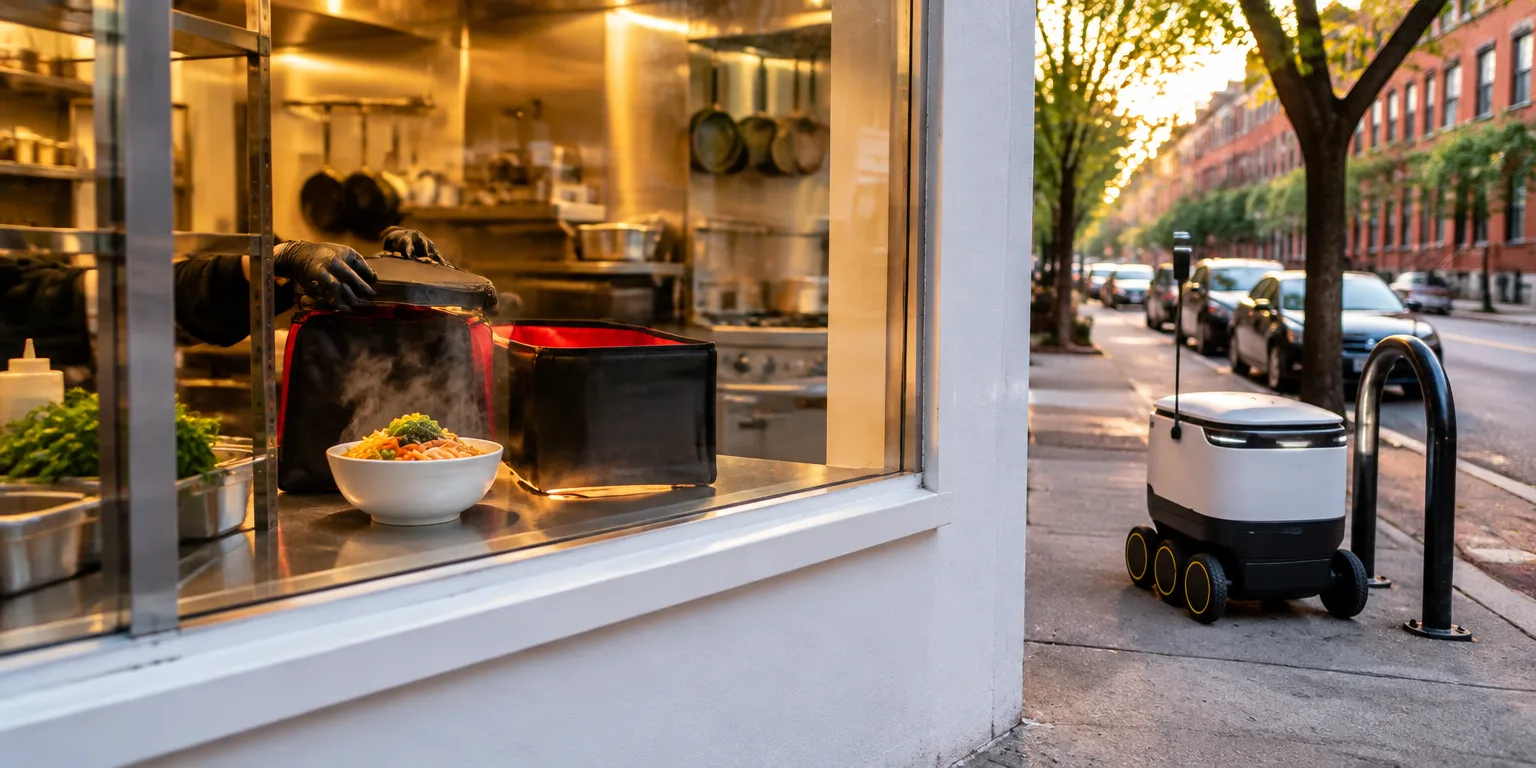
Then comes labor, twice: someone has to make the food, and someone has to drive it to you. Kalanick says every courier drop adds about $12 each, one reason the price rises, alongside expensive production. His proposed fix is to automate both ends, with robotic food production to take out kitchen labor and robotic couriers to take out delivery labor, all housed in that nearby real estate. The goal is a high quality meal delivered for something close to what you would pay at the grocery store.
Questions people ask
Why can't hot food travel the way other packages do?
A package does not change on the way to you. Hot food does, losing heat, texture, and freshness with every minute. Kalanick's shorthand for this limit is the 30-minute half-life, which is why long drives and centralized warehouses do not work.
Could robots really make delivery as cheap as groceries?
In theory, by removing the two biggest labor costs, cooking and driving. Robots do not need wages, breaks, or tips, and a nearby automated kitchen avoids paying for long car trips. Whether they can match a home cooked grocery meal on price and quality is still unproven.
Why does one delivery run cost about $12?
That $12 is Kalanick's figure for what each courier drop adds. As general context, delivery is expensive because a driver's time, gas, insurance, and the app's cut are spread over just one order, unlike a truck that delivers hundreds of boxes to one store.