Writing Started as Pictures of Food Pressed in Clay
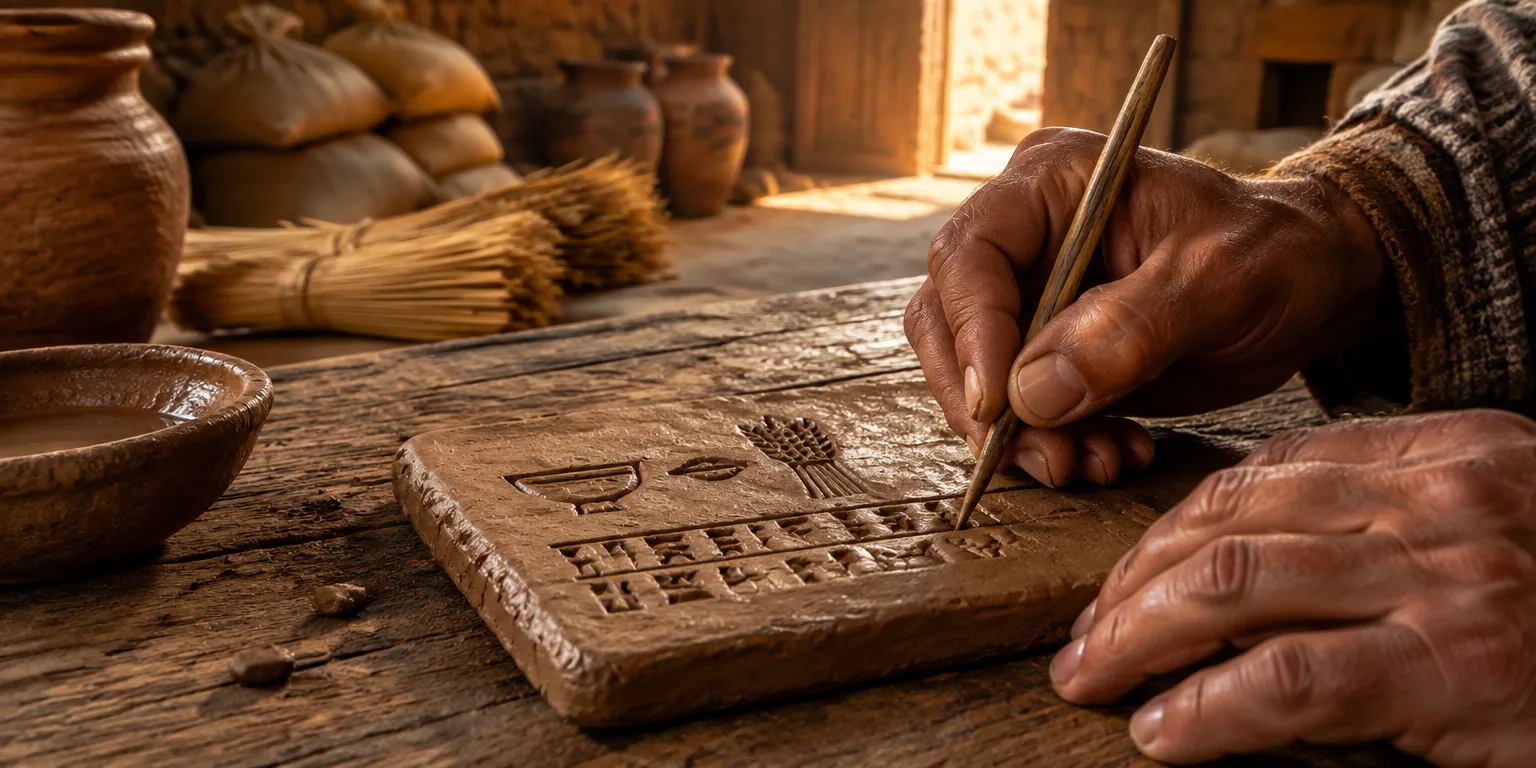
Sumerian clerks pressed pictures of bowls and wheat into smartphone-size lumps of clay, then simplified them until they stood for sounds.
 Fall of Civilizations · 8. The Sumerians - Fall of the First Cities
The first writing was a receipt for rations.
Around 3200 B.C., in the city of Uruk, clerks kept track of rations and supplies by drawing small pictures everyone could understand. One surviving tablet shows a bowl of food beside a mouth, alongside six marks for food containers and five bundles of wheat. The worker who held it could exchange it for six containers of food and five sheaves of wheat.
A Sumerian epic poem, Enmerkar and the ruler of Aratta, tells a grander story. In it, a king gives his messenger so many messages that the messenger's mouth is heavy and he cannot repeat them, so the governor presses words into clay. The local clay and reeds suggest where the writing came from. The plain of southern Mesopotamia offered two things in endless supply, soft clay underfoot and tall reeds along rivers and marshes. Scribes took a lump of clay about the size of a modern smartphone and pressed into it a reed cut into a wedge shape. The wedge marks gave the script its later name, cuneiform, which means wedge shaped writing.
Speed changed the system. Scribes copying hundreds of tablets a day had no time for neat little drawings, so the pictures grew simpler and more abstract until they no longer looked like what they described. After 3000 B.C., the number of signs fell from about 1,500 to about 600. Then someone had the idea that a sign could stand for a sound rather than a whole idea, the first system based on sound.
That efficiency had a cost. Writing was no longer pictures anyone could read. It became a skilled trade, and trained scribes grew into their own profession to do it.
Questions people ask
Why did they use clay and reeds?
They used what was at hand. Southern Iraq has almost no stone or timber, but it has deep beds of river clay and thick stands of marsh reeds. Wet clay is soft enough to take a sharp impression and then bakes hard in the sun, so the record lasts.
How did a picture become a sound?
It happened through shorthand and wordplay. A sign that once pictured an object got drawn so quickly that only its shape remained, and then scribes began using it for another word that sounded the same. English does something similar when a picture of a bee plus a leaf suggests the word belief.
Could ordinary Sumerians read these tablets?
At first, perhaps, because a drawing of wheat looks like wheat. Once signs stood for sounds and the set shrank to about 600 abstract marks, reading required years of training. That is why scribes became a separate, well paid profession, and literacy stayed narrow.