You Cannot Farm Spiders Because They Eat Each Other
It took more than a million spiders, caught by hand in Madagascar, to collect enough silk for one golden cape.
 Veritasium · Is spider web really stronger than steel?
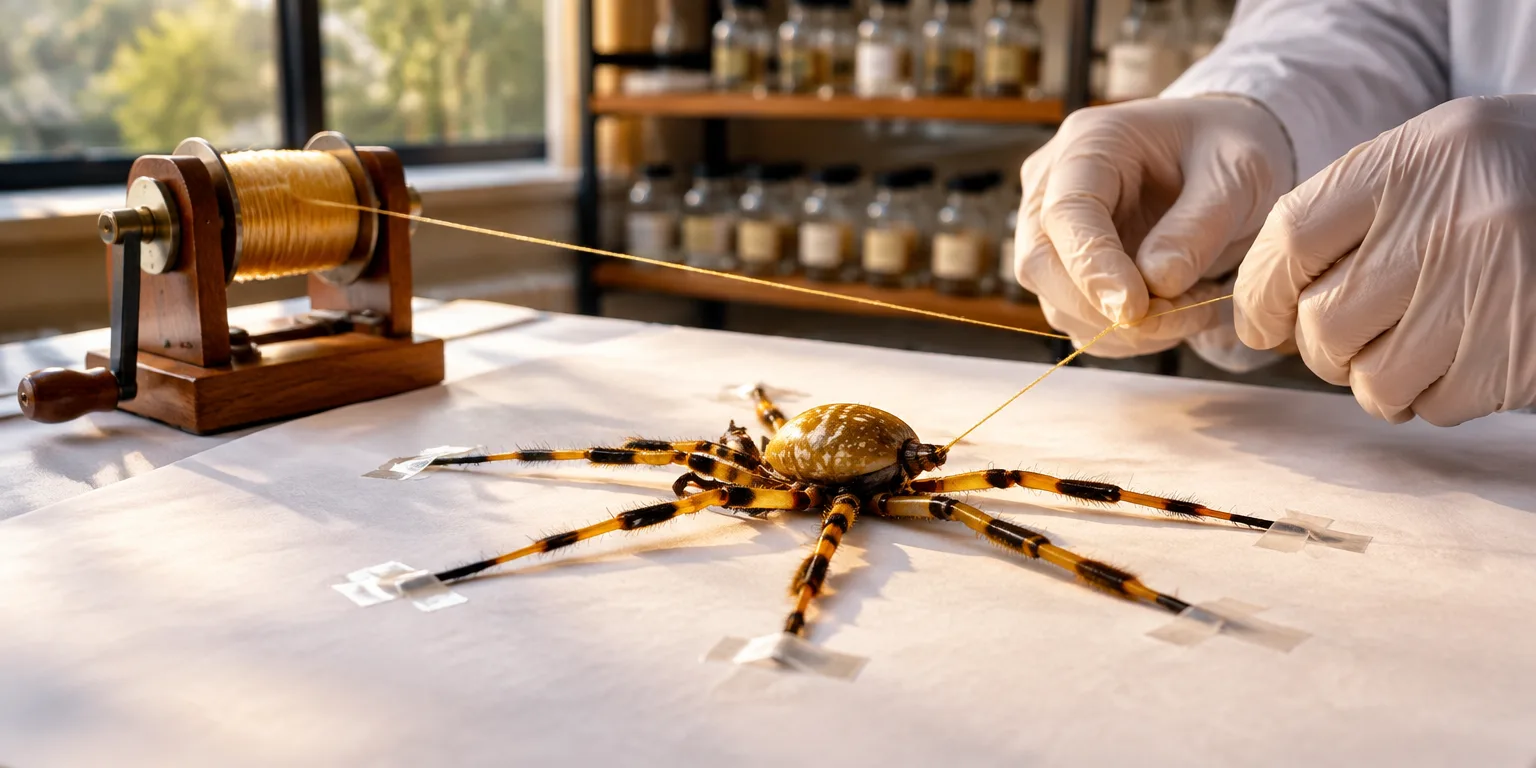
The spider lies motionless on the table, knocked out with carbon dioxide and pinned down with tape. Henry, a researcher who studies spider silk, reaches in and teases out a single thread of dragline silk, the strong fiber that anchors a web. It is so light he can barely feel it.
He fastens the thread to a large rotating mechanism, built to milk spiders, and winds it out by hand. In a web, that line does most of the work of stopping a moving insect.
A really cooperative spider gives about 300 yards of silk, and 100 yards is much more typical. Yields are uneven because spiders behave as individuals, and some snap the fiber at once instead of letting it be drawn out.
That uneven yield sits on top of a larger problem. Spiders make one of the toughest fibers known, but they cannot be raised together the way silkworms can. They eat each other, so a farm would have to house them apart, and keeping even 10,000 spiders alone would take a lot of real estate.
In 1709, Francois Xavier Bon, a Frenchman who worked with the material, gathered hundreds of egg cases, heated them, brushed out the fibers as if they were wool, and twisted them into yarn for stockings. The stockings drew attention at the royal court. As Bon later said, "The only difficulty now lies in procuring a sufficient quantity of spider bags to make any considerable work of it."
Three hundred years afterward, Simon Peers and Nicholas Godley, who led a silk project in Madagascar, showed how costly it is to work around that shortage. Over several years, teams of Malagasy workers went into the jungle and gathered more than one million golden orb weaver spiders by hand.
The silk had to be drawn spider by spider, because the animals must be kept apart. The yield from each milking was small and unpredictable. That fiber was woven and embroidered into a single golden cape, built up thread by thread from those separate milkings.
Questions people ask
Why not just collect spider webs instead of milking spiders?
No. Webs are made of several kinds of silk, mixed with glue and debris, and they break down quickly in sunlight and wind. Milking the dragline silk directly gives a clean, continuous, much stronger thread.
What makes silkworms so much easier to farm than spiders?
Silkworms are caterpillars that welcome company, eat mulberry leaves, and spin cocoons that can be unwound in one long thread. Spiders are territorial predators, so they must be housed alone, fed live prey, and milked a hundred yards at a time.
What does the golden cape actually look like?
The cape is naturally gold, the color of the golden orb weaver's silk, so no dye was needed. It is more than 11 feet long, embroidered with spider motifs, and has been shown in museums in New York and London.