Your Brain Has a Network Built Mainly for Language
It prefers real sentences to nonsense sounds, stays connected even during other tasks, and varies no more across languages than between people who speak the same language.
 Wu Tsai Neurosciences Institute, Stanford · A new precision neuroscience of language (Big Ideas in Neuroscience) | Cory Shain
Your brain has a network built mainly for language.
That is the argument of neurolinguist Cory Shain. The question has been controversial for years. Some scientists say there is tissue that is reliably, selectively, and critically engaged in language, for both understanding and speaking. Others say there is no such thing, only general purpose systems for hearing, listening, and meaning, or for parsing temporal structure in tasks and music, that get recruited to handle language.
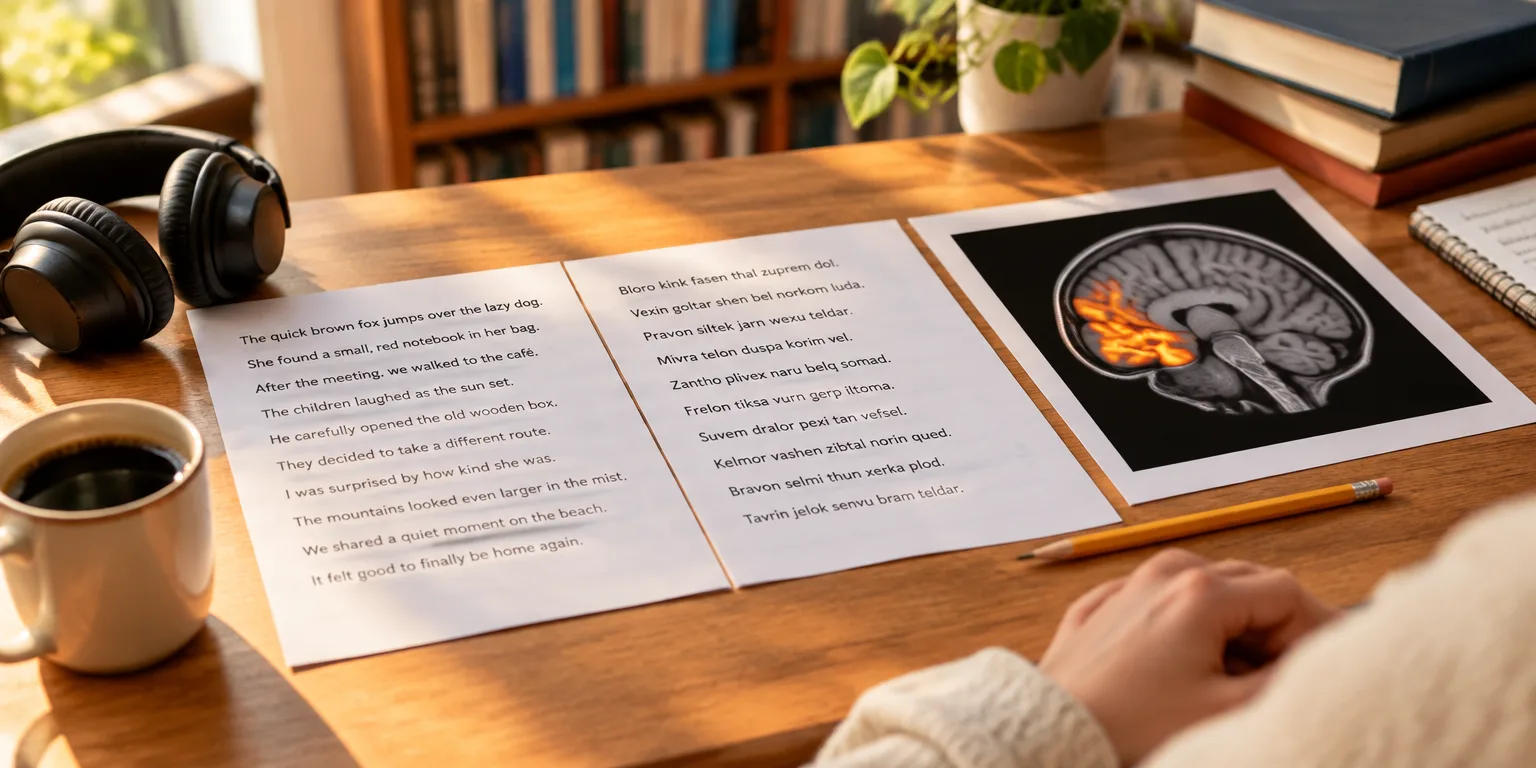
To find out, Shain and colleagues start with a simple comparison. Volunteers read real sentences, one word at a time, and then read lists of made up non-words matched for length. The two look and feel similar to the eyes, but only the sentences mean anything. The spots that prefer the sentences form a distributed network, mostly on the left side of the brain, in the temporal lobe, beside the ear, and in a lower front region, behind the forehead, along with other places.
It starts to look like a true network because very different tests find the same spots. People hear normal speech and then hear the same speech that has been low-pass filtered, which means it keeps its rhythm and muffled sound but loses its meaning. Again, the same regions prefer the meaningful version.
The newest evidence does not depend on any language test at all. The team watched how brain regions rise and fall together over time during all kinds of activities. The language regions still fluctuate together, as a unit. That suggests the network "is an intrinsic property of how the adult brain" is organized, Shain says, not just an artifact of one task.
The same pattern shows up across about three dozen languages. Researcher Simon Malik-Moretta, cited by Shain, ran comparable language tests and found qualitatively the same network, with variation between languages no greater than variation between individuals who speak the same language.
Whether scientists will ultimately agree that the network is fully language-selective remains debated. What the work already shows is why mapping must be individual, because brains that parse the same grammar can place that work a few millimeters apart, and averaging them can hide the common structure.
Questions people ask
Where exactly is this language network?
Mainly in the left temporal lobe, beside the ear, and a lower front region, behind the forehead, along with other places. Studies have found the exact location shifts by millimeters from person to person, which is why researchers now map it individually rather than averaging brains together.
Does the network handle sign language too?
Yes, evidence suggests it is. Sign languages have the same kinds of sentences, meanings, and hidden structure as spoken languages, and brain imaging studies generally find they engage the same left-side language regions, not just visual areas.
Are babies born with it, or does it develop?
The basic left-side bias appears early in childhood, but the network sharpens with exposure to language. Children still show more variability and bilateral activity, and the adult-like selective response builds as vocabulary, grammar, and reading experience grow.
If someone speaks five languages, do they have five networks?
It looks surprisingly similar. Other work cited in the discussion found that people who speak many languages have somewhat smaller language networks, possibly because the system becomes more efficient, but responses to their different languages overlap heavily in the same tissue.