Your Charger Tames Wall Power Before It Ever Reaches Your Phone
Inside the brick, power is straightened, chopped, isolated, and then negotiated with your phone.
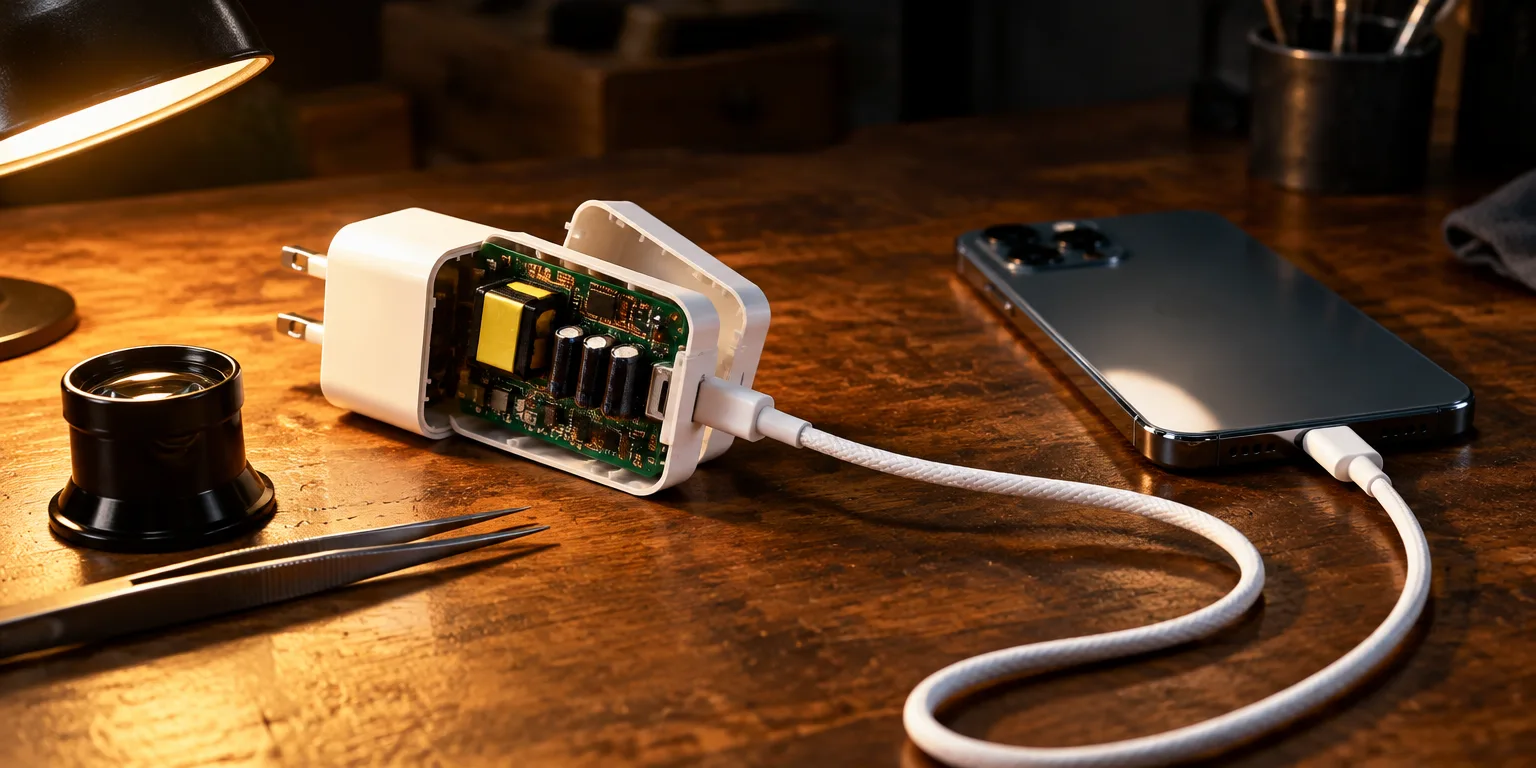
 anker.com · Budowa ładowarki do telefonu – schemat i zasada działania - Anker EU
The power in your wall outlet is 230 volts of alternating current, flipping direction many times a second. Your phone wants something utterly different, low voltage direct current flowing one way. The charger converts the wall's alternating current into low voltage direct current for the phone.
Inside, past the plastic housing, plug, and USB port, the first job is cleanup and straightening. A filter limits electrical noise from the mains. Then a part called a bridge rectifier turns back and forth current into one way current, and a capacitor smooths out its ripples. The result is still high voltage direct current, and it never goes straight to your phone.
Next comes fast switching and isolation. An electronically controlled transistor switches that high voltage current on and off at very high frequency, which lets a transformer pass the energy across magnetically. In a typical isolated charger, that transformer provides what engineers call galvanic isolation, meaning there is no direct electrical connection between the wall side and the phone side. Running at high frequency means the transformer can be tiny, which helps keep the brick small. On the far side, the current is straightened and filtered again, and a regulator holds the voltage steady even as the load changes.
Then the charger talks to the phone. USB Power Delivery is the standard that lets the two devices agree on power. The charger tells the phone which power profiles it offers, sets of voltage and current levels it can supply, and the phone requests the one it wants. PPS, or Programmable Power Supply, is a newer variant where the charger adjusts voltage in small steps within a set range. Higher voltage happens only by agreement, and a big number on the box does not mean the phone will take it all. The cable matters too.
In the end, the phone is in charge. Its own charging circuit adjusts voltage and current for the battery, factoring in temperature and charge level, which is why power usually drops near the end. Some of the incoming energy also keeps the running phone alive while the rest fills the battery. The phone sets the pace, drawing only what it needs at that moment.
Questions people ask
Will a more powerful charger damage a smaller phone?
No. With USB Power Delivery, the charger and phone agree on voltage and current before fast charging begins. The phone draws only what it needs and can handle, so a 65-watt charger will not force 65 watts into a phone built for 25 watts.
Can the cable change how fast my phone charges?
Yes. Some fast modes need a cable rated for higher current, and some 5-amp cables include a tiny electronic marker chip that tells the devices what the cable can handle. A thin, old, damaged, or low-rated cable can limit speed even with a capable charger and phone.
Why does my charger get warm?
Some warmth is normal, especially during fast charging when a lot of energy is moving through small parts. Stop using the charger right away if you smell burning, see discoloration, or find a melted connector, and never charge under a pillow or blanket where heat gets trapped.