Your Charger Tames Wall Power by Chopping It Into Pulses
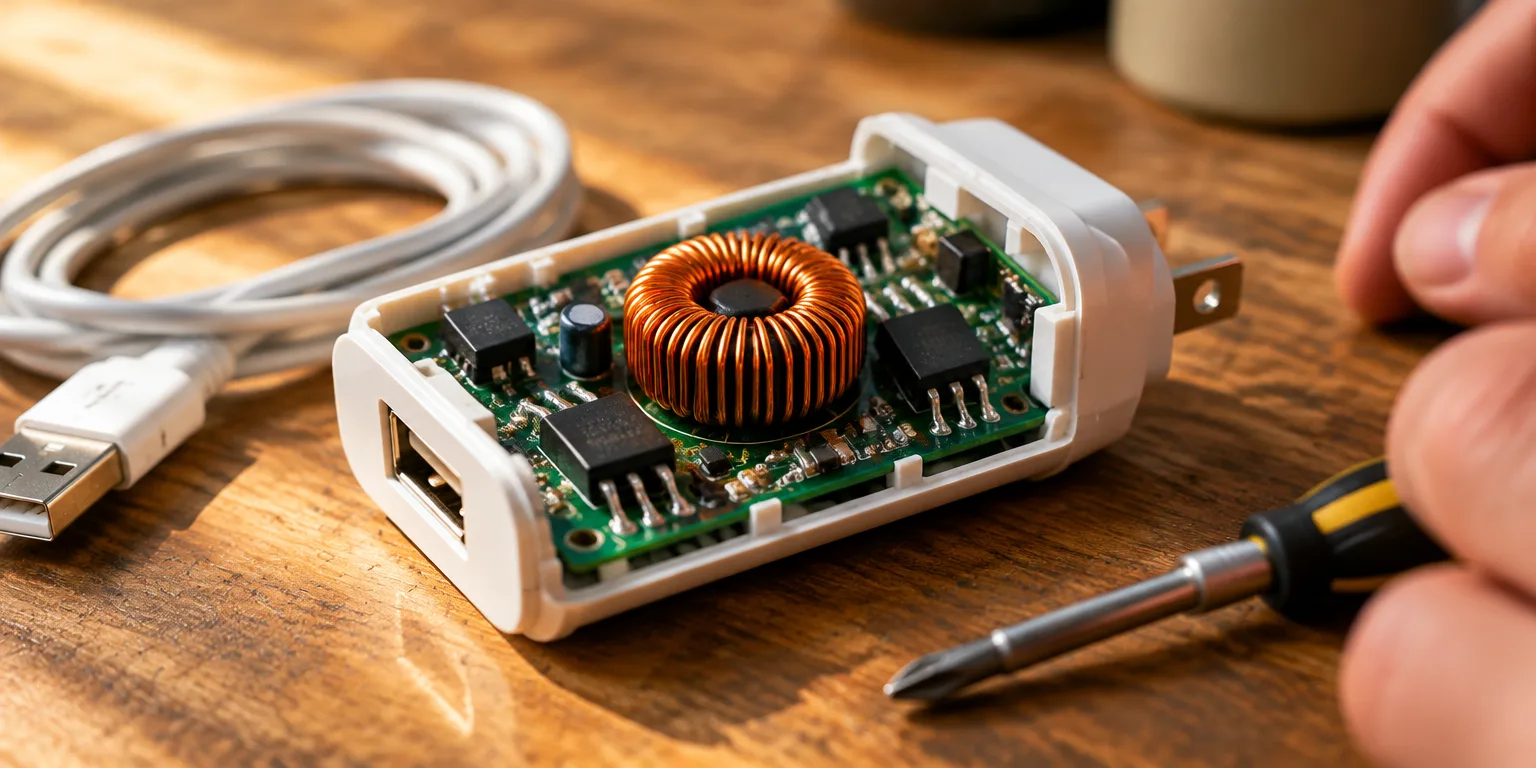
Inside the little box, transistors chop electricity into pulses and a coil of wire smooths them into a steady stream.
 Veritasium · AD - Why do I get this spark when I unplug my hair dryer?
Your phone cannot handle the electricity coming out of your wall. That power arrives at high voltage, and it surges back and forth. Your phone wants the opposite, smooth, low voltage power that flows in one direction.
So a wall charger performs a rough translation. First, it chops the incoming electricity into tiny pieces. Inside the charger, electronic switches called transistors flick the current on and off at a rate measured in the hundreds of thousands each second, breaking it into a rapid train of pulses.
Those pulses are still too choppy to feed a battery. That is where a second part comes in, a coil of wire called an inductor.
That coil pushes back against abrupt shifts in flow, a behavior Derek Muller, who makes the science videos Veritasium, describes this way: "It acts like a shock absorber." When a pulse rises, the coil stores some of its energy in a magnetic field around the wire. When the pulse falls, the coil releases that stored energy back into the circuit.
Pulse by pulse, that storing and releasing fills in the gaps. The choppy train of bursts emerges as steady direct current, the smooth, one way flow that phones and laptops need.
There is a catch, and you can feel it in your bag. Coils designed for higher voltages must be built larger in size. That is why chargers built for high power laptops and fast charging need really large inductors, and why shrinking a charger means finding a way to shrink that coil.
Questions people ask
Why can't I plug my phone straight into the wall?
Wall power in most homes is alternating current at 120 or 240 volts, far more than a phone battery, which charges at around 5 to 20 volts. Plugging a phone in directly would overwhelm its circuits and destroy the battery. The charger steps the voltage down and changes its character before it ever reaches the phone.
What is the difference between AC and DC?
Alternating current reverses direction many times per second, which makes it efficient to send over long wires from power plants. Direct current flows in one direction, which is what batteries store and microchips use. Almost every portable electronic device therefore needs a conversion from one to the other.
Why are some fast chargers small while older ones were big bricks?
Faster switching generally allows the smoothing parts to be smaller, because each pulse carries less energy that must be stored and released. That is one reason modern compact chargers can deliver more power than older, heavier bricks. Heat, materials, and safety limits still set how small and powerful they can get.