Your Coffee in 1679 London Came With a Porpoise Dissection
London's early coffeehouses survived a royal ban to become shared labs and debating rooms.
 TED-Ed · How humanity got hooked on coffee - Jonathan Morris
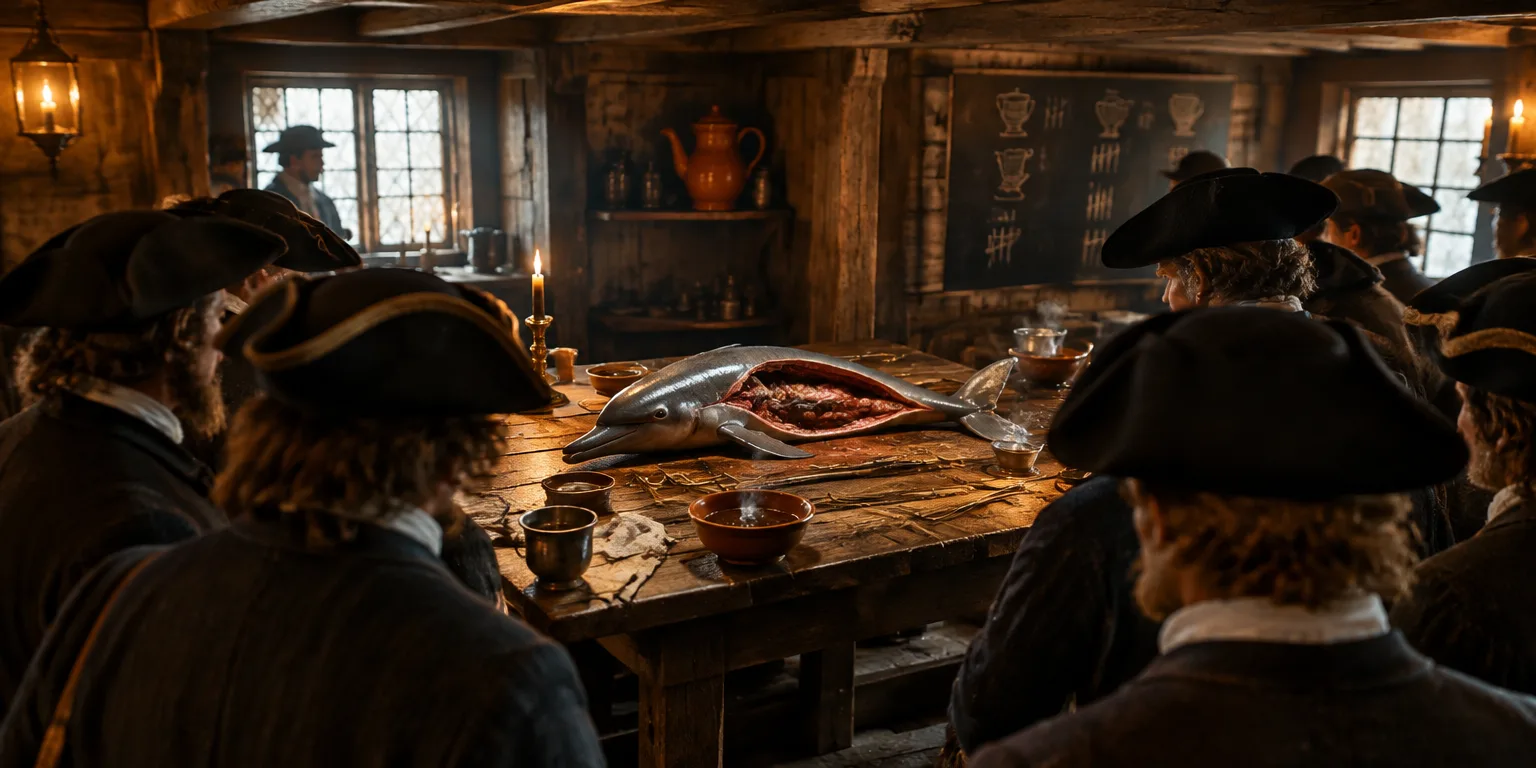
The porpoise was cut open at Garraway's coffeehouse in London in 1679. Cups of coffee were nearby as customers gathered around Robert Hooke, the scientist credited with naming the cell for the tiny units that make up living things, while he worked on the porpoise, a small sea mammal, in front of them.
London's first coffeehouses had opened in the 1650s. By 1663 there were more than 80 of them. They were busy gathering places where people met to talk and hear new ideas.
They were places where science and talk happened together, and Hooke's public dissection at Garraway's was a vivid example.
Coffee had reached Europe through the Ottoman Empire. King Charles II, the king of England, tried to ban the coffeehouses in 1675. The effort did not hold, and the shops stayed busy.
Hooke's dissection was part of that busy life. Best known for giving science the word cell, he did his work in front of coffee drinkers, who watched together.
The mix of coffee and ideas kept spreading. In France, drinkers started lightening coffee with milk and sweetening it with sugar. Throughout the 1700s, coffeehouses in Paris became meeting places for French writers and thinkers such as Diderot and Voltaire, figures of the Enlightenment. The Enlightenment was the 1700s movement for new ideas about reason and science. Voltaire allegedly drank 50 cups of coffee a day.
Questions people ask
What else was Robert Hooke known for?
Hooke was an English natural philosopher, architect, and curator of experiments for the Royal Society in London. He published Micrographia in 1665 with detailed drawings made through a microscope, described elasticity in what is now called Hooke's Law, and helped survey London after the Great Fire of 1666.
Why would a king try to ban coffeehouses?
Stuart authorities worried that coffeehouses encouraged political gossip and organizing against the king. Charles II issued a proclamation in 1675 to close them, but it faced such strong opposition from merchants and the public that it was withdrawn within days.
Did other science really happen in coffeehouses?
Yes, for a time. Early members of the Royal Society, England's leading science group, often met in coffeehouses and used them to share news, show experiments, and debate ideas. Later the formal laboratory, the university, and the office took over much of that role.