Your dominant hand was picked before your brain could move it
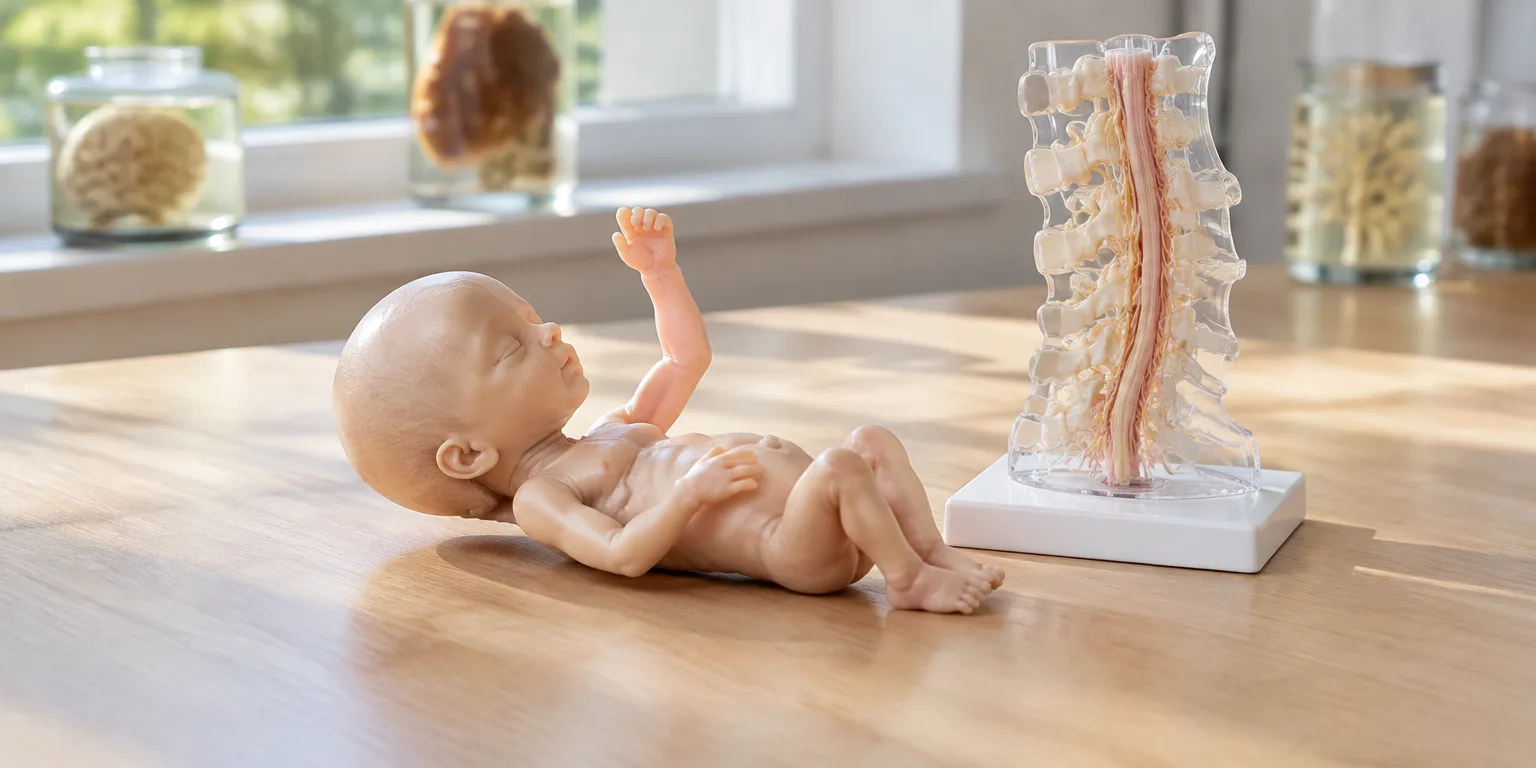
At about 10 weeks after conception, one arm flails more, and the spinal cord is already chemically lopsided.
 Quanta Magazine · Why Am I Left-Handed?
Your dominant hand was likely picked about 10 weeks after conception, before the brain was directly linked to the limbs.
At that stage, a fetus starts flailing one arm a lot more than the other. Those early waves are reflexes, not decisions, but the busier arm gives a strong early hint about later handedness.
Researchers have proposed that the lead comes from lower down, in the spinal cord. In a 2017 study in eLife, scientists looked at spinal tissue from fetuses aged 8 to 12 weeks, around the time the uneven movement appears, and reported signs of sharp left-right differences in which genes were turned on to build proteins.
One proposed route is that this uneven activity helps wire uneven motion. More signaling on one side might build denser local motor wiring, which would then make that arm jerk more on its own.
If that sequence holds, it would flip the usual assumption. Rather than the brain first dictating the favorite hand, movement and feedback from that hand would help shape the brain area that later controls it, as input from the active limb reinforces its representation in the developing motor cortex, the strip that guides voluntary movement.
The authors stress this could explain how a preference takes hold so early, but not why about 90% of people end up right-handed. No single gene for handedness has been found, and the genetic link looks diffuse, so the spinal cord account remains a partial hypothesis, not a settled explanation.
Questions people ask
When does the brain actually connect to the limbs?
The connections form gradually during the first trimester, with nerves growing out from the spinal cord toward the muscles and sensory pathways growing back toward the brain. The key point in these studies is that one-sided arm movement shows up before those brain-to-limb circuits are working. Early flailing is driven locally by the spinal cord.
If the spinal cord starts it, why do left- and right-handers have different brains?
Because use is thought to reshape the brain. The arm that moves more would send more sensory feedback to the motor cortex, and that input would strengthen the network that maps to that hand. In this hypothesis, the adult brain asymmetry is largely a result, not the original cause.
Does the spinal cord stay lopsided in adults?
The work cited here only examined fetuses at 8 to 12 weeks, so it does not show what the adult spinal cord looks like. Researchers propose the early movement bias is later reinforced in the brain, but whether spinal asymmetry itself lasts is not addressed in these findings.