Your Phone Does Not Feel Your Finger, It Senses an Electrical Disturbance
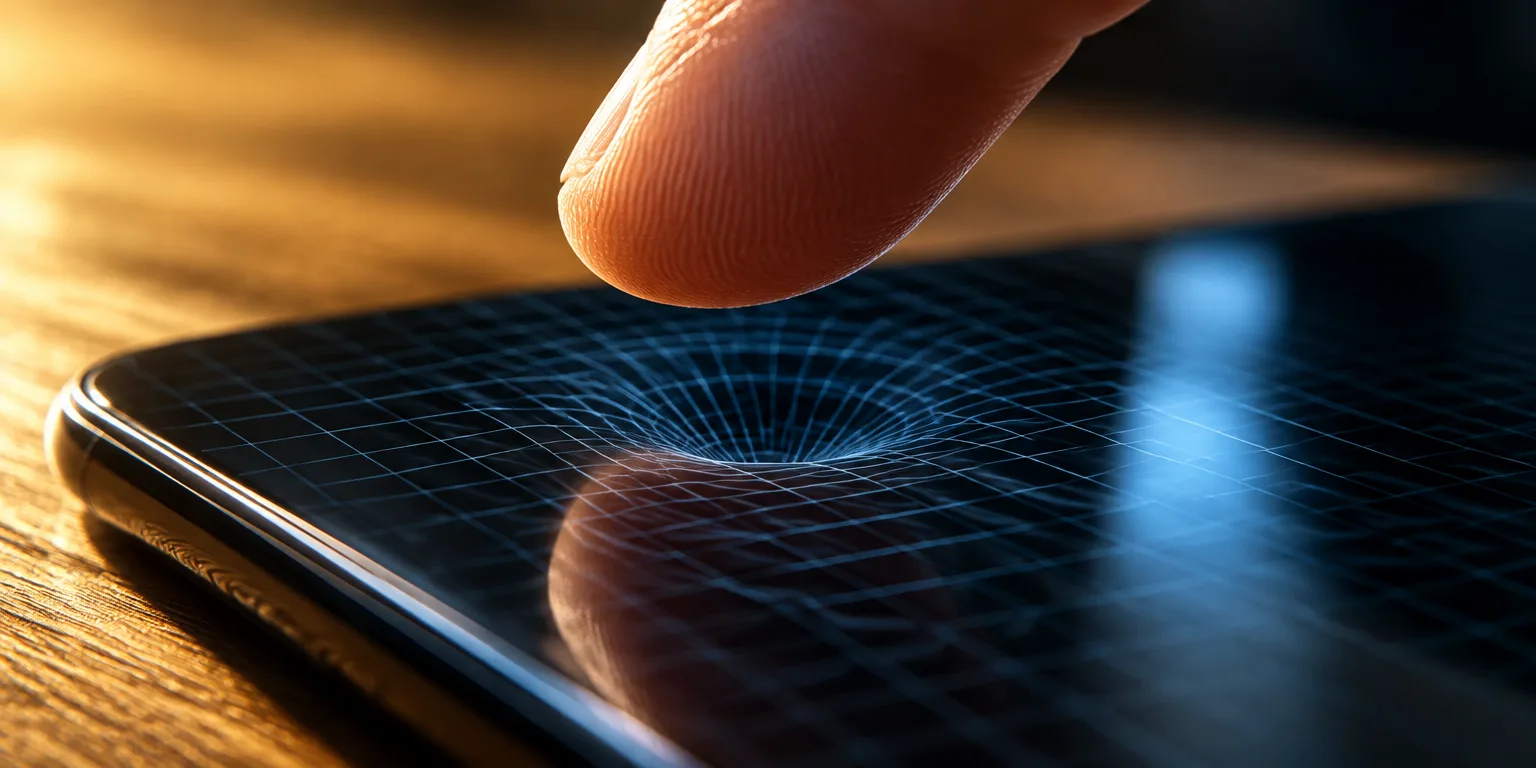
A conductive fingertip distorts a hidden grid of electricity, and the phone calculates where the row and column meet.
 EverythingProfessor · Explaining Everyday Things YOU Don't Actually Understand
When you tap your phone, the glass is not feeling the push.
Modern smartphones use what engineers call a capacitive touch screen. Beneath the glass sits a transparent layer laced with a grid of tiny electrodes, and that grid keeps a faint electric charge spread evenly just under the glass.
Your body disrupts it. Because a fingertip holds salty fluid, it conducts electricity, so when it comes close to the glass it warps the charge at that spot.
The phone measures that change across the whole grid at once. Its processor then finds where an affected row and an affected column intersect, and that intersection is your touch point.
That is why an ordinary glove breaks the trick. The fabric insulates your finger and keeps it from disturbing the field.
Gloves made for touch screens solve the problem with conductive threads woven into the fingertips, which carry the electrical effect through to the screen.
The same system explains pinch to zoom. Because the grid can sense several distortions at the same time, it can follow two fingers moving apart or together and translate that into a larger or smaller image.
Questions people ask
Why do some styluses work and others do not?
The stylus must disturb the field like a finger. A passive stylus has a conductive rubber or mesh tip that disturbs the field, while an active stylus sends its own tiny electrical signal that the grid can locate more precisely.
Did phone screens ever actually sense pressure?
Older resistive screens did work by pressure. They had two flexible layers that touched when pushed, so a fingernail, stylus, or gloved finger would register. Most phones switched to capacitive screens because they are clearer, more durable, and handle multiple touches better.
Why does water confuse a touch screen?
Water is also conductive, so raindrops or a wet finger can distort the field and create false touches or dead spots. That is why phones can act strangely in rain, and why water-resistant does not mean the screen will work perfectly when wet.