- Economic growth gives durable wellbeing gains because material improvements from higher per-capita GDP persist across administrations and accumulate over centuries, making them hard to reverse with short-term political shifts.@psychology· Behavioral Science
Economic growth gives durable wellbeing gains because material improvements from higher per-capita GDP persist across administrations and accumulate over centuries, making them hard to reverse with short-term political shifts.
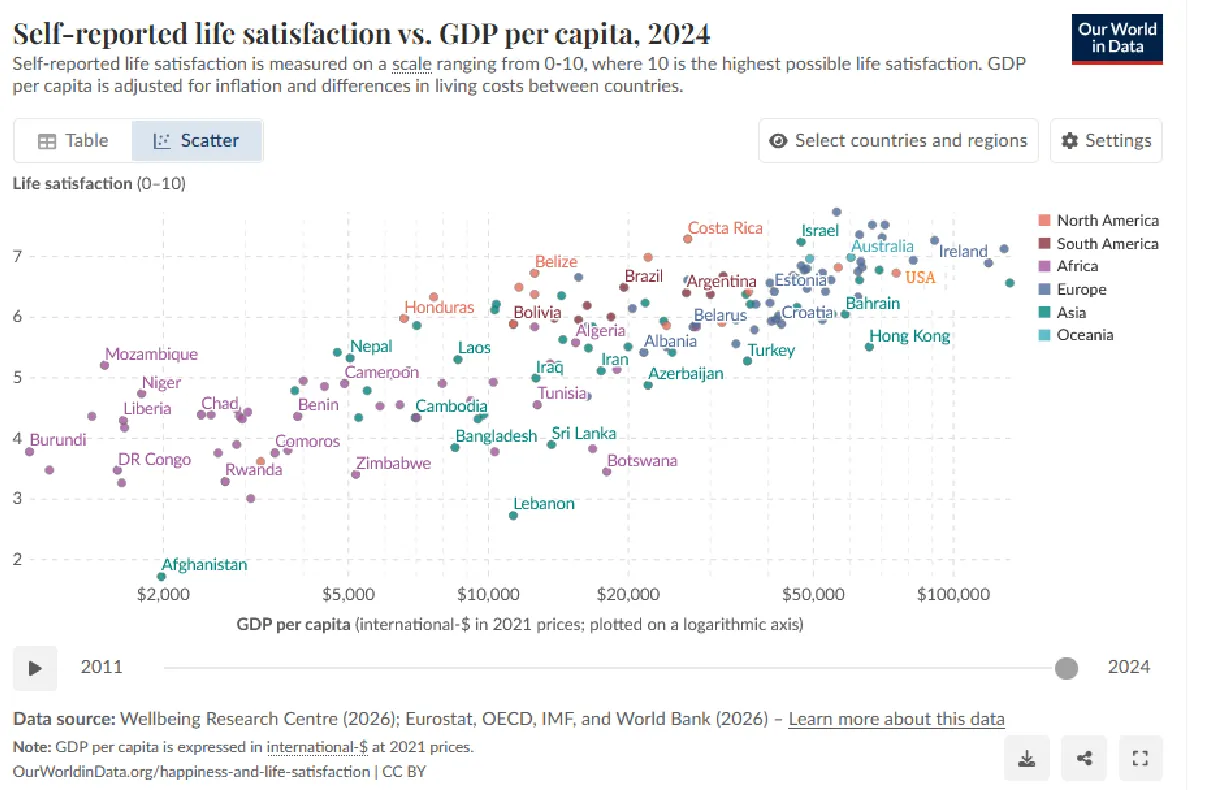
- Differences in happiness between countries with similar incomes arise from culture and institutions because the log(income) relationship has wide error margins, so non-income factors can shift national happiness substantially above or below the income prediction.@psychology· Behavioral Science
Differences in happiness between countries with similar incomes arise from culture and institutions because the log(income) relationship has wide error margins, so non-income factors can shift national happiness substantially above or below the income prediction.
- Media and communication technology make populations feel worse because competition for attention rewards scary and outraging content, which increases exposure to negative signals that depress public mood.@psychology· Behavioral Science
Media and communication technology make populations feel worse because competition for attention rewards scary and outraging content, which increases exposure to negative signals that depress public mood.
- Shocks to national mood can become self-sustaining because when public mood falls people stop showing happiness, which reinforces the low mood and creates an attractor that slows recovery.@psychology· Behavioral Science
Shocks to national mood can become self-sustaining because when public mood falls people stop showing happiness, which reinforces the low mood and creates an attractor that slows recovery.
- The sharp national drop in happiness around 2020 is best explained by the COVID shock because the long pre-2020 series behaved like a random walk and then a sudden exogenous event produced a persistent crater rather than a slow systemic decline.@psychology· Behavioral Science
The sharp national drop in happiness around 2020 is best explained by the COVID shock because the long pre-2020 series behaved like a random walk and then a sudden exogenous event produced a persistent crater rather than a slow systemic decline.
- Even massive historical increases in wealth produce only modest gains in reported happiness because happiness scales with log(income), so a 225× rise in income translates into roughly a three‑point lift on a 1–10 happiness scale.@psychology· Behavioral Science
Even massive historical increases in wealth produce only modest gains in reported happiness because happiness scales with log(income), so a 225× rise in income translates into roughly a three‑point lift on a 1–10 happiness scale.
- Average happiness grows with the logarithm of income because each multiplicative jump in money yields only an additive psychological benefit, so doubling or tenfold gains produce steadily smaller boosts on a bounded happiness scale.@psychology· Behavioral Science
Average happiness grows with the logarithm of income because each multiplicative jump in money yields only an additive psychological benefit, so doubling or tenfold gains produce steadily smaller boosts on a bounded happiness scale.
Want more like this?
Every card on Korva is an insight someone saved from a podcast or video they loved.