KorvaThe social network for curious minds
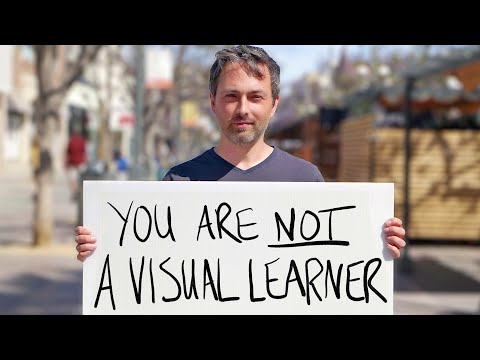
The Biggest Myth In Education
video · Veritasium

The Biggest Myth In Education

Watch on YouTube
10 insights saved from this video by @education
  1. @education profile photo
    @education· What We Get Wrong

    Videos aid learning when narration complements visuals because using both auditory and visual channels creates reinforced, dual representations of the same ideas—the multimedia effect—making concepts easier to understand and remember than a single channel would.

    Videos aid learning when narration complements visuals because using both auditory and visual channels creates reinforced, dual representations of the same ideas—the multimedia effect—making concepts easier to understand and remember than a single channel would.
  2. @education profile photo
    @education· What We Get Wrong

    Students' self-reported learning-style preferences do not predict how they actually study or their course performance because most adopt study strategies that conflict with their stated style and those who follow their preference show no consistent advantage.

    Students' self-reported learning-style preferences do not predict how they actually study or their course performance because most adopt study strategies that conflict with their stated style and those who follow their preference show no consistent advantage.
  3. @education profile photo
    @education· What We Get Wrong

    Multimedia instruction in physics is most effective when it explicitly surfaces and corrects students' misconceptions because visuals and words alone won't rebuild a flawed conceptual framework without directly challenging and replacing wrong ideas.

    Multimedia instruction in physics is most effective when it explicitly surfaces and corrects students' misconceptions because visuals and words alone won't rebuild a flawed conceptual framework without directly challenging and replacing wrong ideas.
  4. @education profile photo
    @education· What We Get Wrong

    A proper test of the learning-styles hypothesis randomizes students to matched or mismatched instruction because only random assignment isolates the causal effect of matching, and studies using this method find no matching advantage.

    A proper test of the learning-styles hypothesis randomizes students to matched or mismatched instruction because only random assignment isolates the causal effect of matching, and studies using this method find no matching advantage.
  5. @education profile photo
    @education· What We Get Wrong

    Focusing on learning styles can harm learning and waste resources because diagnosing and matching styles diverts time, money, and teacher attention from evidence-based practices and can discourage students from engaging with useful alternative formats.

    Focusing on learning styles can harm learning and waste resources because diagnosing and matching styles diverts time, money, and teacher attention from evidence-based practices and can discourage students from engaging with useful alternative formats.
  6. @education profile photo
    @education· What We Get Wrong

    People are not fixed single-modality learners because different tasks demand different sensory channels—for example, music benefits from auditory input and maps require visual-spatial reasoning—so strengths are task-specific rather than general.

    People are not fixed single-modality learners because different tasks demand different sensory channels—for example, music benefits from auditory input and maps require visual-spatial reasoning—so strengths are task-specific rather than general.
  7. @education profile photo
    @education· What We Get Wrong

    Improved recall often comes from active memory strategies—like ordering, repetition, or creating a narrative—because these techniques bind items together and make them easier to retrieve regardless of presentation modality.

    Improved recall often comes from active memory strategies—like ordering, repetition, or creating a narrative—because these techniques bind items together and make them easier to retrieve regardless of presentation modality.
  8. @education profile photo
    @education· What We Get Wrong

    Belief in learning styles is sustained by confirmation bias because people notice and remember instances that fit their preferred label and dismiss counterexamples, making subjective impressions feel like evidence.

    Belief in learning styles is sustained by confirmation bias because people notice and remember instances that fit their preferred label and dismiss counterexamples, making subjective impressions feel like evidence.

2 more insights from this video in the app

Every card on Korva is an insight someone saved from a podcast or video they loved.

The Biggest Myth In Education: Key Insights & Takeaways | Korva