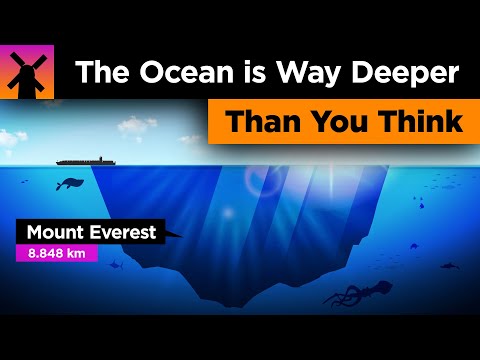
- If you shaved off all land and dumped that volume into the ocean basins, the added material would fill low regions and produce a global ocean roughly two miles deep, illustrating how land volume compares to basin capacity.
@nature· Planet EarthIf you shaved off all land and dumped that volume into the ocean basins, the added material would fill low regions and produce a global ocean roughly two miles deep, illustrating how land volume compares to basin capacity.
- Because only about 5% of the seafloor has been accurately mapped, vast unmapped regions remain where deeper, undiscovered depressions could exist.
@nature· Planet EarthBecause only about 5% of the seafloor has been accurately mapped, vast unmapped regions remain where deeper, undiscovered depressions could exist.
- As external pressure rises with depth, mechanical stresses on submersible hulls and windows increase and can exceed design limits, causing cracks or catastrophic structural failure during extreme dives.
@nature· Planet EarthAs external pressure rises with depth, mechanical stresses on submersible hulls and windows increase and can exceed design limits, causing cracks or catastrophic structural failure during extreme dives.
- Hydrostatic pressure increases with the weight of the water column, so at hadal depths (around 6,000 meters and below) pressures reach roughly 1,100 times surface pressure, producing crushing forces that would destroy unprotected objects or organisms.
@nature· Planet EarthHydrostatic pressure increases with the weight of the water column, so at hadal depths (around 6,000 meters and below) pressures reach roughly 1,100 times surface pressure, producing crushing forces that would destroy unprotected objects or organisms.
- Extreme pressure, perpetual darkness, and near-freezing temperatures select for highly specialized abyssal animals, causing traits like bioluminescence, huge mouths, and slow metabolisms to evolve so they can find food and survive where surface life cannot.
@nature· Planet EarthExtreme pressure, perpetual darkness, and near-freezing temperatures select for highly specialized abyssal animals, causing traits like bioluminescence, huge mouths, and slow metabolisms to evolve so they can find food and survive where surface life cannot.
- Sperm whales often bear sucker marks and scars because violent encounters with giant squid at depth leave physical traces on their bodies, revealing predator–prey battles in the deep sea.
@nature· Planet EarthSperm whales often bear sucker marks and scars because violent encounters with giant squid at depth leave physical traces on their bodies, revealing predator–prey battles in the deep sea.
- Both animals and submarines have depth limits because biological systems fail under extreme pressure (oxygen use and tissue tolerance) while engineered hulls collapse when materials reach their strength limits.
@nature· Planet EarthBoth animals and submarines have depth limits because biological systems fail under extreme pressure (oxygen use and tissue tolerance) while engineered hulls collapse when materials reach their strength limits.
- Because the weight of the overlying water column produces compressive force that scales with depth, pressure at intermediate deep-sea levels can be enormous—so intense that vivid analogies (e.g., a polar bear on a quarter) help convey how much force is exerted on small areas.
@nature· Planet EarthBecause the weight of the overlying water column produces compressive force that scales with depth, pressure at intermediate deep-sea levels can be enormous—so intense that vivid analogies (e.g., a polar bear on a quarter) help convey how much force is exerted on small areas.
3 more insights from this video in the app
Every card on Korva is an insight someone saved from a podcast or video they loved.