KorvaThe social network for curious minds
The Psychology of Money
article · Morgan Housel

The Psychology of Money

Read the original article
20 insights saved from this article by @money
  1. @money profile photo
    @money· Personal Finance & Investing

    Academic finance can mislead practitioners because neat formulas and statistically optimal rules often ignore psychological limits and practical constraints, making those prescriptions infeasible or harmful in real-world investing.

    Academic finance can mislead practitioners because neat formulas and statistically optimal rules often ignore psychological limits and practical constraints, making those prescriptions infeasible or harmful in real-world investing.
  2. @money profile photo
    @money· Personal Finance & Investing

    Taking cues from traders playing a different game misleads long-term investors because short-term participants move marginal prices for horizon-specific reasons that don't align with long-term objectives, causing poor timing and losses.

    Taking cues from traders playing a different game misleads long-term investors because short-term participants move marginal prices for horizon-specific reasons that don't align with long-term objectives, causing poor timing and losses.
  3. @money profile photo
    @money· Personal Finance & Investing

    Financial news functions as entertainment because drama, heroes, and villains amplify emotions and attention, which encourages reactive behavior rather than disciplined investment.

    Financial news functions as entertainment because drama, heroes, and villains amplify emotions and attention, which encourages reactive behavior rather than disciplined investment.
  4. @money profile photo
    @money· Personal Finance & Investing

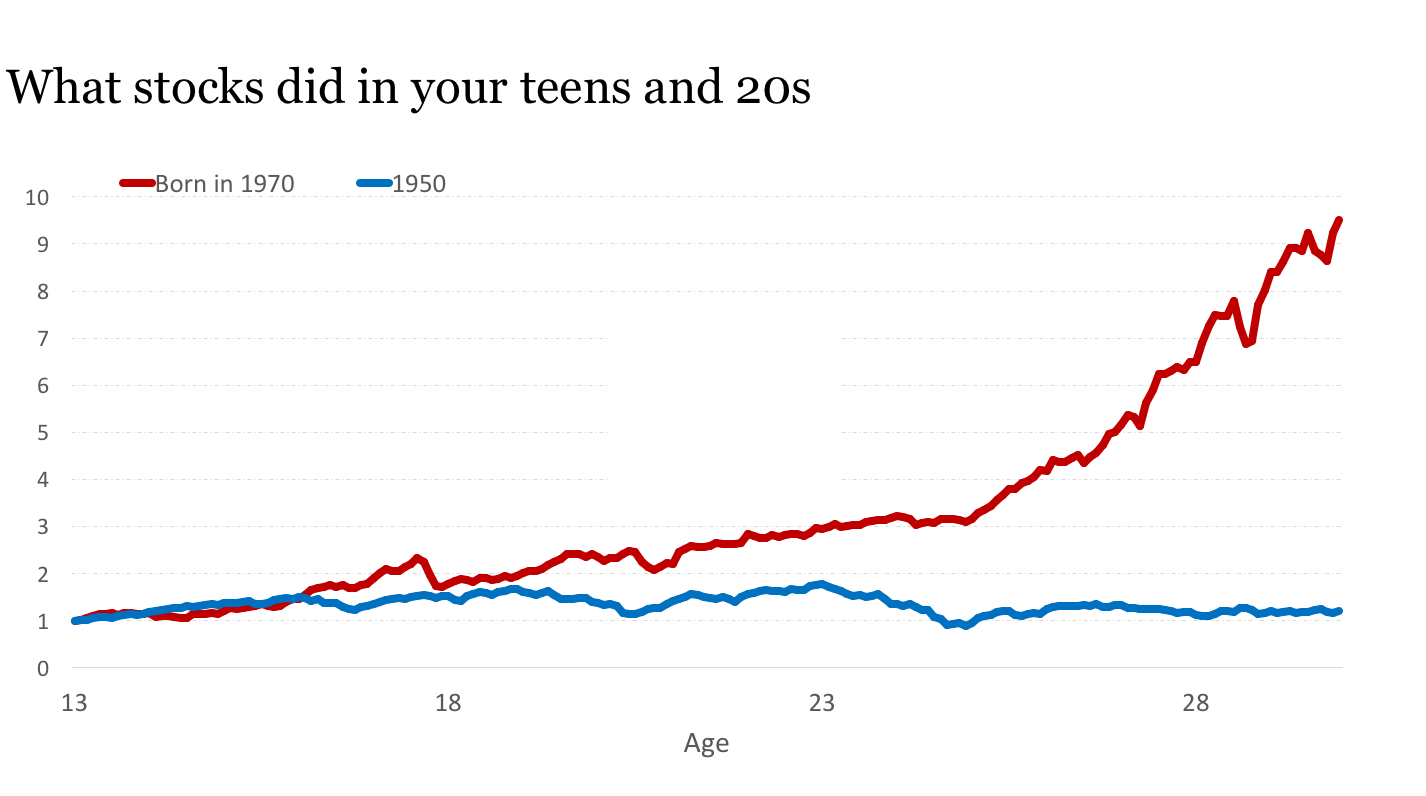
    People overweight their own life experience when judging the economy because small, formative samples form mental models that dominate perception despite representing an infinitesimal slice of history.

    People overweight their own life experience when judging the economy because small, formative samples form mental models that dominate perception despite representing an infinitesimal slice of history.
  5. @money profile photo
    @money· Personal Finance & Investing

    Investment outcomes hinge more on investor behavior than on technical models because long-term results depend on how people manage emotions, stick to plans, and avoid self-sabotaging habits that formulas alone can't enforce.

    Investment outcomes hinge more on investor behavior than on technical models because long-term results depend on how people manage emotions, stick to plans, and avoid self-sabotaging habits that formulas alone can't enforce.
  6. @money profile photo
    @money· Personal Finance & Investing

    Investors often try to capture high returns while avoiding the volatility that pays for them, and because returns require bearing uncertainty, hedges and tricks frequently fail when markets demand the 'price' be paid.

    Investors often try to capture high returns while avoiding the volatility that pays for them, and because returns require bearing uncertainty, hedges and tricks frequently fail when markets demand the 'price' be paid.
  7. @money profile photo
    @money· Personal Finance & Investing

    People underfund margin-of-safety because they overestimate forecasting accuracy and underestimate how drawdowns damage psychology and endurance, leaving them unable to survive and exploit rare favorable events.

    People underfund margin-of-safety because they overestimate forecasting accuracy and underestimate how drawdowns damage psychology and endurance, leaving them unable to survive and exploit rare favorable events.
  8. @money profile photo
    @money· Personal Finance & Investing

    Optimism about favorable odds can be dangerous because even low-probability adverse events (like leveraged wipeouts) can cause catastrophic, irreversible ruin, so a statistical edge doesn't justify risks that can eliminate recovery.

    Optimism about favorable odds can be dangerous because even low-probability adverse events (like leveraged wipeouts) can cause catastrophic, irreversible ruin, so a statistical edge doesn't justify risks that can eliminate recovery.

12 more insights from this article in the app

Every card on Korva is an insight someone saved from a podcast or video they loved.