Korva is a scroll of the internet’s best ideas.
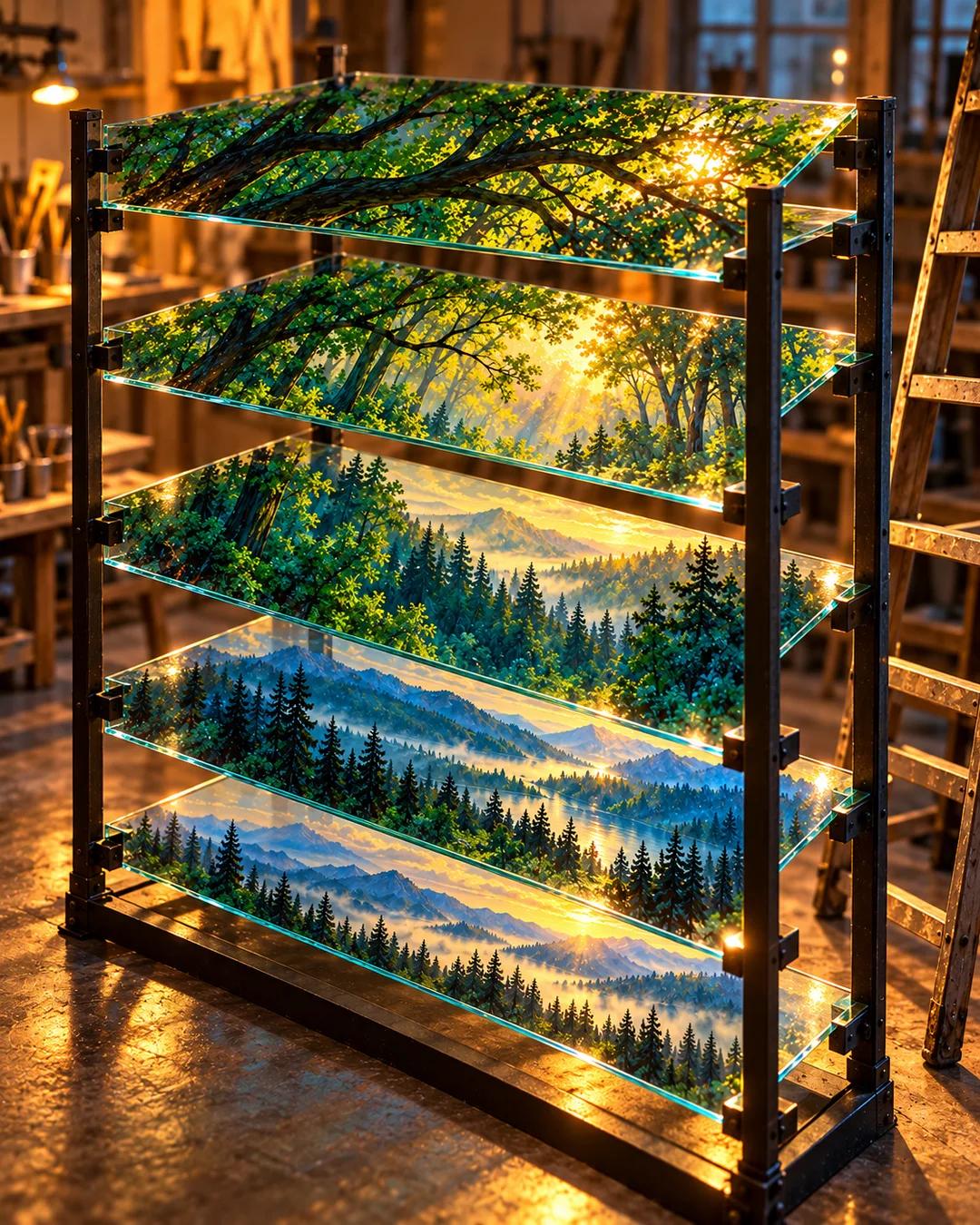
A camera shot through seven glass panes

How it worked
The rig filled a room of its own, took a team of operators, and required climbing a ladder to reach the top, about 12 feet up. The character's cel sat near the camera, and the background elements sat below it at different depths, painted on panes of glass and paper. Spacing them this way created a parallax effect as the scene panned. For an establishing shot, operators brought the panes closer to the camera at different calculated rates in every frame, which zoomed in on a subject from far away.
It was a photo camera, not a movie camera, so it photographed one frame at a time, and then technicians adjusted all the knobs and layers for the next one.
Who built it
The idea existed before Disney. Iwerks built one of the first advanced multiplane cameras in 1933 while away from the company, using parts from an old Chevy, and Walt later rehired him. Disney built the first one used in a feature film. Only three are known to exist, and one is at the Walt Disney Family Museum in San Francisco's Presidio.
Why does parallax make a scene look deep?
Nearby objects appear to shift farther than distant ones when the viewpoint moves. The brain reads that difference in motion as depth. The multiplane camera copied it by moving each glass layer at a different rate. A flat painting gained the feel of a real space.
Which Disney film used it first?
The 1937 short The Old Mill was the first to use the multiplane camera, and it won the Academy Award for Best Animated Short. Snow White used it for several scenes that same year. Pinocchio opened with a long multiplane shot of a village at night. The camera became a signature of Disney features.
What did Iwerks do after leaving?
Iwerks built his multiplane camera while running his own studio. He rejoined Disney in 1940 and worked on special effects and camera technology. He helped adapt xerography to copy animators' drawings onto cels for One Hundred and One Dalmatians in 1961. He won an Oscar for technical achievement in 1960.
More from Acquired