Korva is a scroll of the internet’s best ideas.
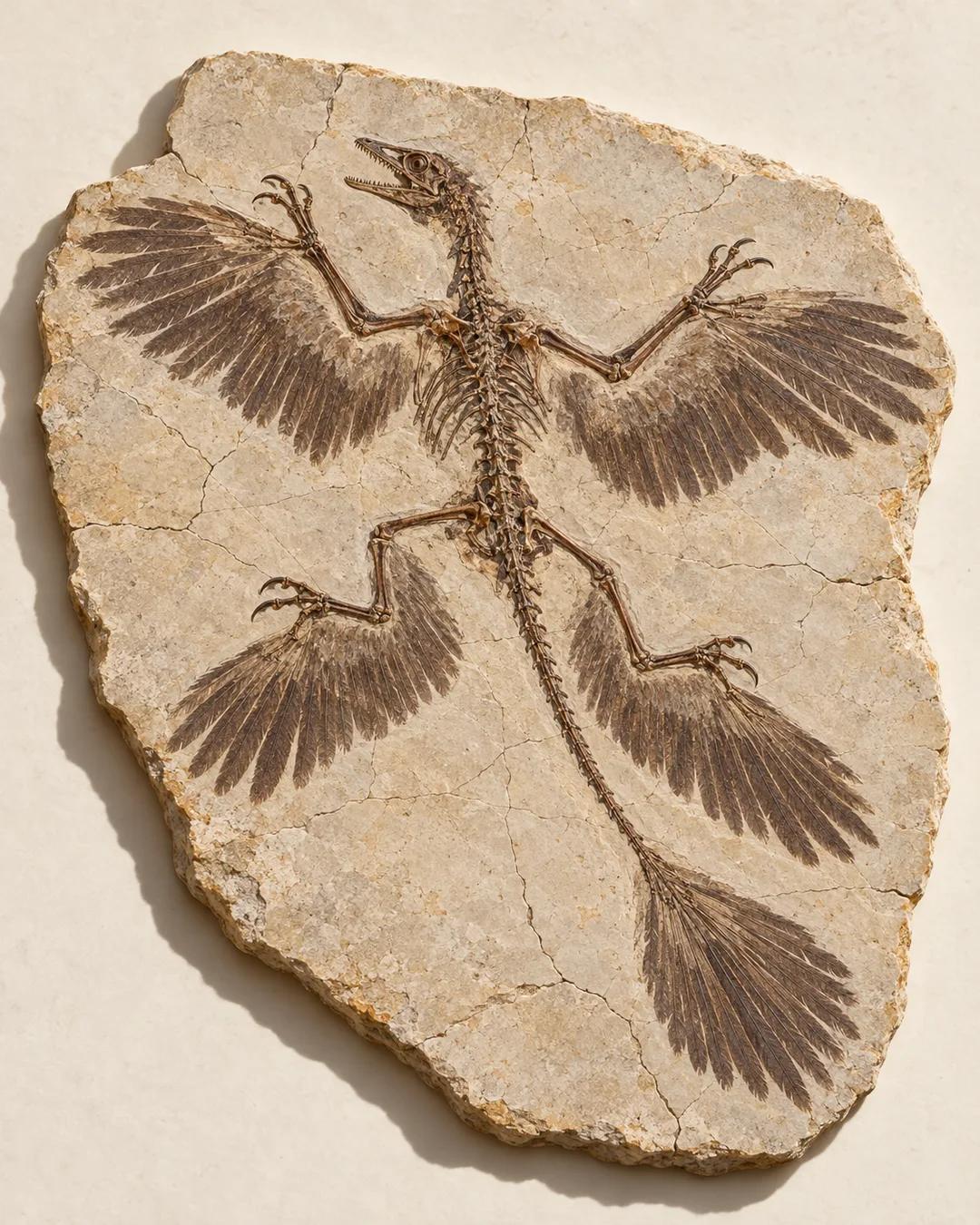
A dinosaur with four wings

A farmer found it in an outcrop of rocks that date back more than 120 million years. Researchers recently had the chance to examine the skeleton up close, and the newly identified species is about the size of a crow.
Scientists are now studying its sharp claws and its mouth full of teeth. Both pairs of wings are made of quill pen feathers, so the animal carried feathered wings on its legs as well as on its arms.
A paleontologist described the dinosaur to the magazine New Scientist as having four wings. It may not be the only winged creature to surface: in recent years, research in paleontology has suggested there were probably more kinds of flying dinosaurs than scientists previously thought.
Why did dinosaurs grow feathers on their legs?
Microraptor, a feathered dinosaur from China, was described in 2003 with long flight feathers on its hind limbs as well as its forelimbs. A 2007 study using models of its body suggested the leg feathers could have helped it glide from tree to tree. Other four-winged dinosaurs turned up afterward, which showed the arrangement was not a one-off. The first Microraptor fossils came from Liaoning Province in northeastern China.
How do fossils preserve feathers for millions of years?
Many of the best feathered fossils come from ancient lake beds in northeastern China. Animals that sank into the water were buried quickly by fine volcanic ash and mud in conditions with little oxygen, which slowed decay. The fine sediment captured the outline of feathers as a dark film. Under a microscope, researchers have found melanosomes, tiny pigment-carrying structures, in those films, and a 2010 study used their shapes to reconstruct the colors of the feathered dinosaur Anchiornis, reporting a rust-colored crest and black-and-white wings.
Why did feathers evolve before flight?
Feathers appear on dinosaurs that could not fly. Sinosauropteryx, described in 1996 from China, was covered in simple filaments and had no wings. Early feathers are thought to have served as insulation and display, and later versions became useful for gliding and flight. Birds descend from small feathered theropod dinosaurs, so the flight feathers of living birds are modified versions of those early structures.
More from The Headlines