Korva is a scroll of the internet’s best ideas.
A drilled hole stops cracks

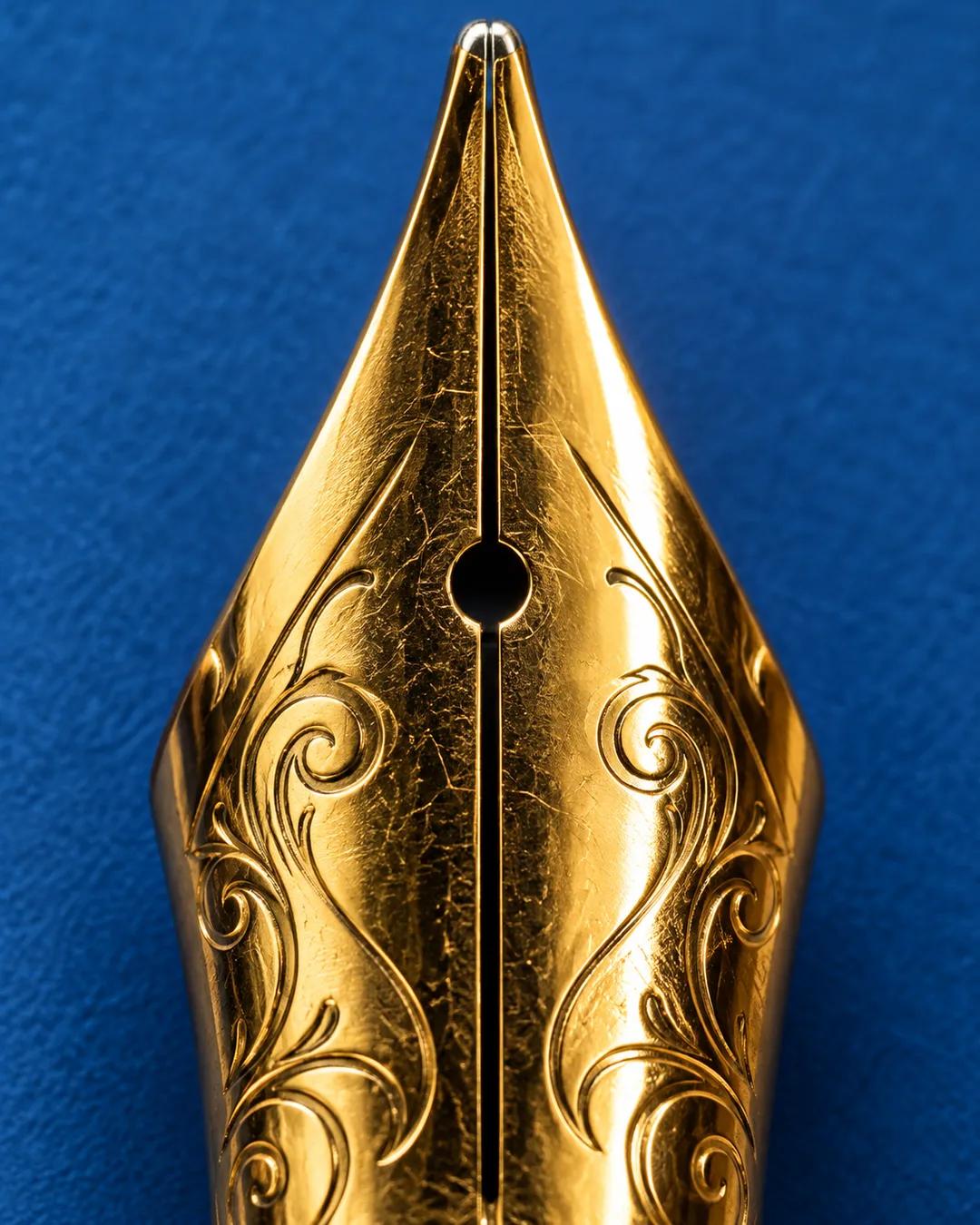
The split in a nib lets ink flow down from the chamber by capillary action, but it is also a crack that could spread. A hole at the top spreads the forces out better, so the split doesn't crack further. Aircraft get the same treatment: when there's a little crack, you drill a hole at the top of it.
Some pens give the hole a second job. Air can get in through it, which helps the older pens with vacuum chambers, and makers can make it decorative. One little Waterman has a heart instead of a hole.
The split and the hole alone would do little for control. Without something behind them, the ink would splay out all over the place.
Why does a round hole stop a crack?
At the sharp tip of a crack, stress piles up in a very small area, which is why the crack keeps tearing forward. Drilling a round hole at the tip turns that sharp point into a smooth curve, and the load spreads around its edge. A sharp crack tip concentrates stress far above the average across the metal. A plain circular hole raises local stress to only about three times the average, a result worked out by Gustav Kirsch in 1898.
Why are airplane windows rounded?
Corners concentrate stress the way crack tips do, and a cabin is squeezed and relaxed with every flight as it is pressurized and depressurized. Rounded corners spread that stress around a larger curve. Fatigue cracks starting at the corners of square openings taught designers that lesson in the early jet era. Modern airliner windows are ovals or rounded rectangles for that reason.
How does a slit pull ink down?
Ink travels along the slit by capillary action, in which a liquid clings to the walls of a narrow gap and drags the rest behind it. The gap has to be narrow enough for that pull to beat gravity, which is a fraction of a millimeter in a typical nib. Once the tip touches paper, the paper's fibers draw the ink out in the same way.
More from The Rest Is Science