Korva is a scroll of the internet’s best ideas.
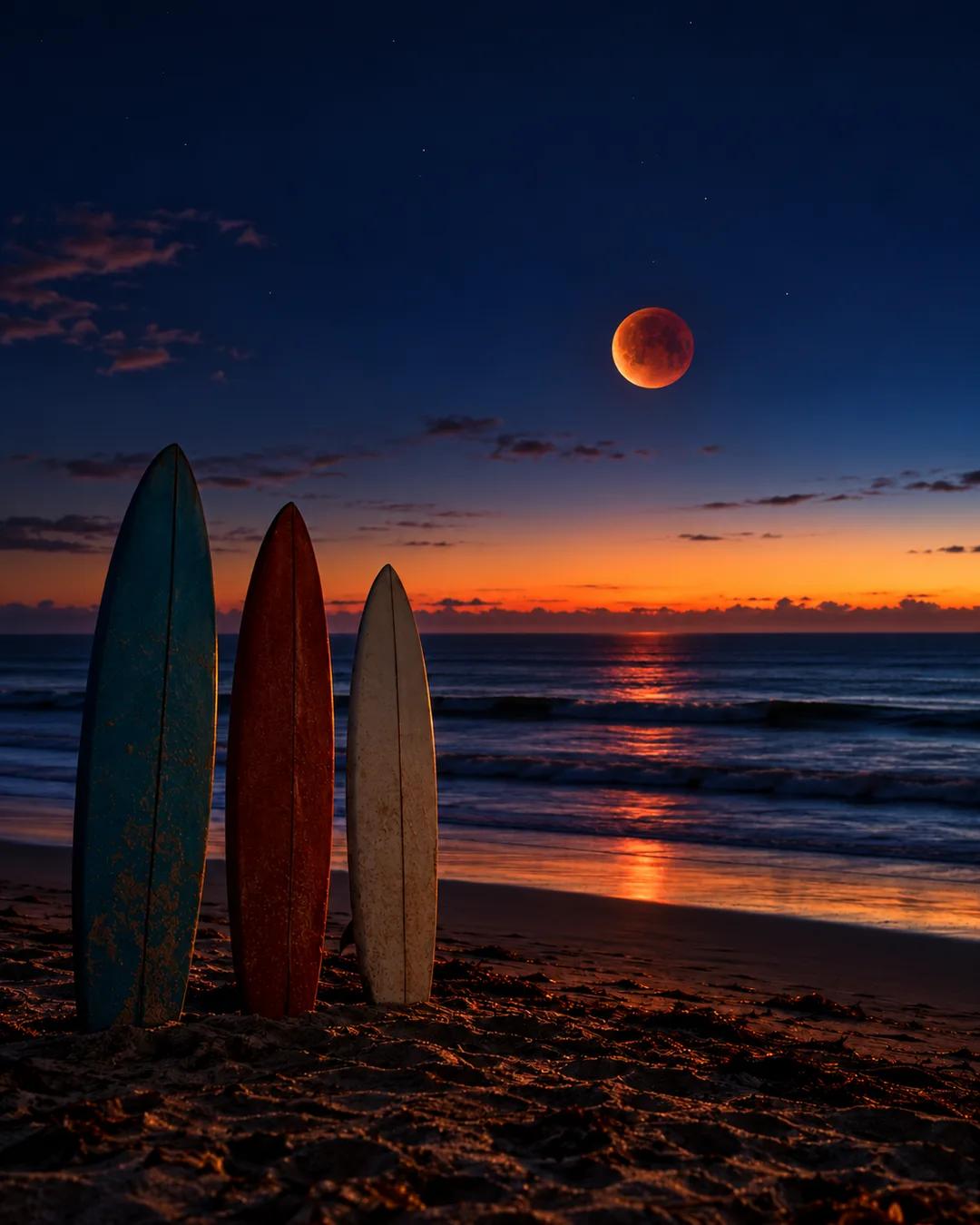
A full-moon surf became an eclipse

The Full-Moon Tradition
Surfing the morning of the full moon is a fixture on one family's monthly calendar. They get to the water around 4:30, with about 45 minutes before the sun rises. The ocean's texture feels like silk, and the moon is dropping toward the water just as the sun starts lifting.
A Darker Beach
This time it was the first full-moon surf for River, a boy who had recently moved from surfing white water to paddling out the back to catch real waves. His father, Chris Begg, walked onto the beach and found it much darker than expected. He wondered whether he'd miscalculated the date, because the moon was nowhere to be seen.
Totality
Then it hit him that this was a lunar eclipse, and the moon was in totality at that exact moment, completely blocked out. They paddled out anyway and surfed in far more darkness than usual, and afterward sat on the beach together until sunrise.
Why does the moon turn red in totality?
Earth's atmosphere bends sunlight around the planet and scatters out most of the blue light, the same process that reddens sunsets. The remaining red light curves into Earth's shadow and falls on the moon. A total lunar eclipse shows the moon lit by every sunrise and sunset on Earth at once.
Why isn't there an eclipse every full moon?
The moon's orbit is tilted about five degrees relative to the plane of Earth's orbit around the sun. Most full moons pass above or below Earth's shadow and miss it. An eclipse can happen only when a full moon falls near one of the two points where the moon's orbit crosses that plane.
How long can totality last?
NASA reports that totality in a lunar eclipse can last up to about an hour and forty-seven minutes. The length depends on how close to the center of Earth's shadow the moon passes. A moon that crosses the shadow's edge stays in totality for a much shorter time.
More from We Study Billionaires - The Investor’s Podcast Network