Korva is a scroll of the internet’s best ideas.
A little plastic stops washboarding

How washboarding forms
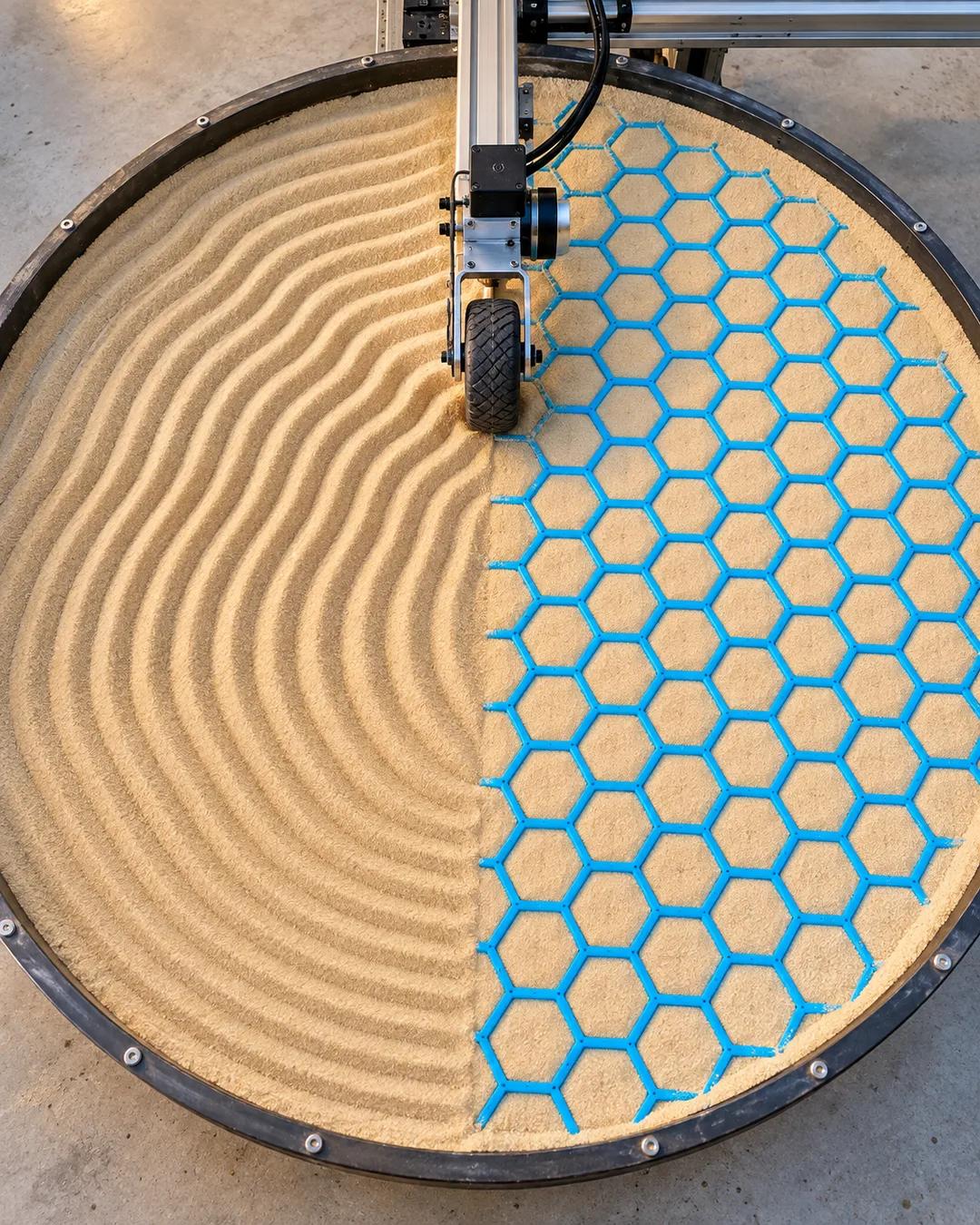
Washboarding is the rhythmic corrugation that forms on dirt and gravel roads, the kind that jostles a vehicle and can even cost it traction. A circular track with a motorized arm and wheel recreates it in real time, and it only appears above a threshold speed. Below that speed, the wheel leaves a plain rut. Without the cells, this track started to corrugate at about 35 rpm.
The printed cells
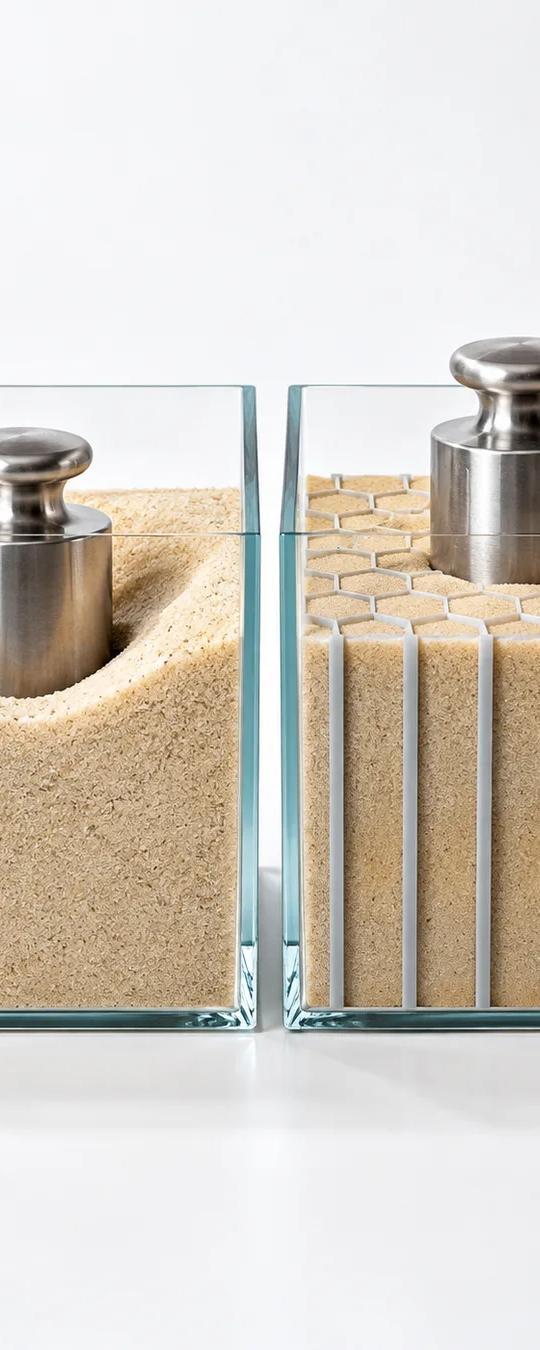
The cells were printed in TPU, a flexible material like the real thing, so they bulge a little under load and draw on the strength of the plastic and the passive resistance of neighboring cells. Loose sand is close to the worst case for an unpaved road. About the only place anyone drives on it is a beach, and tow trucks make good money there.
What the test showed
At 35 rpm, after roughly a hundred rotations, the profile of the track had basically not changed. There was not even a rut, only a little movement at a few of the cells. Pushed to about the fastest speed the track could safely run, the sand stayed remarkably stable. After quite a few more rotations, one section of cells began to float, with the cells left bare on top. On a real road they would sit under a layer of cover.
High-speed footage of the plain track shows the particles skipping and pushing along. With the cells in place, that skip and push is gone and the sand stays mostly confined in the grid. The plastic is a tiny amount next to the weight of the sand.
Why do dirt roads ripple into washboard?
Ripples start from a feedback loop. A wheel that passes over a small bump bounces and presses a dip into the surface just beyond it, and the next wheel meets that dip and bounces in turn. Below a critical speed the bounces die out, and above it they reinforce each other and the ripples grow. In a 2007 Physical Review Letters study, Nicolas Taberlet and colleagues reproduced the effect on a rotating sand track with a wheel.
Why do tires lose grip on washboard?
Each crest can launch a tire briefly off the ground. While airborne it cannot push, steer, or brake, so grip depends on how long the tire stays loaded between bumps. Vehicle engineers call this repeated bouncing wheel hop, and shock absorbers exist largely to damp it.
Why is loose sand so hard to drive on?
Dry sand has no cohesion, so a tire pushes the grains beneath it sideways instead of resting on them. The tire digs a rut, and climbing out of its own rut adds rolling resistance. Lowering tire pressure widens the contact patch and spreads the load over more sand, which is why vehicles on beaches and dunes are often run with softer tires.
More from Practical Engineering