Korva is a scroll of the internet’s best ideas.
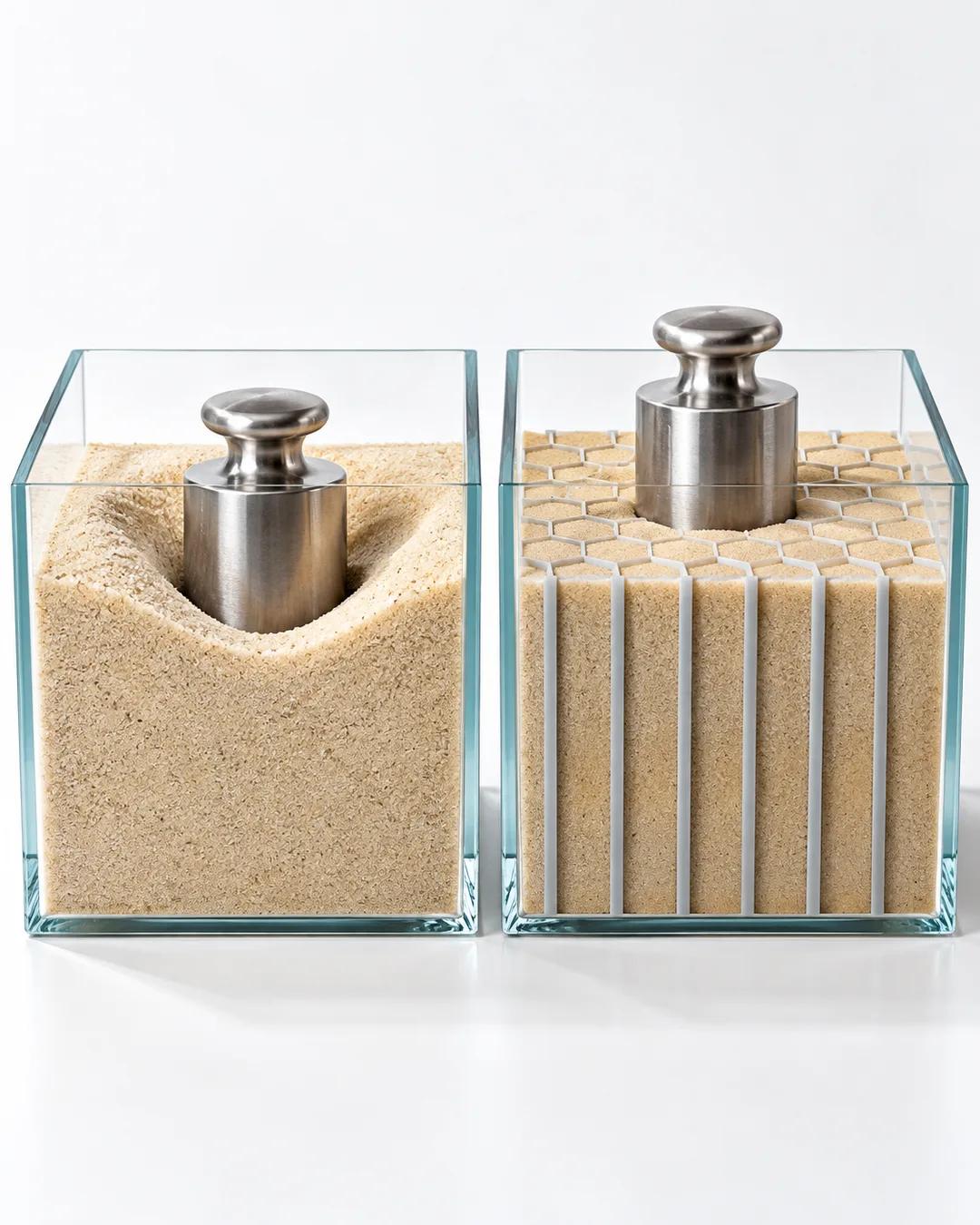
Confined sand has nowhere to go

Why confinement works
A heavy weight dropped on unconfined sand sinks in pretty deep. Confine the sand to a small area and the sinking drops a lot. Soil can't simply disappear under a load, so with cell walls around it there is nowhere for it to go.
How geocells spread load
Geocells are plastic strips welded together into a honeycomb shape, and they encapsulate the fill instead of just touching it. Set side by side, the cells act like the foundation footing of a building, spreading the load so the weak soil underneath sees much lower stress.
Cheaper road base
That matters because road base is an expensive, specialized material. It has to be quarried, crushed, sorted, and sometimes hauled a long way, and not every place on earth has a quarry nearby. Through added strength alone, geocells can cut the thickness of base a road needs. Since the plastic does so much of the work, the fill no longer depends on the perfect interlock of angular crushed rock and fines, which opens the door to cheaper base materials or the soil already on site.
Why does confining sand make it stronger?
Sand gets its strength from friction between grains, and friction grows as the grains are squeezed together harder. A cell wall resists the sideways push that a load creates, so it works like a hoop holding the sand in, which raises the pressure between grains. Engineers call this the confinement effect. Triaxial tests, which squeeze soil samples under controlled side pressure, show that sand carries more load the higher that side pressure is.
How does a wide footing protect weak soil?
Pressure from a footing spreads out with depth, roughly like a cone widening downward, so the same load acts over a larger area farther below. Engineers often estimate this with a rule of thumb that the load spreads at about 2 vertical to 1 horizontal. A wide footing therefore delivers lower pressure to the soil beneath it than a narrow one carrying the same weight.
Why does road base need crushed, angular rock?
Crushed pieces have rough faces that lock against their neighbors, so they resist sliding past one another far better than rounded river gravel does. Mixed with finer particles, they fill their own gaps and compact into a dense layer. A well-graded mix of sizes packs tighter than stones of uniform size, leaving fewer voids.
More from Practical Engineering