Korva is a scroll of the internet’s best ideas.
Dirt has a weight limit

How ground fails
Soil doesn't crush like concrete or bend like a steel beam. When the friction between particles can't resist the pressure, they slide along a plane: the soil moves down, then out, then up, and whatever sits on top sinks or tips. This is called a bearing capacity failure, and anything built on the ground has to account for it, from buildings and dams to retaining walls and roadways.
Spreading the load
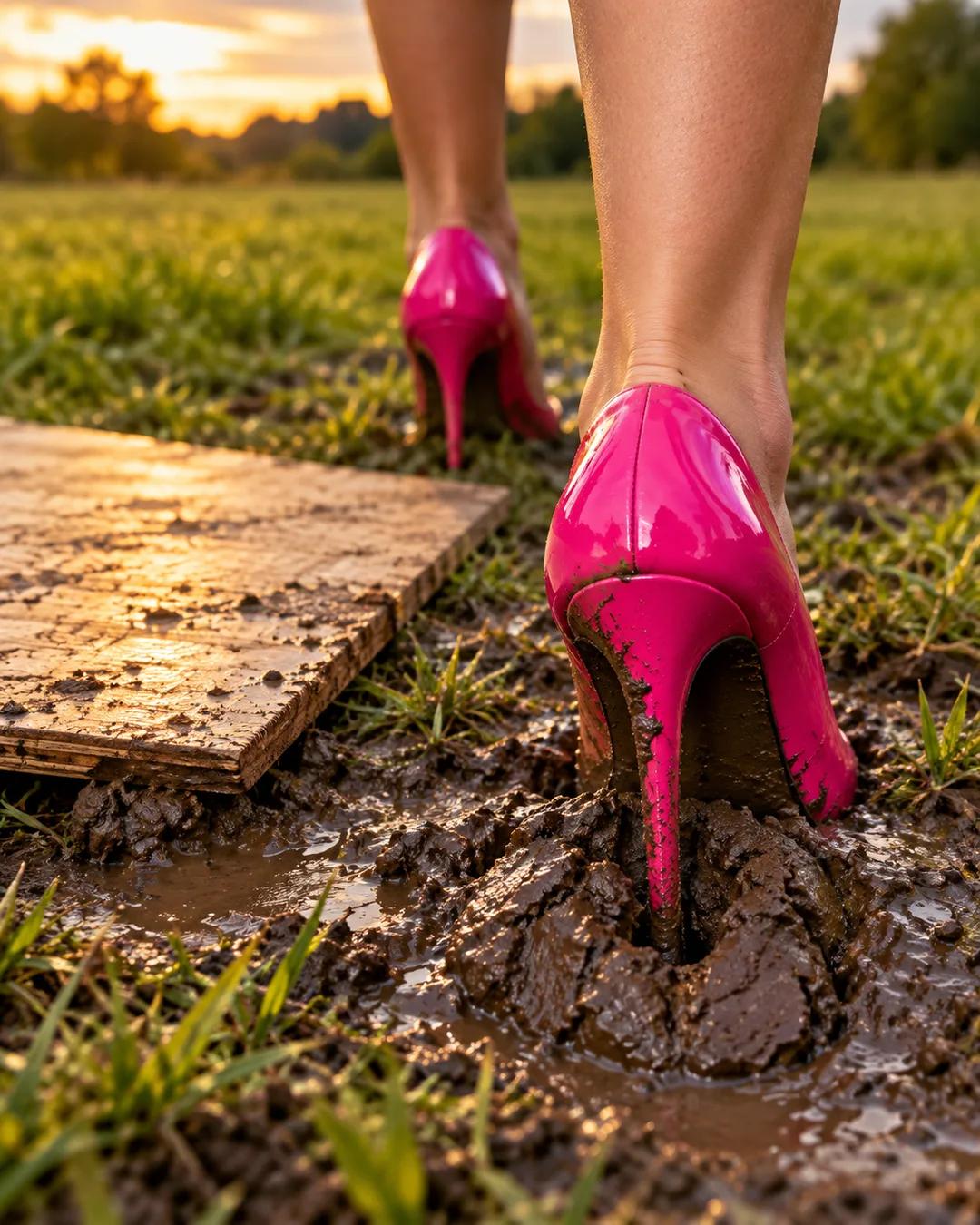
The simplest fix is to spread the load. High heels sink on a muddy lawn, and a wide piece of plywood on the same lawn holds a person up. In engineering that means wide concrete footings that distribute weight over more ground. Concrete is expensive, which is why not every roadway is paved with it.
Replacing the soil
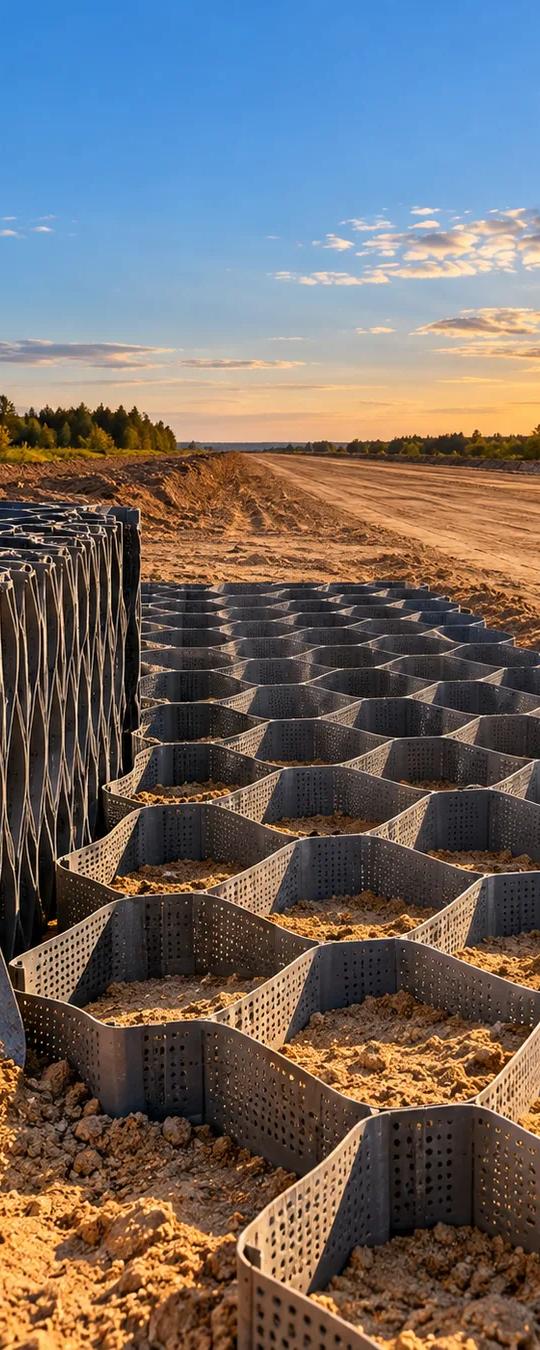
The other fix is to replace the subgrade. The mushy dirt is dug out and hauled away, and select fill goes in, which for roads usually means high-quality, angular crushed stone mixed with finer particles that help lock everything together. That mix is called road base. The stress from a load spreads out in a cone as it reaches downward, so the base has to be thick enough that the pressure left at the bottom is low enough for the native soil to support. The weaker the subgrade, the thicker the base, sometimes many feet of it.
Why does soil fail by sliding?
Soil is a mass of loose grains, and grains resist being pushed past each other only through friction and, in clays, a slight stickiness. Engineers describe this with the Mohr-Coulomb model, in which shear strength equals cohesion plus the pressure pressing the grains together multiplied by the tangent of the friction angle. Ground fails when the shear stress along some surface reaches that strength. That surface usually curves, which is why failing ground often bulges up beside the load.
Why did the Tower of Pisa lean?
Construction of the Tower of Pisa began in 1173 on layers of soft clay and sand, and it started to lean while still under construction. Work stopped for about a century because of wars, which gave the clay time to compress and gain strength, and many engineers think that pause kept the tower from toppling. Between 1990 and 2001, engineers removed soil from beneath the high side, straightening the tower by roughly 45 centimeters.
Why does wet ground carry less load?
Water fills the spaces between grains, and when a load squeezes saturated soil faster than the water can escape, the water takes up part of the pressure. The grains then press together less, and the friction between them drops. Karl Terzaghi described this in the 1920s as the principle of effective stress. In an earthquake, saturated sand can lose its strength entirely and flow like a liquid, a process called liquefaction.
More from Practical Engineering