Korva is a scroll of the internet’s best ideas.
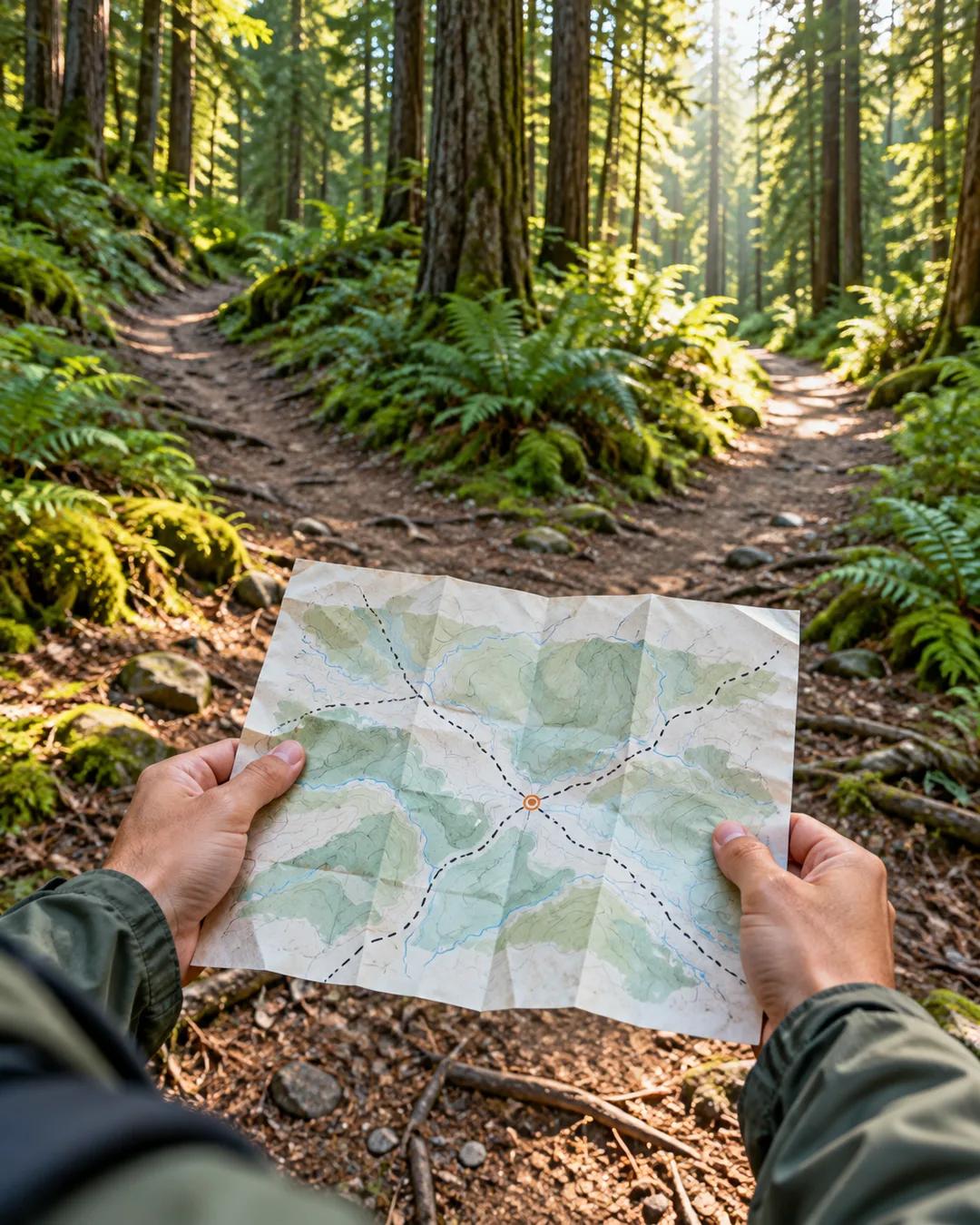
A perfect map would be useless

Why perfect maps fail
If a map represented the territory perfectly, it would no longer be a reduction, and it would no longer be useful. That is why even the best maps are imperfect. A map can also be a snapshot from a point in time, so it may represent something that no longer exists.
Maps in everyday work
People lean on maps like this every day to simplify complexity. A company's financial statements distill the complexity of thousands of transactions into something manageable. They tell nothing about whether the product is good for the customer or what is really going on inside the company.
Using a map well
A policy document on office procedure and a performance review are maps of the same kind: each simplifies a complex territory to guide a person through it. Relying solely on a map like that can lead to the wrong conclusion, and a map or mental model is useful to the extent that it is explanatory and predictive.
Has anyone imagined a map the size of its land?
Lewis Carroll did in Sylvie and Bruno Concluded, published in 1893, where a character describes a map made on the scale of a mile to the mile. Farmers objected that it would block the sunlight, so the country itself became its own map. The Argentine writer Jorge Luis Borges wrote a one-paragraph story in 1946 about an empire whose cartographers drew a map as large as the empire. In Borges's story, later generations judged the giant map useless and left it to decay in the desert.
Why does a subway map ignore geography?
Harry Beck, an engineering draftsman who worked for the London Underground, drew a new diagram of the network in 1931. He straightened the lines to vertical, horizontal, and 45-degree angles and spaced the stations evenly, ignoring true distances. Riders needed the order of stops and the connections, not the geography above ground. The Underground published his design in 1933, and transit maps around the world follow the same style.
How do statements compress thousands of transactions?
Accountants record each transaction twice, once as a debit and once as a credit, a method called double-entry bookkeeping. The totals are then grouped into three standard summaries: an income statement, a balance sheet, and a cash flow statement. Accounting standards such as US GAAP and the international IFRS set the rules for how items are grouped. The Italian mathematician Luca Pacioli described double-entry bookkeeping in a printed book in 1494.
More from Shane