Korva is a scroll of the internet’s best ideas.
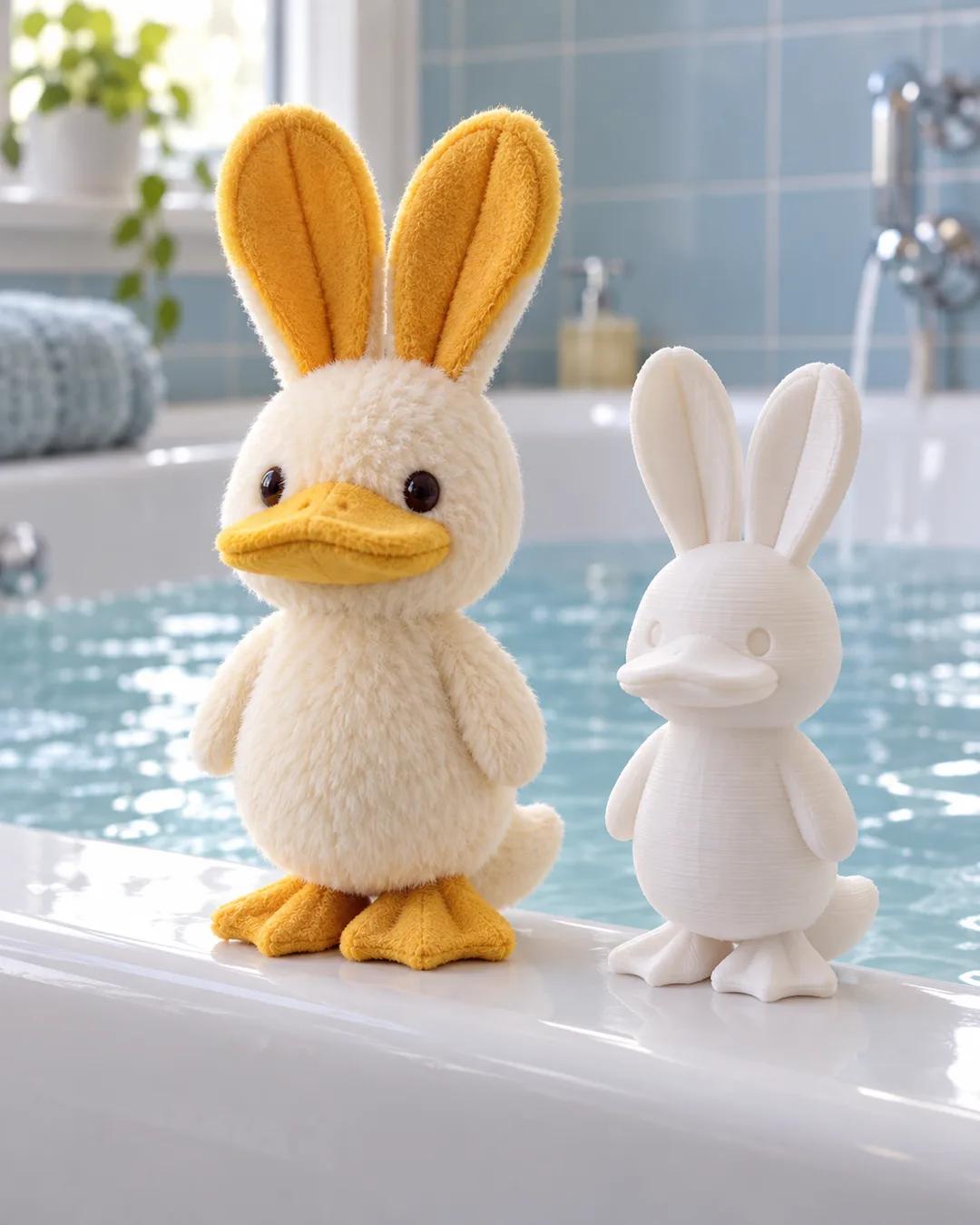
A rabbit-duck that wouldn't float
The Illusion
The rabbit-duck illusion is a drawing that reads as a duck or a rabbit depending on how you look at it. Its first known publication was around 1899, and nobody knows who came up with it. The rabbit's two ears can just as well be the two halves of a duck's bill.
From Bath Toy to Plush
The idea began as a rubber ducky for the bathtub in the shape of the illusion. Floating in both orientations never worked out, but standing up in both orientations worked fine as a stuffed animal. The bunny's tail becomes the webbed feet of the duck.
A weight that moved inside the toy might have solved the floating problem, but nobody tried it, because at a certain point the team had to make a decision, and a stuffed animal seemed likely to be more popular than a bath toy anyway. They built a 3D-printed solid prototype first, and it worked well in both positions. Prototyping took a while, and so did finding a factory that could make the stuffed animal to their specifications.
Why does the brain flip between duck and rabbit?
The drawing is a bistable figure: the same lines support two readings, and the brain can hold only one at a time. Perception switches between them every few seconds, even though nothing on the page changes. Psychologist Joseph Jastrow popularized the image in 1899, and philosopher Ludwig Wittgenstein later used it in Philosophical Investigations to discuss how people see something as one thing or another.
Why is floating both ways up so hard?
A floating object stays stable when its weight sits low relative to the center of the water's upward push, which gives most toys one preferred way to sit. A rubber duck gets this from a heavy base and a lightweight body. A toy that must float equally well upside down would need two separate stable positions, which a fixed weight cannot provide. Archimedes' principle sets the underlying rule: the upward force on a floating object equals the weight of the water it displaces.
More from The Rest Is Science