Korva is a scroll of the internet’s best ideas.
A river a mile from the palace

The river route
Linkou and Bali North beaches sit near the river's mouth, and the Port of Taipei lies between them. China is developing floating barges that act as piers for large vessels, but a permanent port would hold more cargo with less exposure to attack. A little farther on is Taoyuan International Airport, the country's largest, which could serve as an on-island airbase.
A failed landing in 1884
French marines landed on the opposite bank of the river's mouth in the Sino-French War of 1884. Their invasion failed because the plan was too easy to predict and defend against.
Rehearsing the defense
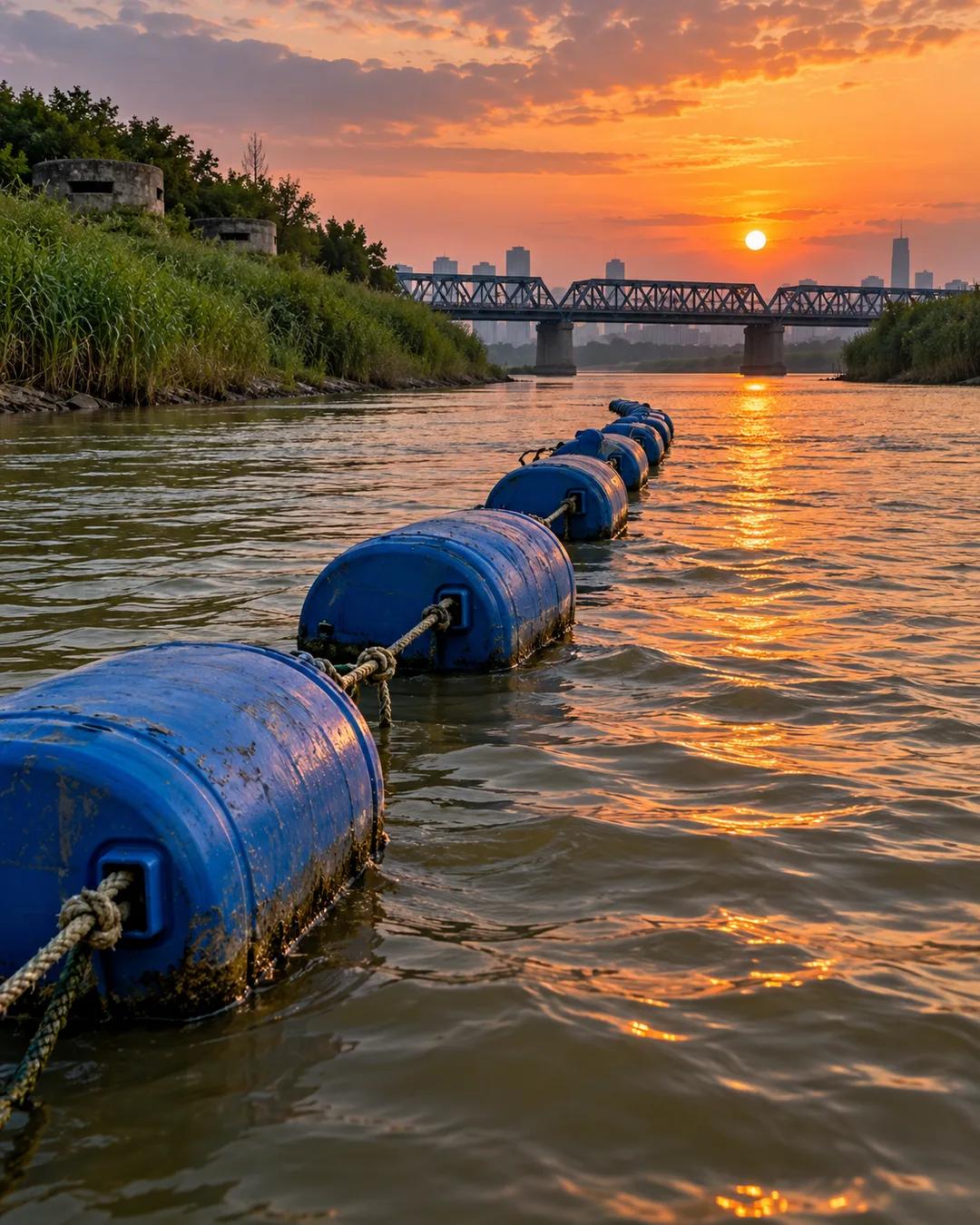
Taiwan has rehearsed nearly every phase of an invasion on these beaches. In 2022, reservists rapidly built a trench facility stocked with supplies for up to 30 days. The next year, with the president watching, one side played the Chinese military in a full amphibious landing against the other side's hardened positions. At least four exercises since have focused on the river itself, with floating gasoline barrels rigged with C4 to explode as vessels pass, and a simulated demolition of Guandu Bridge to block the route into Taipei.
The area has a 17th-century Spanish fort and Cold War pillboxes, but no permanent modern fortifications. Taiwan expects any fixed coastal defense to be destroyed by air strikes before the first boats arrive, so the beach looks like any other.
How did the French try to take Tamsui in 1884?
During the Sino-French War, French marines under Admiral Amedee Courbet landed near Tamsui in October 1884. Qing troops led by Liu Mingchuan met them on the approaches and forced them back to their ships. The French then switched to a naval blockade of northern Taiwan and held Keelung until June 1885, when the war ended.
How do floating piers replace a captured port?
Large ships need deep water and cranes to unload, and a landing force cannot count on capturing an intact port. At Normandy, the Allies towed prefabricated concrete caissons across the English Channel and sank them to form artificial harbors called Mulberries. A floating pier works on the same principle, linking ships to the shore with a roadway that rises and falls with the water. The Allies did not capture a major port until Cherbourg fell in late June 1944.
Why bomb fixed coastal defenses first?
A fixed position cannot move, so its coordinates can be mapped in advance and struck with precision weapons. In the weeks before D-Day, Allied air forces bombed coastal batteries, radar sites, and rail lines across northern France to blind and isolate the German defenders.
More from Wendover Productions