Korva is a scroll of the internet’s best ideas.
AI protein predictions need a wet lab

Predictions need proof
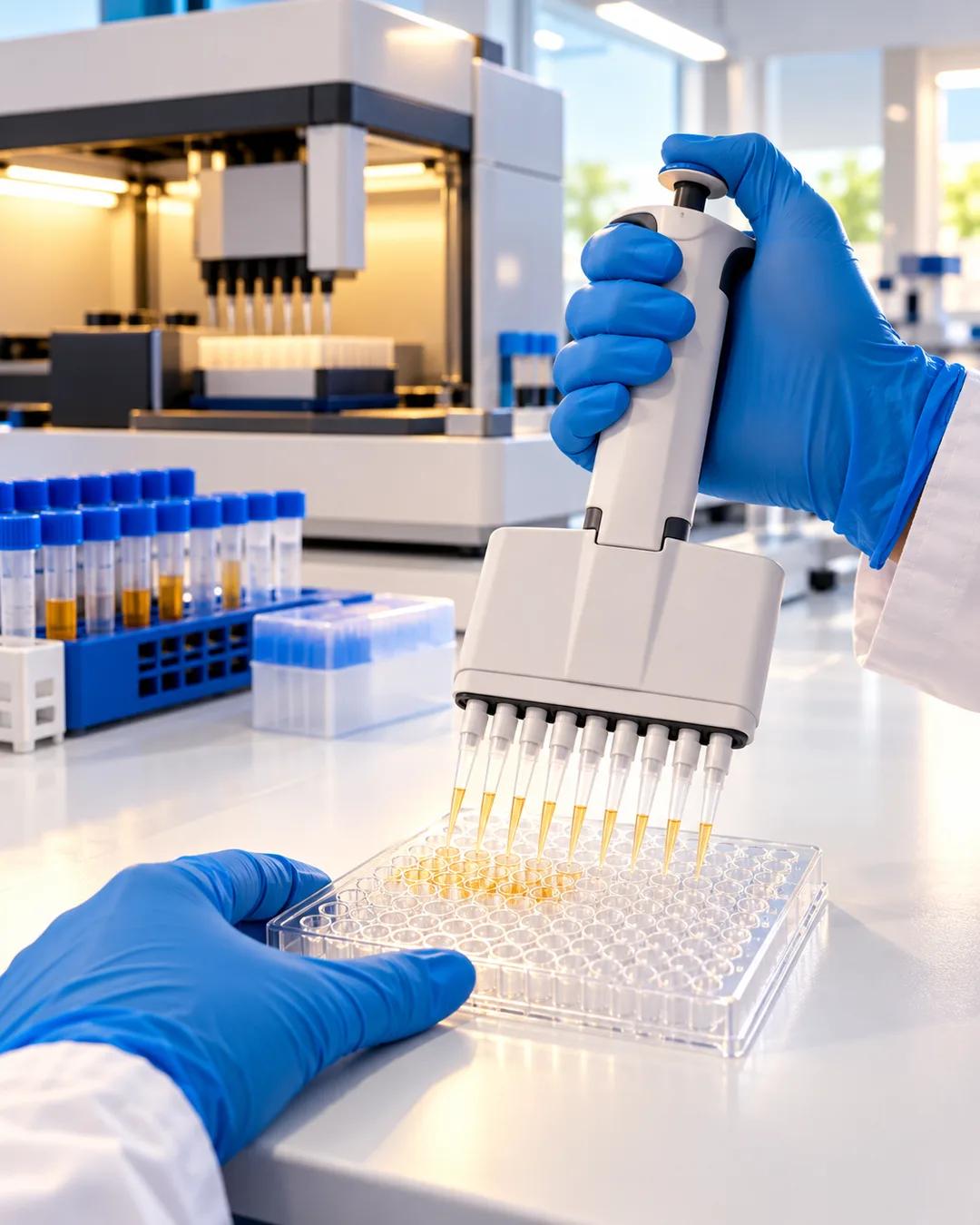
AlphaFold showed the pattern. It predicted a protein's three-dimensional structure from the DNA sequence that codes for it, and proving the prediction meant making the protein and checking that it looked the way it was predicted to look. Predicting function follows the same loop. An enzyme, which is a type of protein, might be wanted to degrade a certain molecule, such as a therapeutic target or something in the body that should be cleared. Software proposes candidates, and the lab tests whether each one does what was predicted.
Inside the wet lab
Most of the work in such a lab is taking DNA, putting it into a bacterium to make a protein, and measuring what that protein does. Protein discovery is the baseline of antibody discovery, which is the majority of the therapeutics industry today. The lab Anthropic set up in San Francisco works at biosafety levels 1 and 2, in bench-top spaces where automation reduces the cost and increases the throughput of testing. These labs do not make viruses or pathogens, and the Bay Area has hundreds of them.
Claude finds new enzymes
Anthropic's recent preprint shows the software side. Claude agents were sent through large amounts of DNA data to find novel enzymes that nobody had characterized before. The system found what looks like a CRISPR-type enzyme, the kind of tool used for gene editing to repair genetic defects, and the discovery may actually yield a number of therapeutic pathways.
How did AlphaFold learn to predict structures?
AlphaFold was built by Google DeepMind and trained on experimentally solved structures held in the Protein Data Bank. It learned patterns linking the order of amino acids to the three-dimensional shape the chain folds into. At the 2020 CASP14 competition, a biennial contest for structure prediction, its second version reached accuracy close to experimental methods for many proteins. Demis Hassabis and John Jumper of DeepMind shared the 2024 Nobel Prize in Chemistry with David Baker, who was honored for computational protein design.
Why does a protein's shape decide its job?
An enzyme works because its folded shape forms a pocket that fits a specific molecule and holds it in position for a reaction. Change a few amino acids in the right place and the pocket changes, and so does what the enzyme can do. In the 1960s, Christian Anfinsen showed with the enzyme ribonuclease that the amino acid sequence alone determines the fold. He received a share of the 1972 Nobel Prize in Chemistry for that work.
How does a CRISPR enzyme edit genes?
The best-known one, Cas9, is guided by a short RNA molecule that matches a target stretch of DNA. When the guide finds its match, the enzyme cuts both strands at that spot. The cell's own repair machinery then fixes the break, which lets researchers disable a gene or insert a new sequence. Jennifer Doudna and Emmanuelle Charpentier described the programmable system in a 2012 paper in Science and won the 2020 Nobel Prize in Chemistry.
More from All-In with Chamath, Jason, Sacks & Friedberg