Korva is a scroll of the internet’s best ideas.
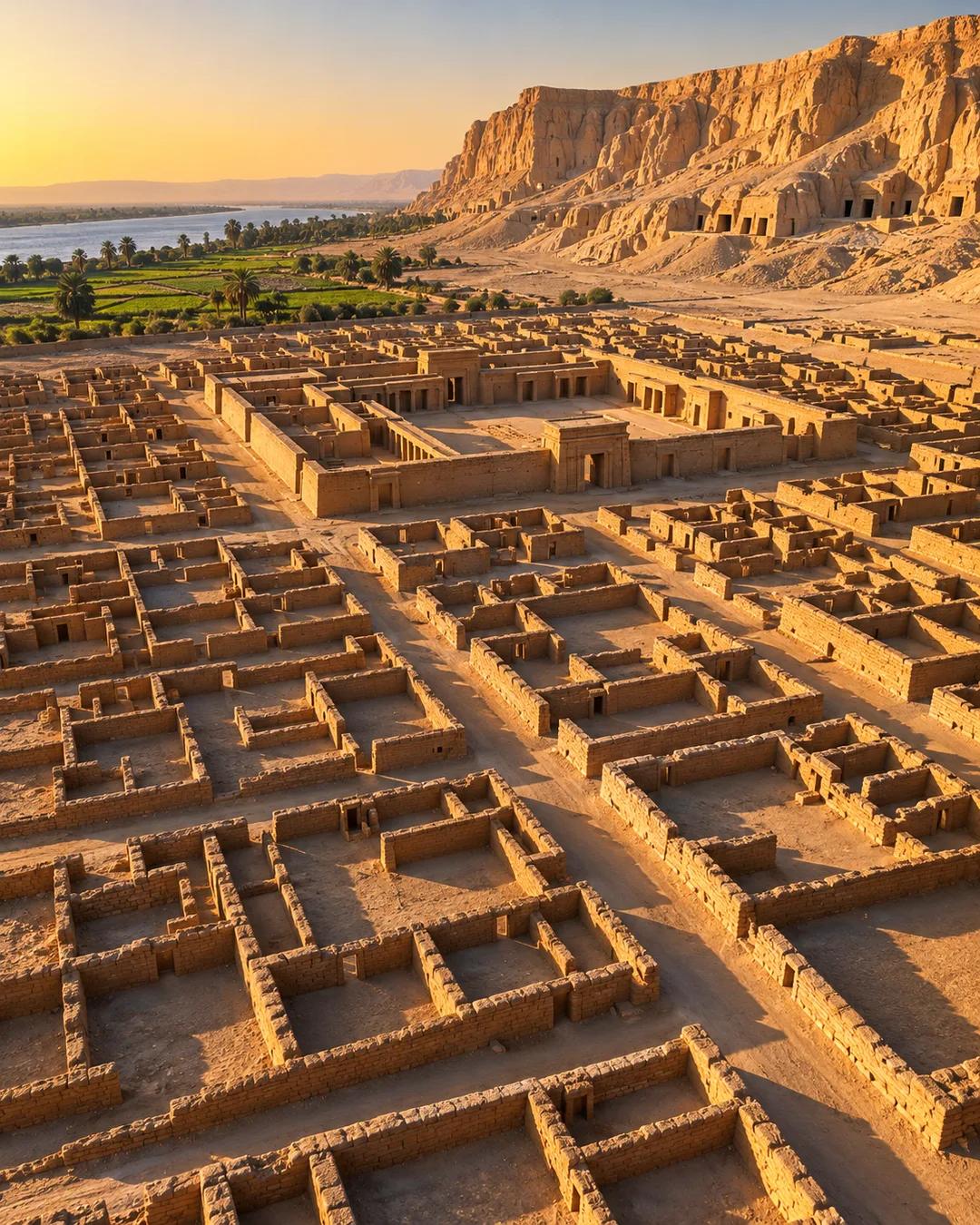
Akhenaten's city built in one go

A Capital From Nothing
That city was Amarna, built for the heretic pharaoh Akhenaten, who ruled there with his wife Nefertiti for not much more than 10 years. He moved 30 to 50,000 people to a stretch of the Nile in middle Egypt, far from the main cult centers and the transport routes toward the delta, with few resources and apparently little water. He wanted a break with everything that had gone before, so he sought out a virgin site.
Inscriptions record Akhenaten announcing the plan, and the ruins show he carried it out in an incredibly short time. Houses for every social class up to royal palaces, temples, administrative buildings, craftsmen's workshops, a network of roads across the desert, and a royal cemetery were all planned in a single phase.
Abandoned Whole
Soon after his death, Akhenaten was treated as a heretic and the whole project as taboo, so the city was abandoned so thoroughly that nobody seemed allowed to return. Most ancient sites stack layer on layer of occupation. Amarna has just one, and it survived incredibly well.
Wilkinson's Discovery
No source available to early Egyptologists mentioned Akhenaten or his capital. In the 1820s, John Gardner Wilkinson was shown the rock-cut tombs at the city's eastern edge and found hieroglyphs paired with strikingly different art, and scenes centered on a figure who looked like a pharaoh but had no royal name. On rare occasions the name survived, and it was Akhenaten's.
Why did Akhenaten abandon Egypt's old gods?
Akhenaten made the Aten, the disk of the sun, the center of worship and turned away from the traditional cults, especially that of the god Amun. Artists showed the Aten as a disk whose rays end in small hands reaching down to the royal family. He named his new capital Akhetaten, meaning Horizon of the Aten. The modern name Amarna comes from the Beni Amrane, a tribe that settled in the area much later.
How do we know where the city's edges were?
Boundary stelae carved into the cliffs around the plain mark the limits of Akhetaten, and more than a dozen of them are known. Their inscriptions record the king's declaration that the site belonged to the Aten and that he would found his city there. They also record his vow not to extend the city beyond those markers. The stelae still stand on both sides of the Nile.
Why was Amarna's archive written in cuneiform?
In 1887, local farmers found a cache of clay tablets at Amarna, now known as the Amarna Letters. They are diplomatic correspondence in Akkadian cuneiform, which served as the common language of international diplomacy across the Late Bronze Age Near East. The senders included kings of Babylon, Mitanni, and the Hittites, along with rulers of Canaanite city-states. Many are addressed to Akhenaten or to his father, Amenhotep III.
More from The Ancients
