Korva is a scroll of the internet’s best ideas.
Almost no grandmaster starts after 30
The chess numbers
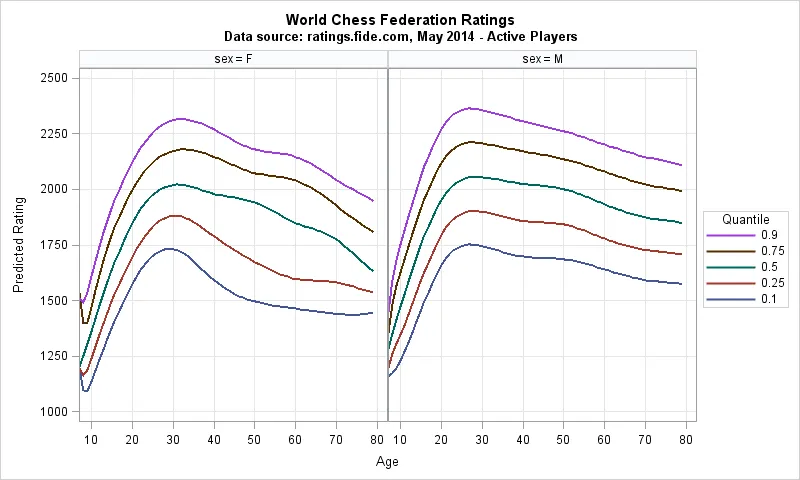
Great people achieve great things young because they are great, and they do it despite a suboptimal environment. A measurable cognitive decline sets in once someone is firmly into middle age, and the chess numbers show it. They also get used to put a time barrier between a person and their potential, as if a choice had to be made correctly before 40.
Talent and want
Two things undercut that picture. The person was never good enough to become a grandmaster, and never really wanted to be one. The same holds for any achievement once thought desired and denied by a cruel life.
The sandbox myth
The sting comes from treating life like a sandbox RPG with infinite choices, where anyone could have been a grandmaster by trying hard enough. That is new-age magical thinking, and it clouds real desire, which arises out of the interaction between reality, self-awareness, and inherent limitations.
Why does chess skill fade with age?
Chess strength leans on working memory and processing speed, which are among the abilities that research on fluid intelligence shows begin declining in adulthood. Studies of tournament players, including a 2007 paper by Thomas Roring and Neil Charness in Psychology and Aging, found that ratings climb to a peak and then decline gradually. Knowledge of patterns built over years of play partly offsets the loss, which is why the slide is gradual and not abrupt.
Why do grandmasters usually start as children?
Reaching master level takes thousands of hours of serious study. A 2007 study by Fernand Gobet and Guillermo Campitelli found that players needed anywhere from about 3,000 to 23,000 hours to get there. The hours add up faster for someone who begins in childhood and trains daily. Abhimanyu Mishra became a grandmaster in 2021 at 12 years, 4 months, and 25 days old, the youngest ever.
How did the grandmaster title originate?
The term circulated in the chess press around the 1914 St. Petersburg tournament, where it was applied to the leading players of the day. The international chess federation, FIDE, formalized the title in 1950 and named 27 original grandmasters. Later the federation tied the title to rating thresholds and results against other titled players.
More from Hyde