Korva is a scroll of the internet’s best ideas.

Back the founder, not the product
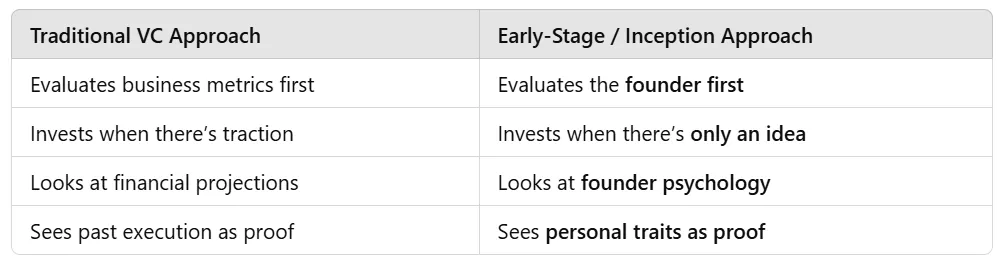
At the inception stage there is no well-oiled machine to evaluate. There is a person or a small team that may not yet have proof of execution, and the question is whether that person can build a billion-dollar company.
Market size, product, competitive advantage, and traction all matter, yet each one gets rewritten along the way. What carries a company through those rewrites is the person running it, so inception-stage investors assess a founder's psychology more than their industry knowledge or product vision.
Founders in the early days tend to sound naive about their business. Most struggle to be succinct, overcomplicate the story and the product, and are quite delusional about how easy or hard it will be. So the questions an investor asks are a way to learn from the founder's whole output, looking beyond the words to the details, the emotions, and the actions.
How often do startups change what they build?
Changing direction is common enough to have its own name, the pivot, which Eric Ries popularized in his 2011 book The Lean Startup. Instagram began as Burbn, a location check-in app, and its founders kept only the photo-sharing feature. Slack grew out of a game called Glitch, which its team shut down in 2012 after building an internal messaging tool along the way. In both cases the original product was dropped while the founding team stayed.
Why do founders overcomplicate their own pitch?
Psychologists call it the curse of knowledge: once you know something well, it is hard to imagine not knowing it. In a 1990 Stanford experiment by Elizabeth Newton, people tapped out the rhythm of a well-known song while listeners tried to name it. The tappers predicted listeners would get it right about half the time. Listeners guessed correctly in only 3 of 120 tries.
More from Jeff Becker