
68 insights saved from Jeff Becker's work by @business
- Productive founders favor action over theory because rapid, pragmatic steps generate real feedback and data that enable faster, better-informed iterations than prolonged analysis.
Productive founders favor action over theory because rapid, pragmatic steps generate real feedback and data that enable faster, better-informed iterations than prolonged analysis.
- Extreme, even narcissistic, confidence can help founders because believing you’re destined and capable fuels audacious goals, risk-taking, and the conviction to pursue world-changing work.
Extreme, even narcissistic, confidence can help founders because believing you’re destined and capable fuels audacious goals, risk-taking, and the conviction to pursue world-changing work.

- The revival of analog hobbies is a corrective to digital deficiency because tactile, bounded activities provide presence and focused attention that algorithmic feeds fail to nourish, so people seek them to recover real-world engagement.
The revival of analog hobbies is a corrective to digital deficiency because tactile, bounded activities provide presence and focused attention that algorithmic feeds fail to nourish, so people seek them to recover real-world engagement.
- Text-based communication fails to create human bonding because oxytocin release depends on physical cues—touch, eye contact, voice and sustained face-to-face signals—that text lacks, so written exchanges trigger bonding responses similar to no contact.
Text-based communication fails to create human bonding because oxytocin release depends on physical cues—touch, eye contact, voice and sustained face-to-face signals—that text lacks, so written exchanges trigger bonding responses similar to no contact.

- An unapologetic culture creates compounding advantages because talent attracts talent, repeated high-expectation execution reinforces performance, and aligned incentives multiply access to better deals and outcomes.
An unapologetic culture creates compounding advantages because talent attracts talent, repeated high-expectation execution reinforces performance, and aligned incentives multiply access to better deals and outcomes.
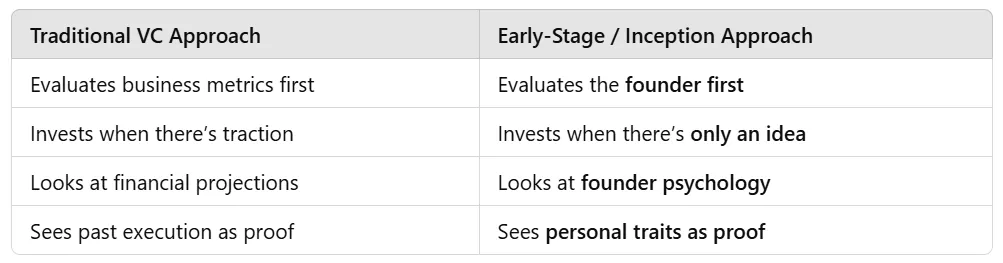
- Early-stage VC hit rates fall partly because pattern-matching to average founder profiles causes investors to underweight atypical outliers that become the biggest winners.
Early-stage VC hit rates fall partly because pattern-matching to average founder profiles causes investors to underweight atypical outliers that become the biggest winners.

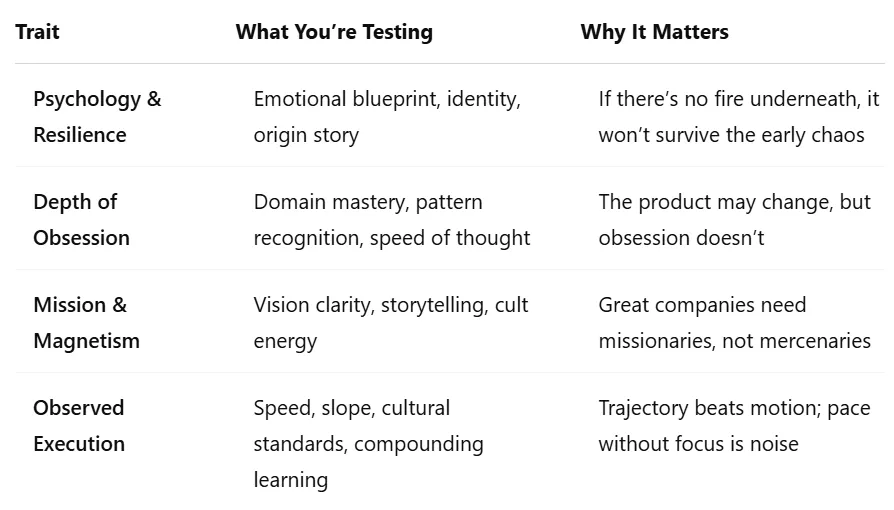
- A four-part framework—emotional wiring, intellectual depth, mission pull, and observed execution—lets you identify generational founders before they have traction because conversational tests of the first three combined with observed behavior compress thousands of signals into a repeatable talent signal.
A four-part framework—emotional wiring, intellectual depth, mission pull, and observed execution—lets you identify generational founders before they have traction because conversational tests of the first three combined with observed behavior compress thousands of signals into a repeatable talent signal.
- Asking "Why will the 20th person join you?" tests a founder's ability to attract early talent because early hires often accept worse pay and only a founder who can transmit conviction and mission pull—not compensation—will persuade them.
Asking "Why will the 20th person join you?" tests a founder's ability to attract early talent because early hires often accept worse pay and only a founder who can transmit conviction and mission pull—not compensation—will persuade them.

- A founder's willingness to outwork everyone else matters because startups demand obsessive, sustained effort and attention to detail, and those extra hours compound into survival and progress.
A founder's willingness to outwork everyone else matters because startups demand obsessive, sustained effort and attention to detail, and those extra hours compound into survival and progress.
- Founders who are emotionally attached to their original idea tend to fail because that attachment makes them resist pivots and necessary adaptations the company needs to survive.
Founders who are emotionally attached to their original idea tend to fail because that attachment makes them resist pivots and necessary adaptations the company needs to survive.

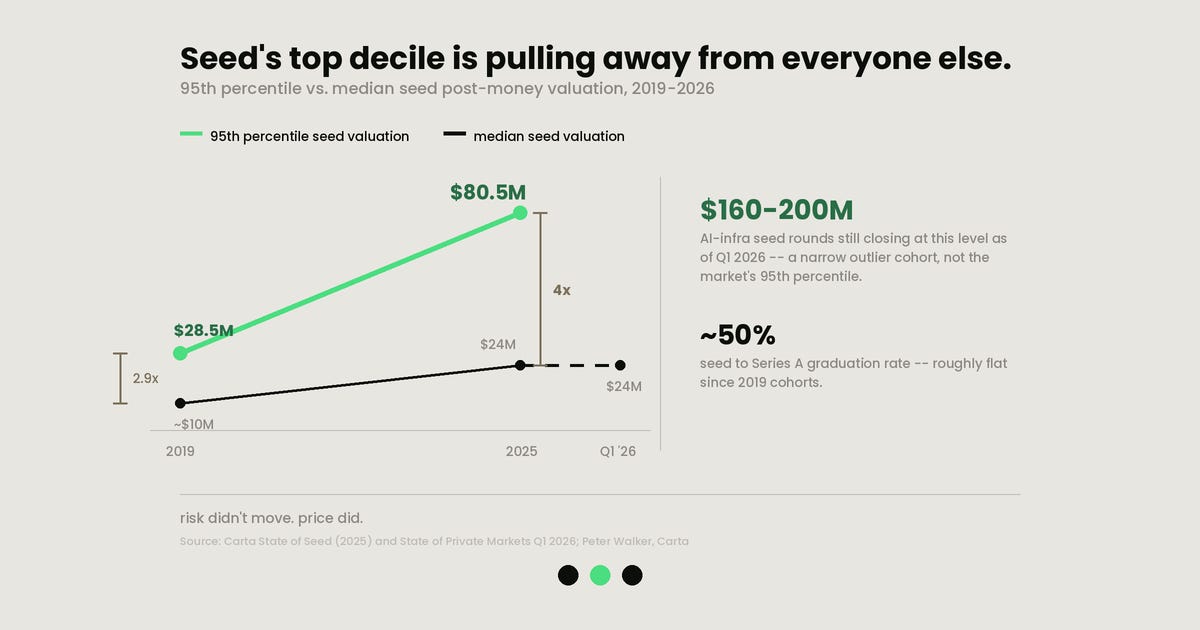
- Aiming for outlier returns is a portfolio-level decision because funds can take many concentrated shots to capture rare winners, whereas an individual founder pricing their round at the top is trading realistic performance expectations for a headline valuation without that diversification.
Aiming for outlier returns is a portfolio-level decision because funds can take many concentrated shots to capture rare winners, whereas an individual founder pricing their round at the top is trading realistic performance expectations for a headline valuation without that diversification.
- Broader market data show capital and fund size concentrating at the top while LPs trim venture allocations and pensions report stronger DPI in public markets, which suggests scale and high headline valuations have not reliably translated into superior realized returns.
Broader market data show capital and fund size concentrating at the top while LPs trim venture allocations and pensions report stronger DPI in public markets, which suggests scale and high headline valuations have not reliably translated into superior realized returns.

- Many startups fail to become unicorns because low standards across talent, attention to detail, work ethic, speed, communication, and culture reduce value creation and differentiation, which undermines their ability to scale and compete.
Many startups fail to become unicorns because low standards across talent, attention to detail, work ethic, speed, communication, and culture reduce value creation and differentiation, which undermines their ability to scale and compete.
- Steve Jobs and Apple raised market expectations because their clearly distinctive, exceptional products shifted customer standards upward, which forced competitors to aim higher or be left behind.
Steve Jobs and Apple raised market expectations because their clearly distinctive, exceptional products shifted customer standards upward, which forced competitors to aim higher or be left behind.
Keep the best of Jeff Becker
A free account saves these cards to your Collection, and Korva resurfaces them so you actually remember.