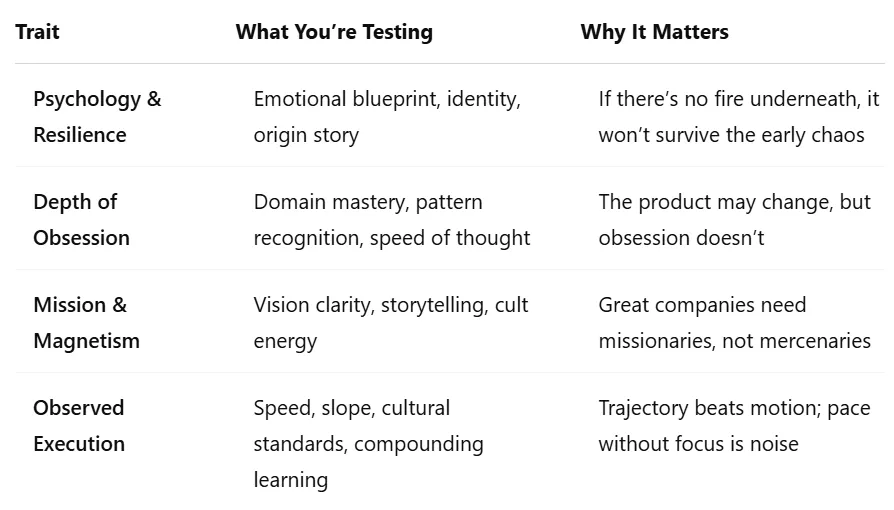
- A four-part framework—emotional wiring, intellectual depth, mission pull, and observed execution—lets you identify generational founders before they have traction because conversational tests of the first three combined with observed behavior compress thousands of signals into a repeatable talent signal.
@business· How VCs ThinkA four-part framework—emotional wiring, intellectual depth, mission pull, and observed execution—lets you identify generational founders before they have traction because conversational tests of the first three combined with observed behavior compress thousands of signals into a repeatable talent signal.
- Asking "What would your family say about you?" reveals a founder's emotional source code because the Trojan Horse phrasing prompts personal stories about identity, early agency, competition, and hardship that expose motivations and resilience hidden by resumes.
@business· How VCs ThinkAsking "What would your family say about you?" reveals a founder's emotional source code because the Trojan Horse phrasing prompts personal stories about identity, early agency, competition, and hardship that expose motivations and resilience hidden by resumes.
- Asking "Why will the 20th person join you?" tests a founder's ability to attract early talent because early hires often accept worse pay and only a founder who can transmit conviction and mission pull—not compensation—will persuade them.
@business· How VCs ThinkAsking "Why will the 20th person join you?" tests a founder's ability to attract early talent because early hires often accept worse pay and only a founder who can transmit conviction and mission pull—not compensation—will persuade them.
- Drilling with progressively specific questions reveals whether a founder truly obsesses over their domain because obsession appears as layered, concrete insights and fluency in the hard parts, and pushing for finer detail forces candidates to show real work instead of rehearsed platitudes.
@business· How VCs ThinkDrilling with progressively specific questions reveals whether a founder truly obsesses over their domain because obsession appears as layered, concrete insights and fluency in the hard parts, and pushing for finer detail forces candidates to show real work instead of rehearsed platitudes.
- Execution is multi-dimensional—speed, focused decision-making, rapid feedback loops, and cultural imprint—and because those behaviors compound through fast iteration and prioritization they produce accelerating improvement and influence that attract people and resources.
@business· How VCs ThinkExecution is multi-dimensional—speed, focused decision-making, rapid feedback loops, and cultural imprint—and because those behaviors compound through fast iteration and prioritization they produce accelerating improvement and influence that attract people and resources.
- Interviews can surface traits, but founders prove them through behavior because only sustained, observable actions validate claims—behavior is the proof that links potential to capacity.
@business· How VCs ThinkInterviews can surface traits, but founders prove them through behavior because only sustained, observable actions validate claims—behavior is the proof that links potential to capacity.
- Polish can be faked, but consistent execution exposes 'maniac' founders because surface presentation and rehearsed answers mask substance, while sustained shipping, iteration, and measurable improvement are hard to fake.
@business· How VCs ThinkPolish can be faked, but consistent execution exposes 'maniac' founders because surface presentation and rehearsed answers mask substance, while sustained shipping, iteration, and measurable improvement are hard to fake.
- Prioritize trajectory—velocity in a direction—over raw speed because consistent direction, prioritization, and week‑over‑week improvement compound into sustainable progress, whereas activity without direction doesn't produce leadership outcomes.
@business· How VCs ThinkPrioritize trajectory—velocity in a direction—over raw speed because consistent direction, prioritization, and week‑over‑week improvement compound into sustainable progress, whereas activity without direction doesn't produce leadership outcomes.
1 more insight from this article in the app
Every card on Korva is an insight someone saved from a podcast or video they loved.