Korva is a scroll of the internet’s best ideas.
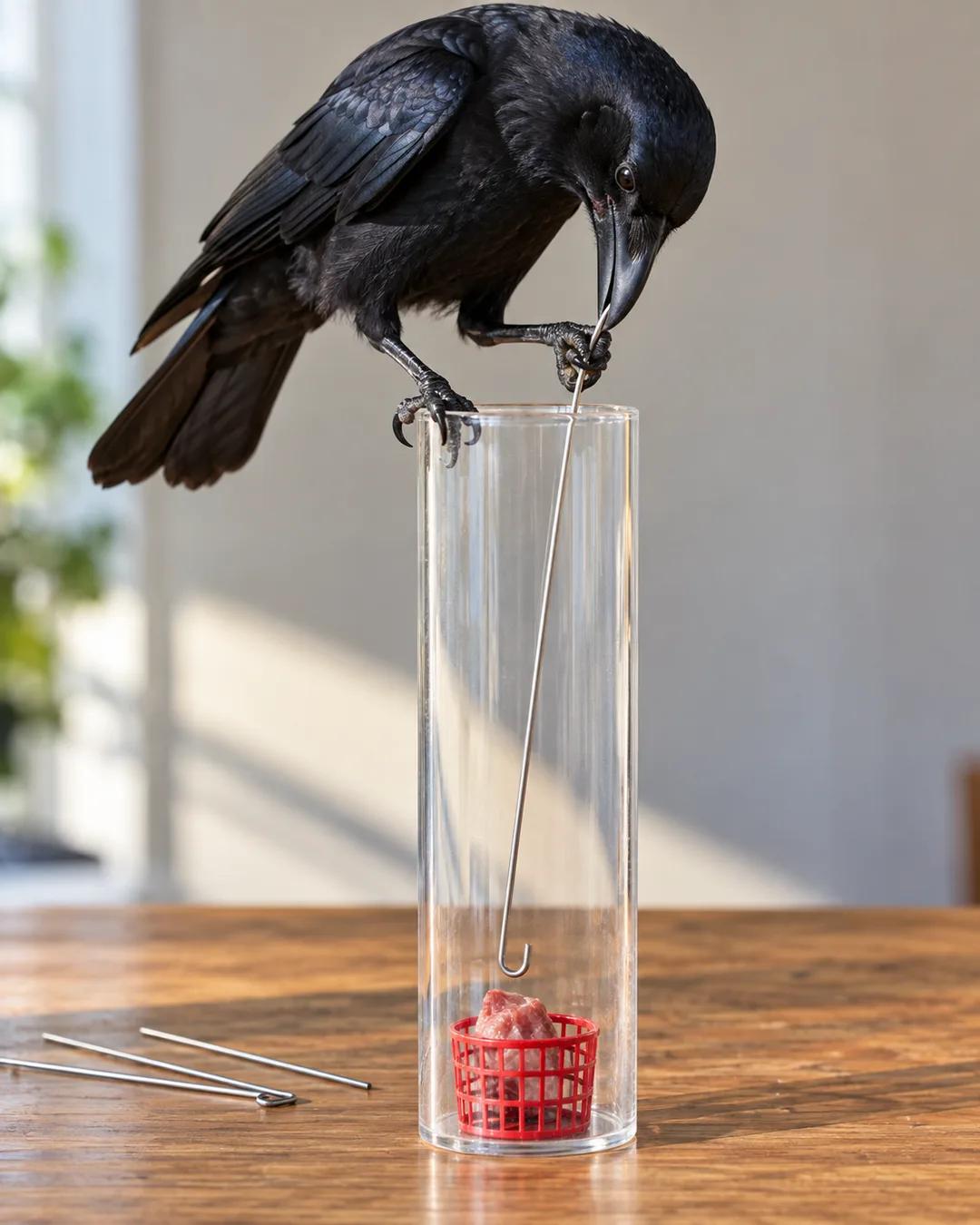
Betty the crow solved the wire

New Caledonian crows live on islands with no woodpeckers, so plenty of food hides under bark and in soil. In the wild they make tools from leaf stems and sticks to skewer the bugs. A straight piece of wire is not something Betty would ever find at home.
In the Oxford experiment, she first used the wire the way she would use a stick on bark, probing and pushing and hoping friction would drag the basket up the tube. Friction did nothing. After that, she came up with a different solution and got the food.
Making a tool is routine for these crows. What stands out is that she seems to have a plan: try this, and if that fails, move on to the next step in the sequence. Using insight to understand a problem and solve it is not something animals, and certainly not birds, were once thought to do.
How do New Caledonian crows make their tools?
In the wild they snap twigs and trim them into hooks, and they tear strips from the edges of stiff pandanus leaves to make barbed probes. Each tool is shaped for pulling larvae from holes in wood. Researchers have found that the crows carry their best tools between feeding sites, and young birds learn the techniques by watching adults. Different regions of New Caledonia have slightly different tool designs.
What did Betty do with the wire?
The Oxford study was published in the journal Science in 2002 by Alex Weir, Jackie Chappell, and Alex Kacelnik. Betty bent the straight wire into a hook against the edge of the apparatus and used it to lift the basket by its handle. She had not been trained to bend wire. A second experiment by the same team showed that she made hooks again on later trials, working out the shape each time.
How do scientists test whether animals plan ahead?
One classic test, by Nicola Clayton and colleagues at Cambridge, used Western scrub-jays that were kept in rooms with and without breakfast. The birds later cached food in the room where they had gone hungry before, which suggested they were planning for a future need. Researchers use this kind of design to rule out simple habit. Similar tests have been tried on ravens, apes, and young children.
More from TEDx Talks