Korva is a scroll of the internet’s best ideas.
Body fat ranks last on DEXA

How DEXA works
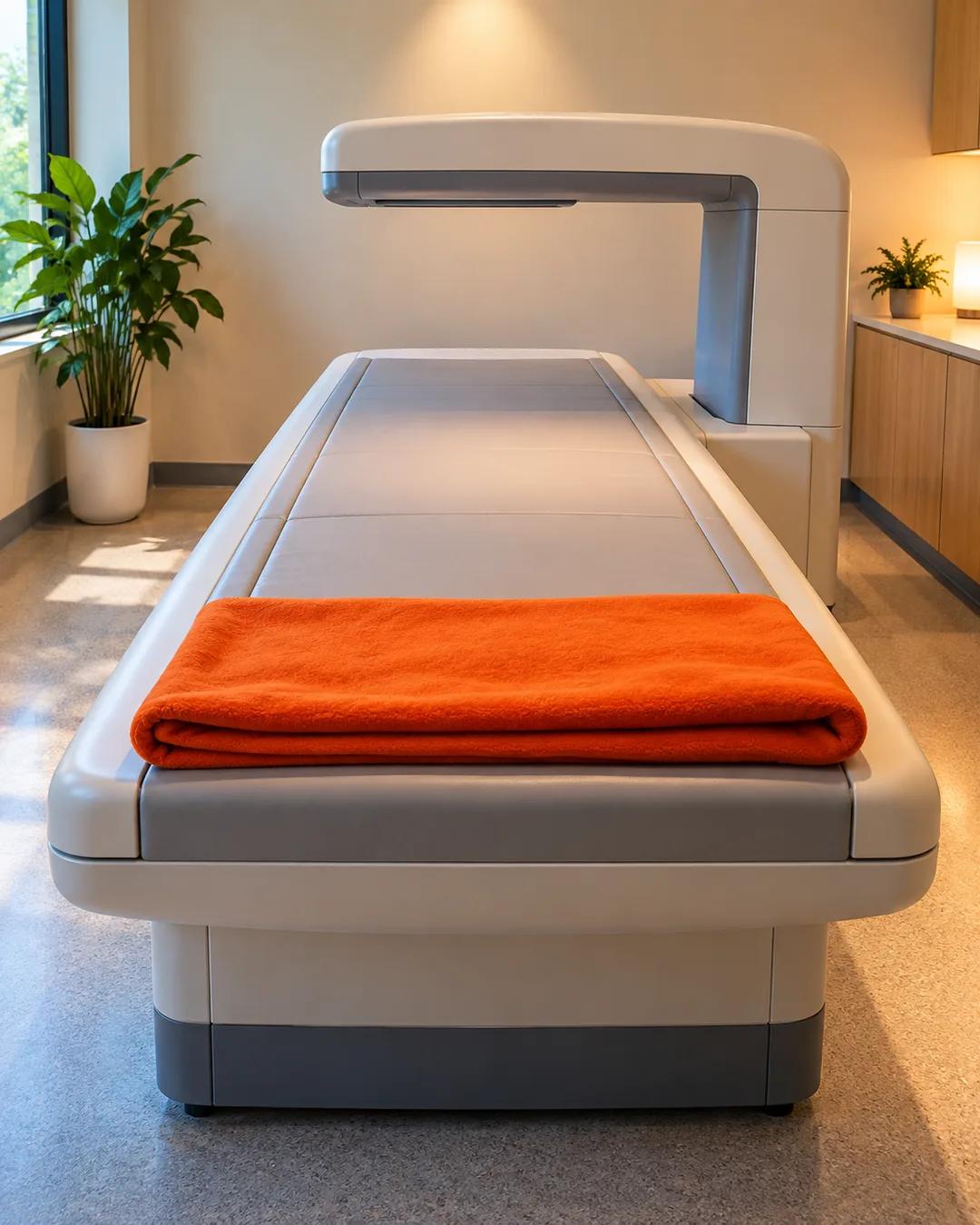
A DEXA scan is a very low power x-ray that moves over the body for about 10 minutes. The denser the material, the less of the beam passes through, which lets the scan separate bone mineral content, fat, and everything else, counted as lean body mass: organs, muscle, and the rest.
What matters more than fat
It produces a far better estimate of body fat than calipers or buoyancy testing when the machine is calibrated and the operator is skilled, and it is the gold standard outside of MRI, which is used for research. Even so, body fat ranks fourth. Bone mineral density, visceral fat, and the metrics behind appendicular lean mass index and fat-free mass index all matter more.
Bone density scores
Bone mineral density speaks to the risk of osteopenia and osteoporosis, and it comes as a Z-score that places a person against others of the same age and sex. Zero is the 50th percentile, and each step is one standard deviation above or below. A T-score compares the person with a young adult and is the one technically used to diagnose osteopenia or osteoporosis.
How does DEXA separate fat from muscle?
A DEXA scanner sends x-rays at two different energy levels. Bone, fat, and lean tissue absorb the two energies in different ratios, which lets the software work out how much of each lies in the path of the beam. Commercial dual-energy scanners arrived in the late 1980s, building on earlier single-photon absorptiometry. A whole-body scan delivers a radiation dose far below that of a chest x-ray.
Why does visceral fat carry more risk?
Visceral fat sits around the organs and drains into the portal vein, delivering fatty acids and inflammatory signals straight to the liver. A 2007 Framingham Heart Study analysis led by Caroline Fox in Circulation used CT to measure fat depots. It found visceral fat more strongly associated with metabolic risk factors than subcutaneous fat.
Why do T-scores and Z-scores both exist?
The World Health Organization defined osteoporosis in 1994 as a bone density 2.5 standard deviations or more below the average of healthy young adults, which is the T-score. That comparison to a young reference group suits fracture risk in older postmenopausal women. A Z-score compares against people of the same age and sex, and it is the one used for children and younger adults.
More from Andrew Huberman