Korva is a scroll of the internet’s best ideas.
Bread older than farming

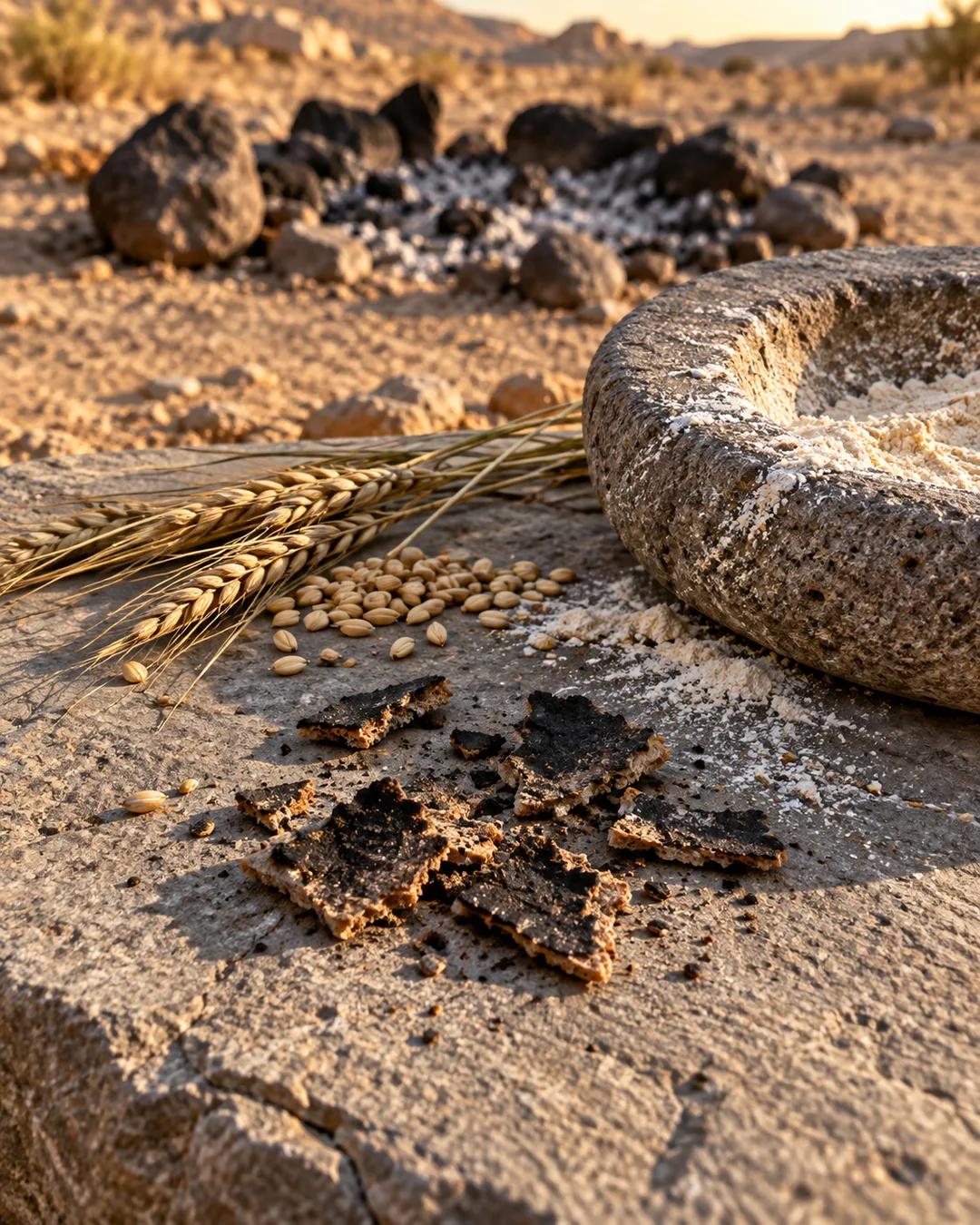
The pieces were tiny, black, and burned almost beyond recognition, and at first glance they looked like very little. Under a microscope, they turned out to be flatbread.
With no planned wheat fields yet, no flour mill, and no bakery, bread meant going out to gather wild grains by hand, grinding them between stones into flour, mixing the flour with water, shaping it, and cooking it over a fire. People put in all that work because they judged bread to be real sustenance, enough to be worth the effort.
How did hunters make bread without farms?
The bread came from the Natufians, hunter-gatherers who lived in the Levant before agriculture. A 2018 study in the journal PNAS, led by Amaia Arranz-Otaegui of the University of Copenhagen, examined remains from a site called Shubayqa 1. The researchers found traces of wild cereals such as barley and einkorn, along with tubers from a plant called club-rush. Those ingredients were ground and kneaded into dough before baking.
How can scientists identify charred bread?
A scanning electron microscope reveals the cell structure of burned plant tissue. Cereal grains that were ground and baked keep a porous texture that differs from whole seeds or boiled porridge. The 2018 PNAS study used this approach to identify the fragments as flat, unleavened bread.
Did bread help push people toward farming?
The study's authors suggested that a taste for bread may have encouraged people to start cultivating cereals, since gathering wild grain by hand was laborious. Farming took hold in the Levant about 11,500 years ago, roughly 3,000 years after the Jordan bread was baked. The Natufians themselves are associated with some of the region's earliest permanent settlements.
More from Eating History