Korva is a scroll of the internet’s best ideas.
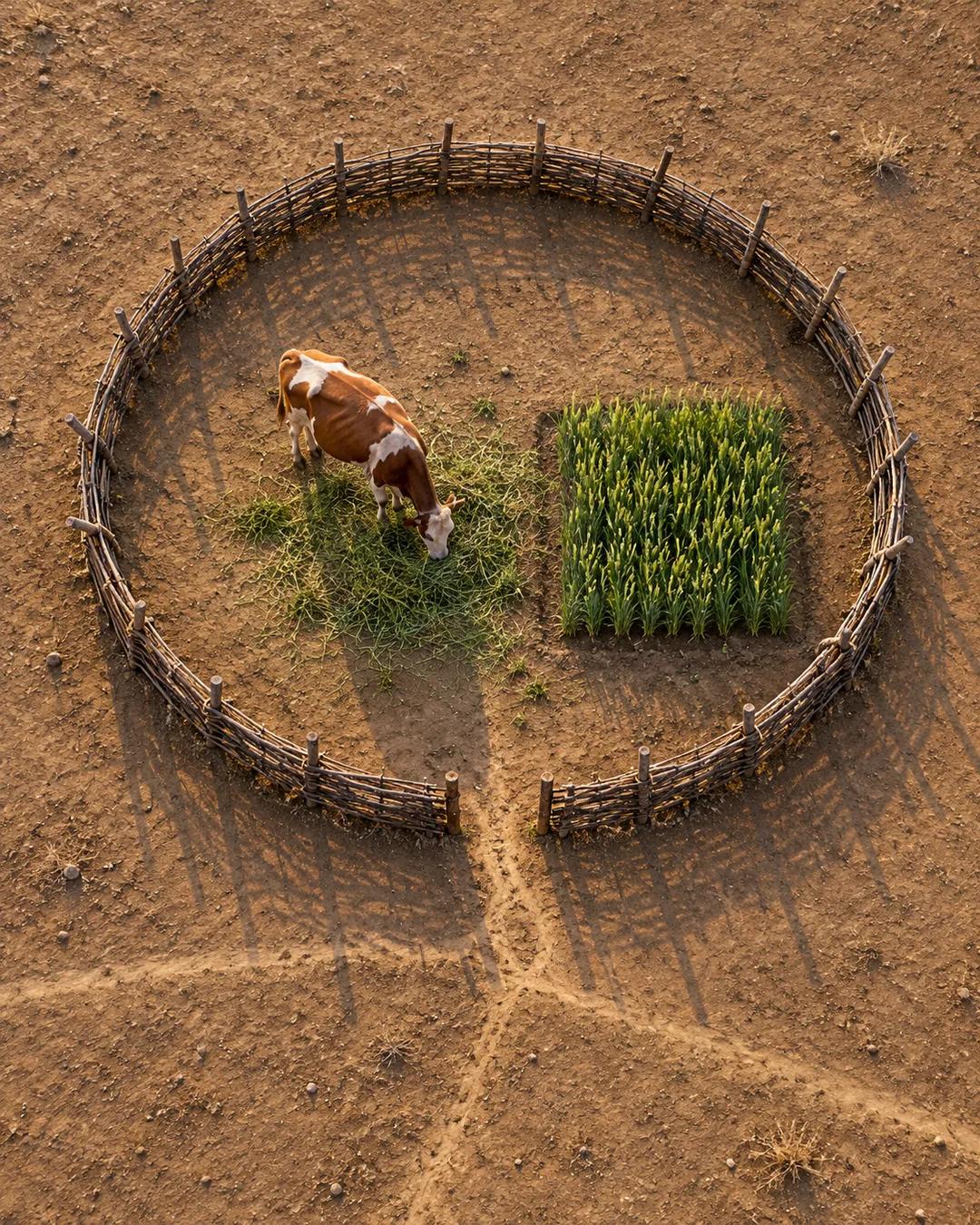
Cows work like mitochondria

Controlling reproduction
For almost all of human history, people lived as hunter-gatherers in small bands. Starting around 12,000 years ago, a minute and 20 seconds before midnight on the Earth calendar, some of them began controlling the reproduction of plants and animals. Crops and livestock ended up depending on humans to look after them.
Cells and villages
The hunter-gatherer community was like a cell, and the domesticated species moved inside its cultural boundary, dependent on their keepers the way a captured bacterium depends on its host. A cow or a sheep survives on grass and turns it into something humans can eat, a job very like a mitochondrion's. Wheat photosynthesizes inside the village the way plastids do inside a plant cell.
Farming spreads
Farmers captured far more energy from the land than hunter-gatherers had, and they displaced hunter-gatherers wherever farming began. Farming began independently several times: first in the Fertile Crescent, and also in Egypt, China, the Indus Valley, New Guinea, the Andes, and Mesoamerica, with different species in different places.
Why did farming start independently in so many places?
The last ice age ended about 11,700 years ago, and the warmer, wetter, more stable climate that followed favored wild grasses and other plants with large seeds. Hunter-gatherer groups in several regions were already harvesting these plants and had been for thousands of years. Selecting the best plants and animals gradually turned those habits into agriculture. Archaeologists have found early crop remains in the Fertile Crescent, China, New Guinea, and the Americas.
How did wheat change once people farmed it?
Wild wheat has brittle stalks that shatter when ripe and scatter the seeds on the ground. A rare mutation keeps the seeds attached to the stalk. Harvesters collected those plants disproportionately, and resowed their seeds, so the trait spread. Archaeobotanists see the shift in grain remains from the Fertile Crescent over roughly a thousand years.
Where did domestic cattle come from?
All domestic cattle descend from the aurochs, a huge wild ox once found across Europe, Asia, and North Africa. Genetic studies indicate that taurine cattle were domesticated from wild aurochs in the Near East roughly 10,500 years ago. The wild aurochs lingered long after that. The last known one died in 1627 in the Jaktorów Forest in Poland.
More from On Humans