Korva is a scroll of the internet’s best ideas.
Early cities worked like bodies

Specialization pays
In an animal, true multicellularity means different cell types do different jobs, and none of them can function independently of the body. Adam Smith described the same gain in the eighteenth century with a pin factory, where workers who each handle one step make far more pins than workers who each make a whole pin. Specialization raises output, even when the work gets dull.
Bronze Age workers
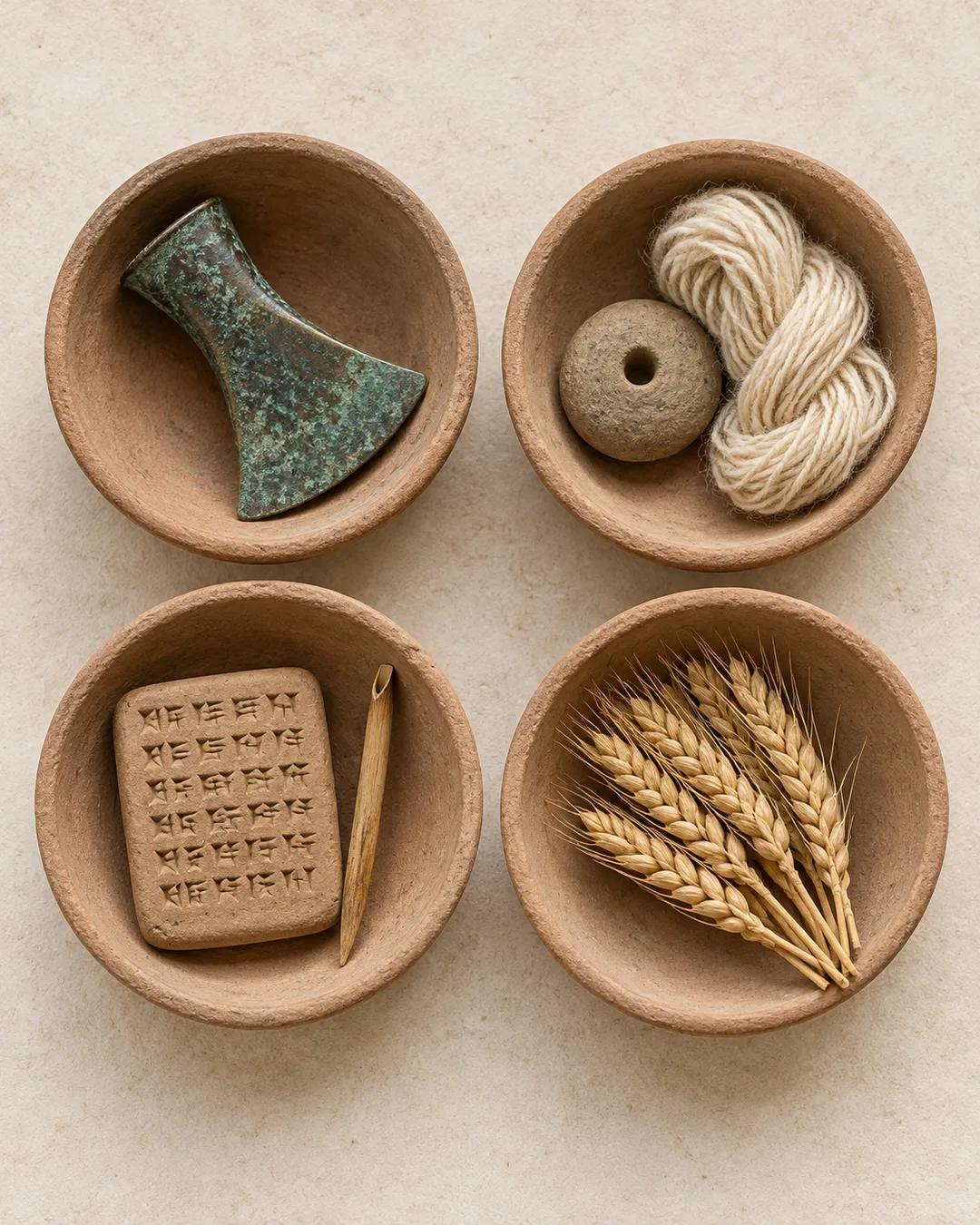
In the early Bronze Age, farming societies in the Fertile Crescent and China went through that change. Most people still farmed, but now there were metal workers making tools, weavers making cloth, administrators, soldiers, and scribes, since writing arrived soon after. Farmers no longer made their own tools or wove their own cloth, and the society as a whole worked far more efficiently.
The first state
The first state was probably Uruk, in what is now southern Iraq. Earlier cities existed, but their houses all look pretty much alike, with little sign of specialization. The pattern repeated in other Mesopotamian city-states, then in Egypt and China. These states replicated themselves, engulfed their neighbors, and went to war with them.
Why was Uruk the first city?
Uruk sat on the Euphrates in southern Mesopotamia, where irrigated fields produced large grain surpluses. By around 3200 BCE it is estimated to have held tens of thousands of people. Its temple precincts managed stores of grain, livestock, and goods. The earliest known writing tablets found there are accounting records of those goods.
What did Adam Smith's pin factory show?
Smith opened The Wealth of Nations in 1776 with the example of a pin factory. He described ten workers splitting pin-making into about eighteen separate tasks and producing upward of 48,000 pins in a day. Working alone, he wrote, one of them could hardly make twenty. He used the numbers to argue that dividing labor multiplies output.
Why did bronze require specialists?
Bronze is an alloy of copper and tin, and the two metals are rarely found together. Tin had to travel long distances, with Bronze Age trade routes carrying it from sources as far away as Central Asia and Anatolia. Casting the alloy took furnaces, molds, and skilled hands. Few families had the knowledge, the materials, and the time to do it themselves.
More from On Humans