Korva is a scroll of the internet’s best ideas.
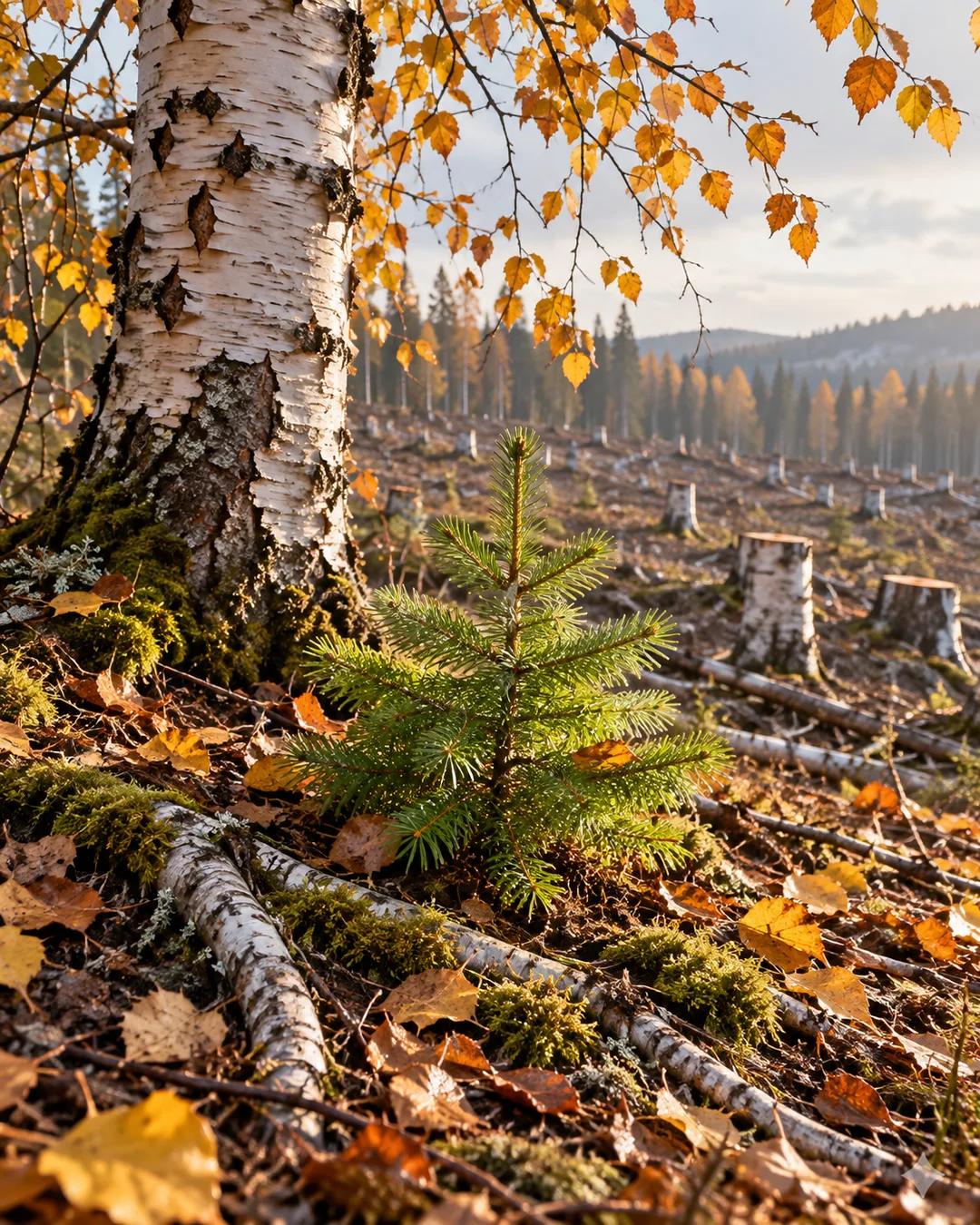
Cutting birch made firs sick

Weeding out birch
Suzanne Simard's first job out of forestry school was marking old growth trees for clearcutting, then replanting the clearings with fast-growing firs and pines. The work also meant weeding out alders, birches, and aspens, which the industry considered competitors interfering with profits. She got good at creating shiny new monocultures. Disease kept spreading through the plantations, and cutting out the birch seemed to make the fir sicker.
The fungus connection
In graduate school she read about a UK laboratory study in which seedlings colonized with a mycorrhizal fungus were joined in a web, passing carbon from one seedling to another. A mycorrhiza is literally a fungus-root: the fungus grows through the soil, collects nutrients and water for the plant, and trades them for carbon from photosynthesis. She wondered whether the fungi colonizing birch could connect with fir and protect it. In real forests, the fungi do connect trees below ground.
Birch feeds fir
Her experiments with carbon isotopes showed that when a Douglas fir is shaded in the understory, birch sends it ten percent of its carbon. That is enough for the fir to make seeds. The exchange runs both ways, with fir sending nutrients back to birch, and it increases the survival, growth, and health of the seedlings in the understory.
Why do single-species plantations get sicker?
Many tree diseases spread from root to root, so a stand of one species gives a pathogen an unbroken path. Laminated root rot, caused by the fungus Phellinus sulphurascens, attacks Douglas fir through root contact. Broadleaf trees such as birch resist that fungus, so they can interrupt the path between infected and healthy conifers. Forest pathologists in the Pacific Northwest have long recommended planting resistant hardwoods in stands with laminated root rot.
Why does birch share carbon with shaded fir?
Sugars move through a fungal network from where they are plentiful toward where they are in short supply. A shaded understory fir makes little sugar, so its demand pulls carbon along that gradient. Birch loses its leaves each autumn while Douglas fir keeps its needles all winter, so the two trees have surpluses at different times of year. Simard's 1997 study in Nature found net movement in both directions, depending on season and shading.
Why did foresters see broadleaves as competitors?
Alder, birch, and aspen grow fast and can overtop young conifer seedlings, cutting off the light they need. Conifers such as Douglas fir and pine are the main source of commercial timber in western Canada, so foresters treated the hardwoods as weeds. The standard remedy was cutting them back or applying herbicide, a practice called conifer release. Conifer release treatments have been used in plantation forestry in many regions.
More from TEDx Talks