Korva is a scroll of the internet’s best ideas.
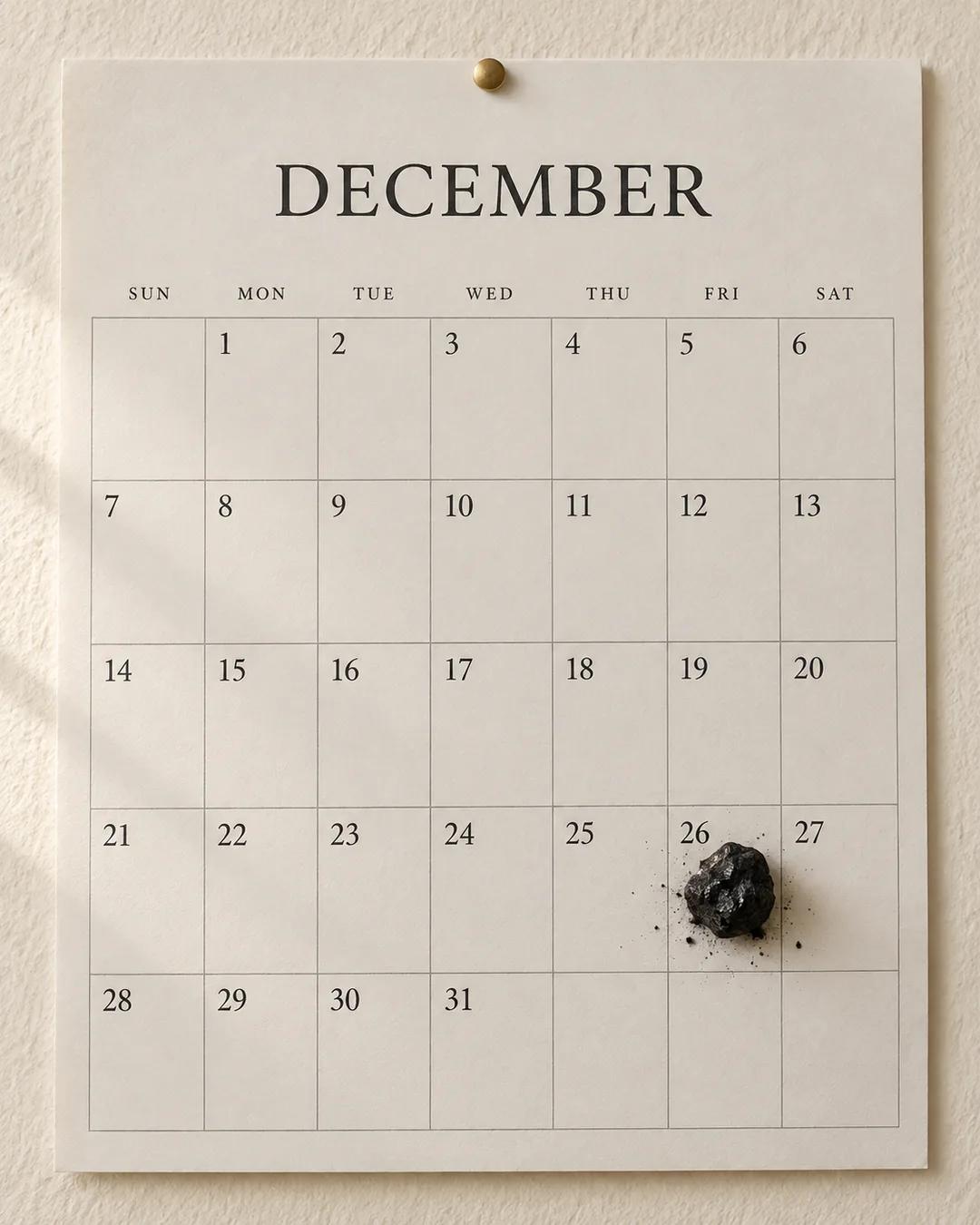
Dinosaurs died on Boxing Day

Forming the planet
The planet forms at midnight on January 1 as a ball of molten lava, pelted by meteorites and rocks smashing together, with no water on its surface. Water can exist once the surface cools enough, around the second week of January. Life gets going soon after: the last universal common ancestor of everything alive today, a hypothetical organism that already used DNA, lived around late January.
Cells and photosynthesis
Photosynthesis begins around March, and oxygen-producing photosynthesis changes the planet by June. The complex cells that all plants, fungi, and animals are made of appear in July. Algae, probably the first multicellular organisms, show up in August, and the earliest animals, probably sponges, arrive in October.
Animals, land, and humans
November brings the Cambrian explosion of sea animals, and late that month plants and fungi reach land. Fish that can crawl out of the water follow in early December. The meteor ends the dinosaurs on December 26, which leaves mammals about a week to take over. Farming begins roughly a minute and 20 seconds before midnight on December 31, and anatomically modern humans appear by 11:30 p.m.
How do scientists know when the impact hit?
The crater, about 180 kilometers wide, lies buried beneath Mexico's Yucatán Peninsula near the town of Chicxulub. Luis and Walter Alvarez and their colleagues reported in 1980 that rock layers around the world hold a thin band of clay rich in iridium, a metal that is rare in Earth's crust and common in asteroids. Radiometric dating of glassy droplets thrown out by the impact places it about 66 million years ago. That date falls at the boundary between the Cretaceous and Paleogene periods.
Why did small mammals survive when dinosaurs did not?
Many survivors were small animals that could burrow, hide in water, or eat seeds, insects, and rotting material. Food chains built on living plants collapsed once dust and soot blocked the sunlight, while chains built on dead matter held on longer. Very few land animals larger than a dog made it through the extinction. Birds, which descend from small feathered dinosaurs, are the one dinosaur lineage that survived.
How do scientists measure Earth's age?
Scientists use radioactive decay as a clock, since uranium atoms turn into lead at a known rate. In 1956 the geochemist Clair Patterson measured lead in fragments of the Canyon Diablo meteorite, which formed along with the planet. His result was about 4.55 billion years. Later measurements on other meteorites and Moon rocks have stayed close to that figure.
More from On Humans