Korva is a scroll of the internet’s best ideas.
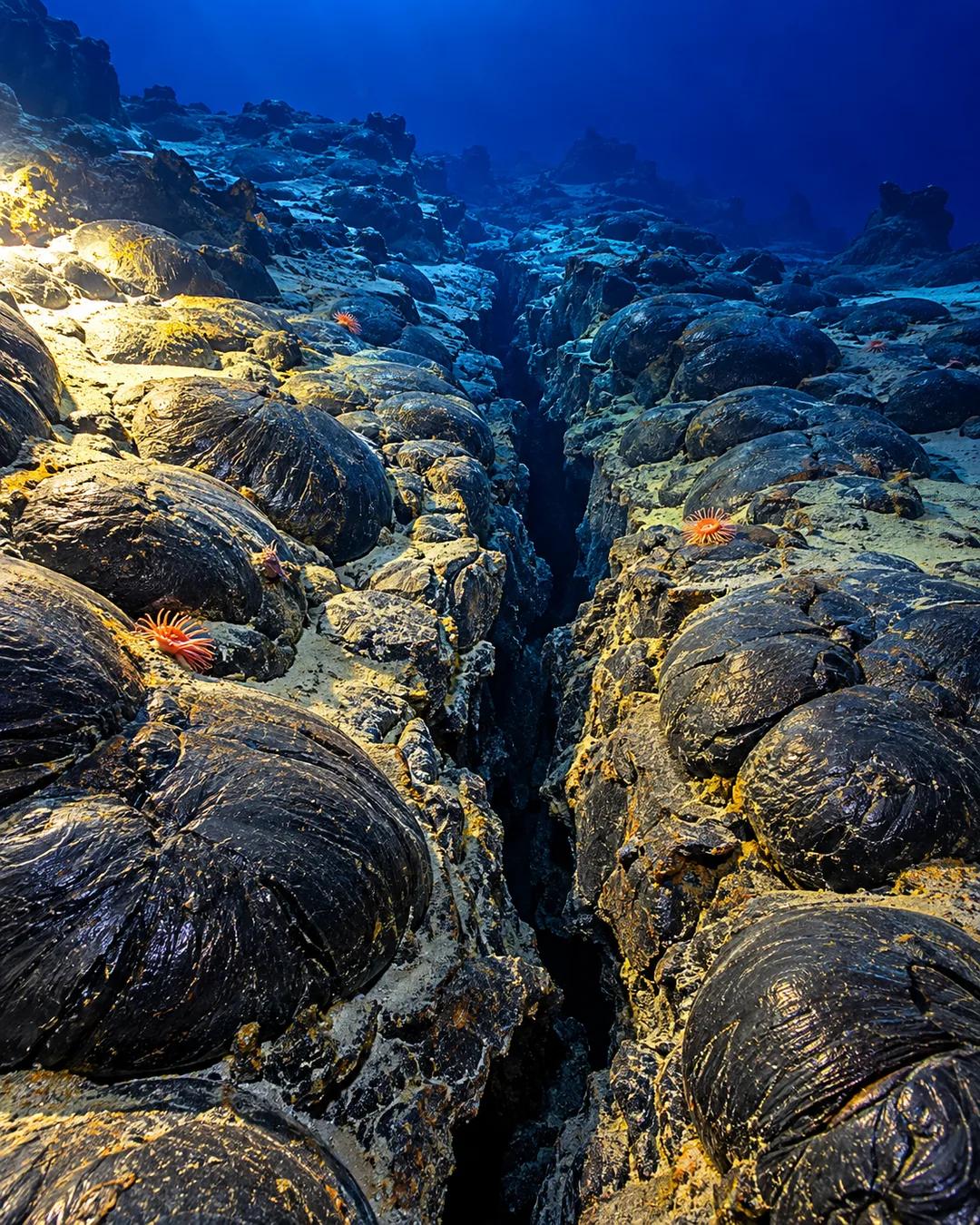
Earth's longest mountain range is underwater

The longest mountain range
Seen on a map, it looks like the seams on a baseball. It runs along the boundaries where tectonic plates meet. About 90% of it is underwater. The Andes, at over 9,000 kilometers, and the Rockies, at about 4,800, are short next to it.
Splitting apart
Parts of the ridge under the Atlantic are as deep as the Grand Canyon. The plates are splitting apart there, and the ridge gets wider and deeper every year.
Visiting the volcanoes
The volcanoes studied there sit between about 2,500 and 5,000 meters down, from a mile and a half to a little over three miles. Most trips use a robot lowered from a ship to collect samples.
How does the ridge make new sea floor?
Along the ridge, plates pull apart and hot rock rises from below to fill the gap. The rock cools and hardens into new crust, which then moves away from the ridge on both sides. The speed varies by ridge. The Atlantic spreads at around two centimeters a year, while the East Pacific Rise spreads at more than ten.
Why are hot springs found along the ridge?
Cold seawater seeps down into cracks in the new crust. Magma below heats it, and it picks up metals and sulfur from the rock as it goes. The hot fluid rises and shoots out of the sea floor, sometimes at around 400 degrees Celsius. It stays liquid because the pressure on the sea floor is so high.
How was the ridge first discovered?
In the 1950s, Marie Tharp worked with Bruce Heezen at Columbia University to plot ocean depth soundings into maps. She noticed a rift valley running down the middle of the Mid-Atlantic Ridge. The valley fit the idea that continents were moving apart. Her maps helped win scientists over to plate tectonics.
More from Ologies with Alie Ward