Korva is a scroll of the internet’s best ideas.
Earthworms make no deliberate sounds
No deliberate sounds
Unlike bats, crickets, frogs, or whales, earthworms and other soil organisms do not shout to find their way around, and they do not trill or whoop to attract mates. Earthworms make no deliberate sounds at all. What can be heard is movement, and movement sounds have no function like bat echolocation does, so they are incredibly difficult to assign to a species.
What soil recordings hold
Only a small fraction of soil organisms are acoustically detectable, and much of what gets recorded falls between 1,000 and 3,000 Hz. Linking soil sounds to broad functional groups would still show what drives differences between sites.
Building a sound library
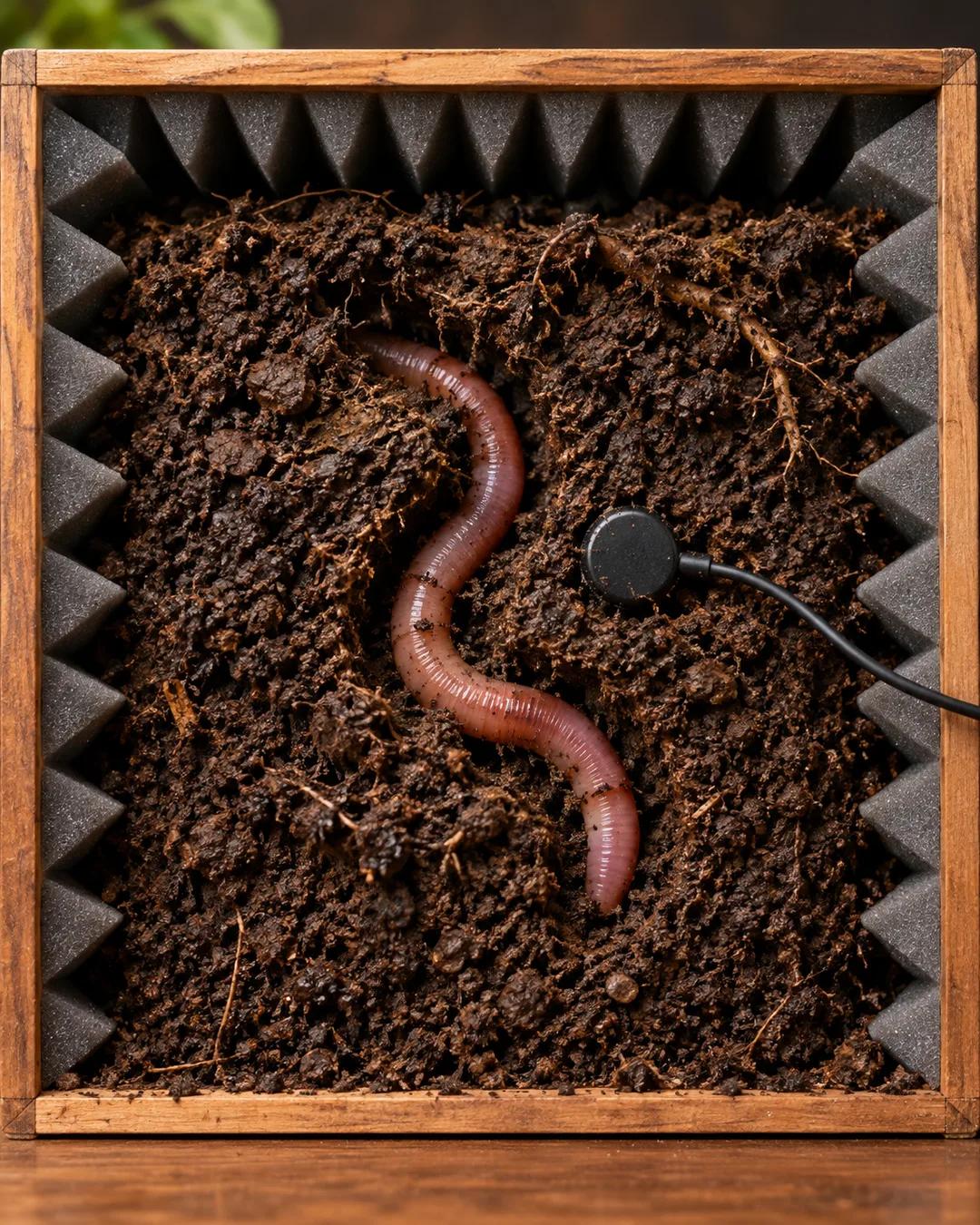
To check what a recording holds, researchers need a library of known soil sounds. Some are building one for beetles, including the dung beetles that work under cow pats. Others started with earthworms: a 0.5 cubic metre wooden box covered in soundproof foam and filled with soil, with no other animals inside. Listening to worms alone in that box confirms the same worms are the ones heard in the field.
How do worms sense without ears?
Earthworms detect vibration and touch through sensory cells spread across their skin, and they have light-sensitive cells that let them tell light from dark. Charles Darwin tested this in the 1800s by exposing worms to a bassoon, a piano, and shouting, and they ignored the noise. They reacted only when the pot of worms sat on the piano and the vibration passed through it. Some bait collectors still rely on vibration, driving a stake into the ground and rubbing it to bring worms to the surface.
Why do dung beetles bury cow pats?
Dung beetles come in three main types: rollers, which shape dung into balls, tunnelers, which bury it in burrows beneath the pat, and dwellers, which live inside it. The dung feeds their larvae, so burying it is how tunnelers raise their young. The work pulls nutrients into the soil and opens channels for air and water. According to a 2013 study led by Marie Dacke in Current Biology, roller beetles even steer by the Milky Way.
Why is movement so hard to match to species?
Calls are shaped by evolution to carry a signal, so each calling species tends to have its own recognizable pattern. Movement noise is a by-product shaped by body size, the surface being crossed, and speed. Many soil animals share similar sizes and ways of moving, so their sounds overlap. A reference library works like a fingerprint database, matching unknown recordings against sounds from animals identified beforehand.
More from Ella Browning