Korva is a scroll of the internet’s best ideas.
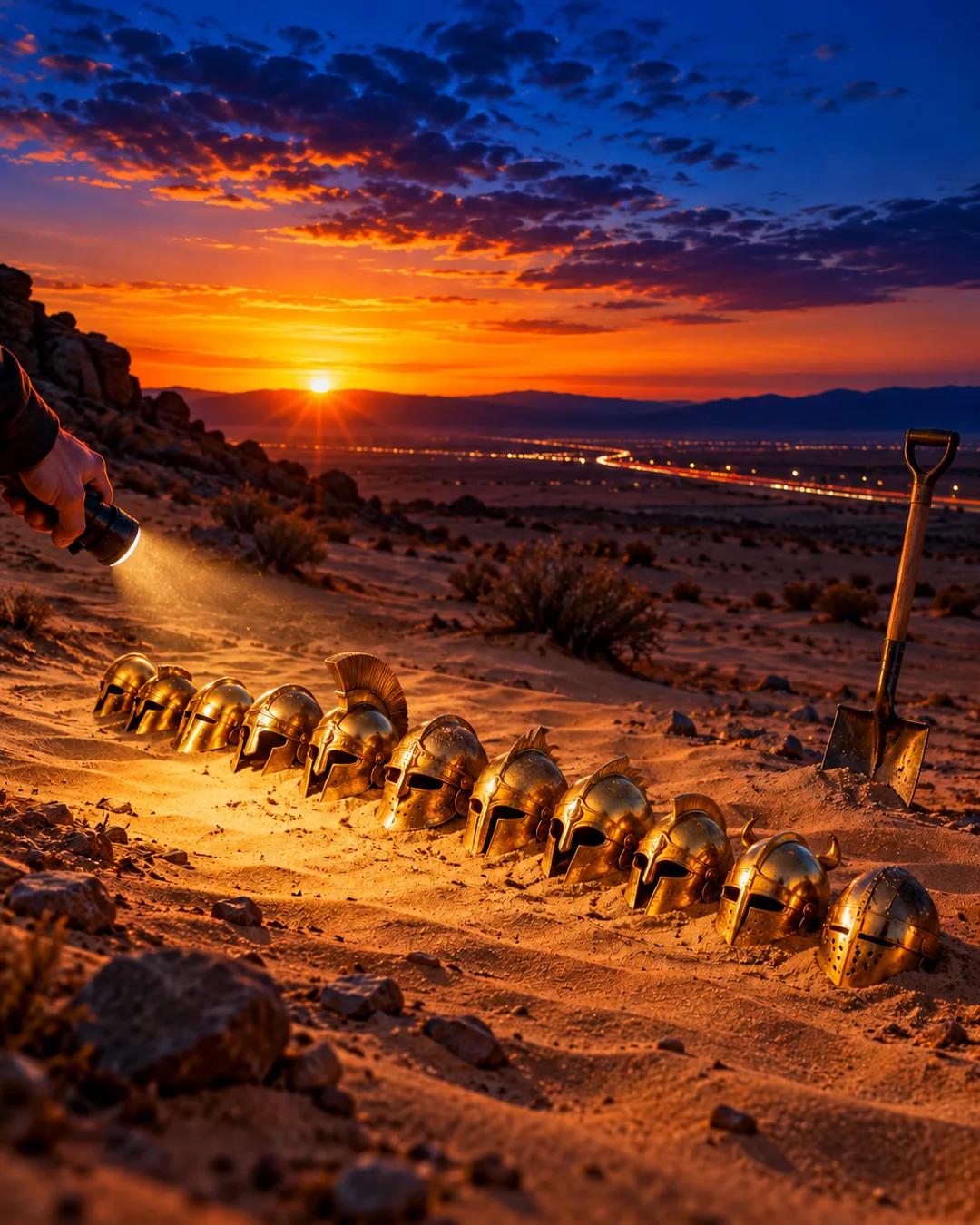
Eleven golden helmets buried in the desert

The golden helmets
Ragsdale claimed that he and his girlfriend, Trudy Truelove, were driving home along Highway 285 when they watched a craft "narrow with a bat-like wing" crash. A later interview clarified that his alleged crash site was nowhere near either of the other proposed sites. In further interviews, the story expanded to include the golden helmets.
A new crash site
Ragsdale's account was one of two that Kevin Randle and Donald Schmitt used in their 1994 book The Truth About the UFO Crash at Roswell to propose a new crash site 35 miles north of Roswell. The other came from Frank Kaufman, whom the book hid behind the pseudonym "Steve MacKenzie." Kaufman then appeared in a 1995 British documentary under his real name.
Kaufman's claims
Kaufman claimed he monitored a UFO's path on radar and recovered debris from a crashed spaceship shaped like an F-117 stealth fighter. His statements did not match the personnel at the base, his service record, the radar technology available in 1947, or the known topography of the proposed site.
Why does an F-117 comparison date a story?
The F-117 Nighthawk first flew in 1981, and the Air Force did not acknowledge its existence until 1988. Its flat, angled panels were designed to scatter radar signals away from the receiver. Any description that borrows its shape draws on an aircraft the public had never seen before the late 1980s. The jet entered service in the early 1980s and retired in 2008.
How good was radar in 1947?
Radar in the late 1940s was mostly wartime equipment built to detect aircraft at ranges of tens of miles. Operators watched echoes on round scopes and estimated position by reading sweeps. Small objects, low-altitude targets, and weather could produce confusing returns. Tracking an object's full path across the sky was far more limited than it is with modern systems.
More from en.wikipedia.org