Korva is a scroll of the internet’s best ideas.
Fighter jet software finished Gaudí's columns

Templates and gaps
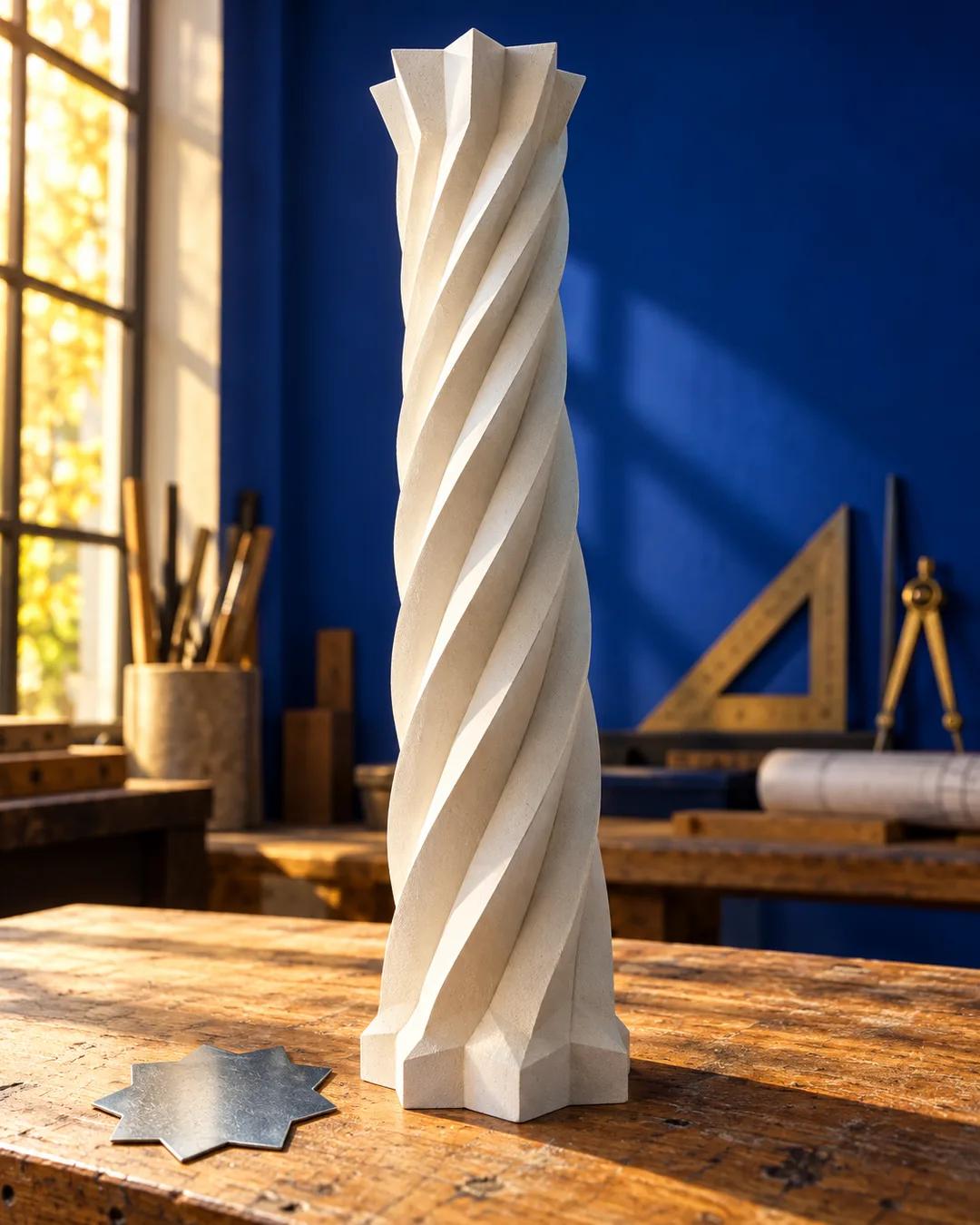
Gaudí left zinc templates that marked the cross section of each column at 1-m intervals, so stonemasons could cut the stone to move smoothly from one profile to the next. Between the templates there was no real guidance. How he meant masons to carve the stretch in between was never fully resolved.
The clue is in the shape. At the foot of the large main columns inside, a curved star pattern appears: two copies of the same shape counter-rotating as the column rises, with their intersection forming the column. Higher up, the same idea shows as counter-rotated rectangles. Gaudí did this with many shapes.
Software falls short
Architecture software of the day connected vertices with a digital skin using non-uniform rational B-splines. In Gaudí's geometry, lines split, emerge from smooth surfaces, or dissolve into them, and those tools had no way to create such lines.
Borrowing from aviation
So the architects turned to aviation, which had spent six decades perfecting shapes governed by strict physical laws. CATIA's wings for the Mirage were crafted to manage airflow at both subsonic and supersonic speeds, and they too were shaped by natural laws.
How did a jet program end up shaping buildings?
The software began as CATI, short for conception assistée tridimensionnelle interactive, built at Dassault Aviation for its jet designs. It received the name CATIA in 1981, when Dassault Systèmes was founded as a separate company. Its surface modeling later spread to other industries, including architecture. Frank Gehry's team used CATIA for the Guggenheim Museum Bilbao, completed in 1997.
How do counter-rotating shapes make a twisting column?
When two copies of a shape turn in opposite directions as they rise, the region where they overlap changes continuously. The corners where their outlines cross trace spiral paths up the column, which gives the surface its twisting look. A star shape at the base can then fade into a rounder section higher up. Because the cross section depends only on height, a program can compute it at any point along the column.
Why do supersonic wings look different from subsonic ones?
Subsonic air flows smoothly around a rounded leading edge. At supersonic speed, air forms shock waves, and thin, sharp edges produce less drag. Dassault's Mirage III used a delta wing, a triangular shape that works across both speed ranges, and it first flew in 1956.
More from Real Engineering