Korva is a scroll of the internet’s best ideas.
France-sized, 3,750 residents

It sits immediately next to Adelaide, Australia's fifth largest city, which has more than 1.3 million people. Spread across the area, the population density works out to about 178 square kilometers of land for every resident, roughly one Aruba's worth of land per person.
Anna Creek is another giant. The territory is slightly larger than Israel, yet it is not a country or any kind of governmental entity. It is a privately owned cattle ranch, the largest cattle ranch anywhere in the world by far, and it has only eight full-time employees.
An area the size of Israel is therefore usually home to fewer than a dozen people and around 10,000 cows.
Why are outback cattle stations so enormous?
In dry country, grass grows thinly and rainfall swings widely from one year to the next. A station needs enough land that cattle can be moved onto areas that caught rain while others recover from drought. At the low stocking rates of arid rangeland, a single animal can need anywhere from dozens to hundreds of hectares of pasture. A station on that scale covers an area that would hold hundreds of farms in a wetter region.
How do cattle find water so far from rivers?
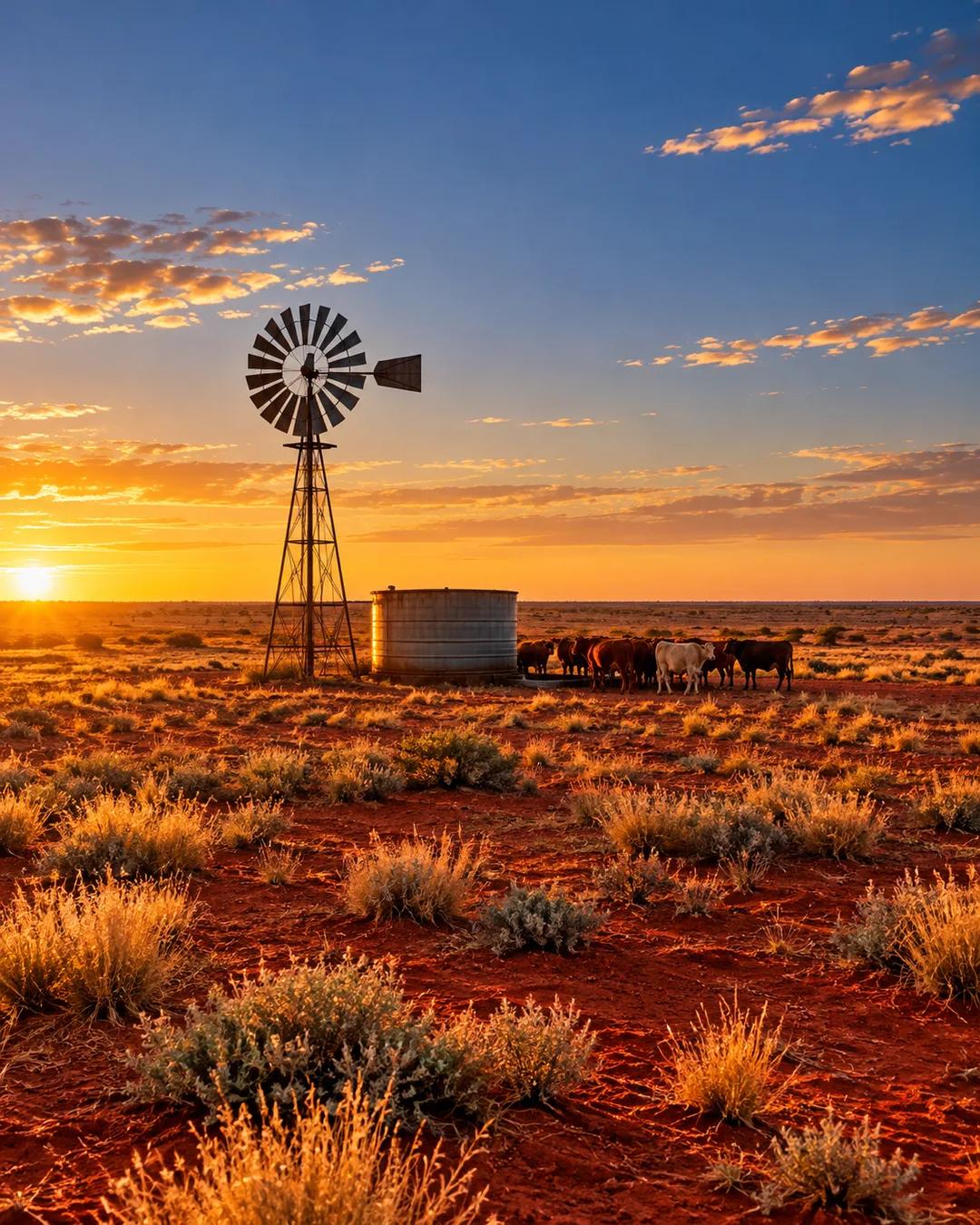
Much of the outback sits above the Great Artesian Basin, a layer of porous sandstone that holds underground water and lies beneath roughly a fifth of the continent. Rain that fell on the Great Dividing Range soaked into the sandstone and has been creeping west for hundreds of thousands of years. Stations drill bores into it, and the water often rises to the surface under its own pressure. Troughs fed by those bores are where the cattle gather to drink.
How do eight workers manage 10,000 cattle?
Mustering on large stations relies on helicopters, light aircraft, and motorbikes as much as on horses. Cattle have to drink regularly, so they return to the water points again and again, and stockworkers concentrate their effort there. Some stations fit water points with trap yards that let cattle in to drink but make it hard to wander back out. The cattle effectively gather themselves, and workers only have to sort them.
More from RealLifeLore