Korva is a scroll of the internet’s best ideas.
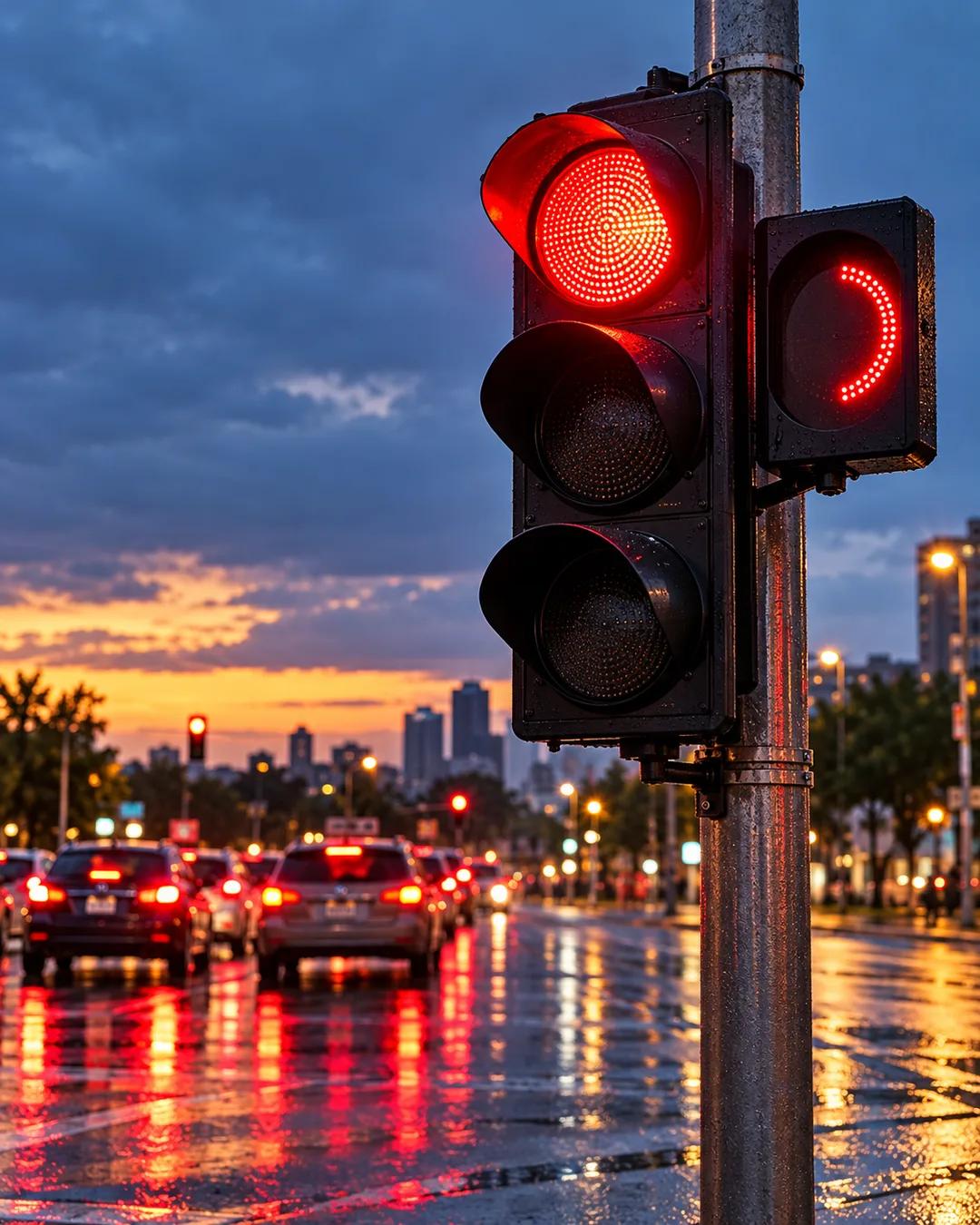
Green-light countdowns increase accidents

Why red countdowns work
Seeing exactly how long a wait will last takes the edge off it. Road rage, impatience, and general irritation drop massively when drivers can watch the seconds run down. The red light itself doesn't get any shorter. The sign changes how the wait feels.
China's green-light version
China took up the idea for green lights as well, without grasping the principle behind it. Picture a driver 200 yards from the junction who looks up and sees five seconds left on the green. The foot goes to the floor.
The Korean tests
The Koreans tested both versions carefully. The red-light countdown pulled accidents down, and the green-light countdown pushed them up. It is a psychological fix to a traffic problem, and it only works where the number gives people a reason to relax.
Why does a known wait feel shorter?
David Maister argued in his 1985 essay The Psychology of Waiting Lines that uncertain waits feel longer than known, finite ones. When people can't tell how long they will wait, anxiety fills the time. A visible number turns an open-ended wait into a bounded one. Maister also observed that unexplained waits feel longer than explained ones.
Why would a green countdown tempt drivers to speed?
Traffic engineers call the stretch where a driver can neither stop comfortably nor clear the junction the dilemma zone. The yellow phase exists to cover that stretch. A countdown on green shows exactly when the zone will open, so some drivers choose to speed up and beat the change. The first mathematical analysis of the amber light problem appeared in 1960, written by Denos Gazis, Robert Herman, and Alexei Maradudin.
More from TED