Korva is a scroll of the internet’s best ideas.
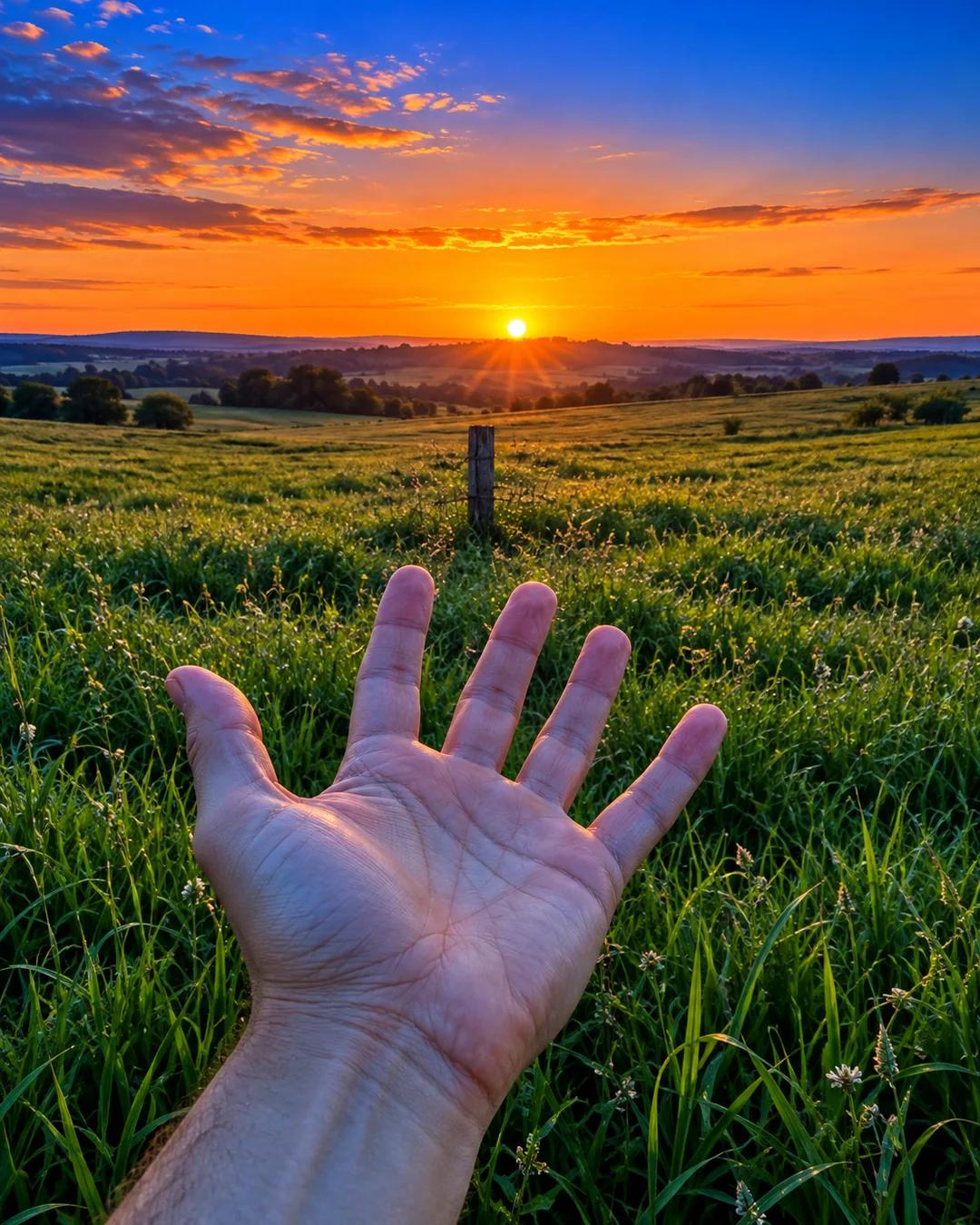
Look at your hand, then the horizon

The steps outward
It starts with the eyes closed and three breaths focused inward on the skin. Then the eyes open on the hand for three breaths, creating a visual tether between the person and the hand. The same three breaths follow at a spot eight or ten feet away, and then at a horizon.
After the horizon comes the pale blue dot: a planet floating in space. The last step is a return to the self.
The logic behind it
The practice grew from a hunch that meditations completely focused inward leave a person more focused inward. The idea is that the value lies in the process of going from one aperture to the next.
The same logic explains seeking a horizon in the morning and then going indoors to focus on the work. No place or event in a day or in life is the right way to live in itself.
How was the pale blue dot photograph taken?
Voyager 1 took the image on February 14, 1990, from about 6 billion kilometers away. Carl Sagan had asked NASA to turn the spacecraft's camera back toward Earth. In the frame Earth occupies less than a single pixel, a point of light caught in a sunbeam scattered inside the camera. Sagan used the image as the title and centerpiece of his 1994 book Pale Blue Dot.
How does seeing Earth from space affect astronauts?
Author Frank White coined the term overview effect in his 1987 book of that name. Astronauts including Edgar Mitchell, who flew on Apollo 14, described a sudden sense of unity with the planet after seeing it as a whole. Many reported that borders and divisions looked arbitrary from orbit. Mitchell founded the Institute of Noetic Sciences in 1973, after his flight, to study such experiences.
Why does widening attention come in stages?
Psychologists Charles Eriksen and James St. James proposed in 1986 that visual attention works like a zoom lens. The wider the spotlight, the less detail it resolves, and focusing narrows it again. Shifts between narrow and wide take time and effort. The model has been used to explain how people search crowded scenes.
More from Andrew Huberman